Statin-Antifungal Interaction Checker
Select Medications
Interaction Result
Select a statin and an antifungal from the menu to check for potential interactions.
Imagine you are recovering from a transplant or managing high cholesterol. You take your daily pills without thinking twice. Then, a fungal infection hits. Your doctor prescribes a common antifungal medication. Two weeks later, you wake up with severe muscle pain, dark urine, and weakness. This isn't just bad luck; it is likely a dangerous chemical clash between your medications.
This scenario highlights a critical but often overlooked danger in modern medicine: the interaction between systemic antifungals, specifically azoles, and other essential drugs like statins and immunosuppressants. These combinations can turn routine treatments into life-threatening events, including rhabdomyolysis (muscle breakdown) and organ toxicity. Understanding how these drugs interact at a molecular level is not just academic-it is a matter of patient safety.
The Mechanism Behind the Clash
To understand why these drugs fight each other, we need to look at how our bodies process them. Most systemic antifungals belong to the azole class. They work by blocking an enzyme called lanosterol 14-alpha-demethylase, which fungi need to build their cell membranes. However, this enzyme is part of the cytochrome P450 family, which humans also use extensively to metabolize drugs.
Azole antifungals do not just target fungi; they inhibit human liver enzymes, particularly CYP3A4, CYP2C9, and CYP2C19. The CYP3A4 enzyme alone accounts for about 30% of all cytochrome P450 activity in the liver. When an azole blocks this enzyme, other drugs that rely on CYP3A4 for breakdown cannot be processed efficiently. They build up in your bloodstream to toxic levels.
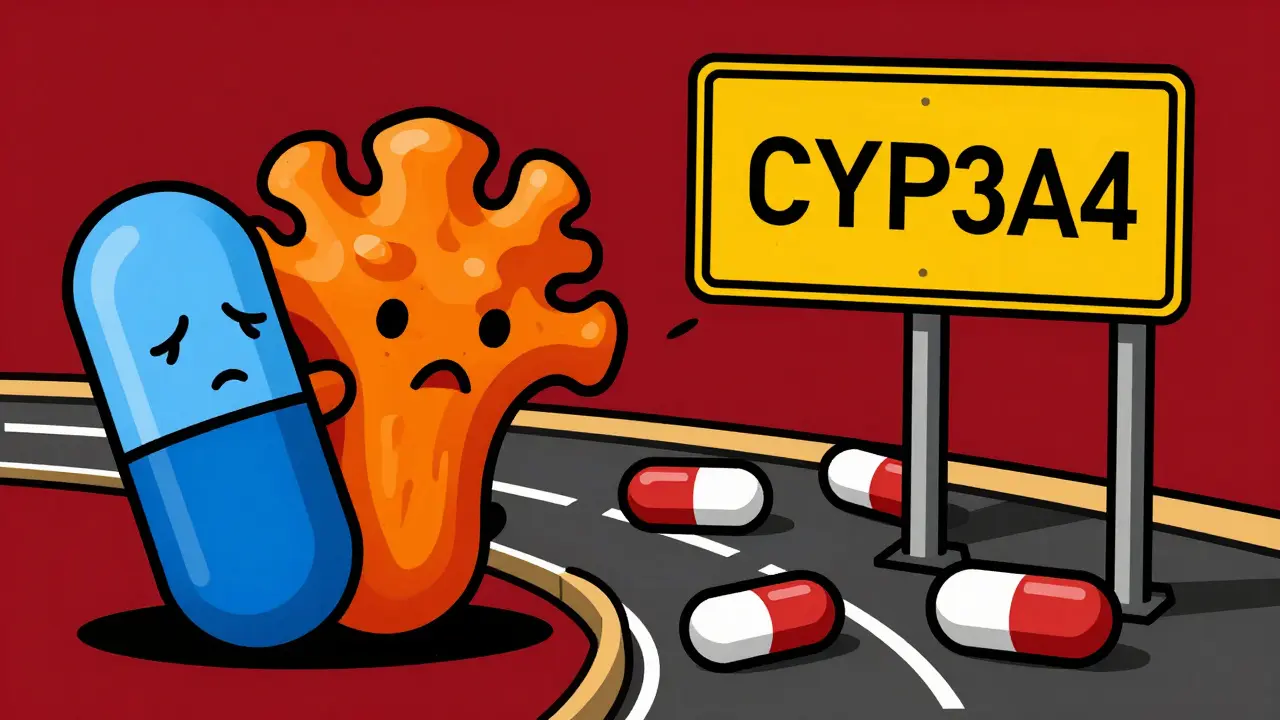
Think of CYP3A4 as a highway exit ramp for drugs leaving your system. Azoles put up roadblocks on that ramp. If statins or immunosuppressants are trying to leave via that ramp, they get stuck in traffic, accumulating in your body until they cause damage.
Statins and the Risk of Muscle Damage
Statins are among the most prescribed drugs globally, used to lower cholesterol and prevent heart disease. However, some statins are heavily dependent on the CYP3A4 pathway for metabolism. These include atorvastatin, simvastatin, and lovastatin.
When you combine these specific statins with strong azole inhibitors like ketoconazole, posaconazole, or itraconazole, the concentration of the statin in your blood can increase tenfold or more. This surge significantly raises the risk of statin-associated myopathy (SAM). Symptoms range from mild muscle aches to rhabdomyolysis, a condition where muscle tissue breaks down and releases harmful proteins into the blood, potentially causing kidney failure.
| Statin Name | Metabolism Pathway | Risk Level with Azoles | Clinical Recommendation |
|---|---|---|---|
| Simvastatin | CYP3A4 | High | Avoid combination; hold statin during treatment |
| Atorvastatin | CYP3A4 | High | Avoid combination; hold statin during treatment |
| Lovastatin | CYP3A4 | High | Avoid combination; hold statin during treatment |
| Pravastatin | Minimal CYP | Low-Moderate | Safer alternative; monitor for OATP1B1 effects |
| Rosuvastatin | Minimal CYP | Low-Moderate | Safer alternative; monitor for OATP1B1 effects |
Not all statins are created equal in this context. Pravastatin and rosuvastatin are not primarily metabolized by CYP3A4. They are generally safer options when a patient must take both a statin and an azole. However, caution is still needed because some azoles, like ketoconazole, also inhibit transporters like OATP1B1, which can still raise levels of pravastatin and rosuvastatin, albeit to a lesser degree.
Immunosuppressants in Transplant Patients
For patients who have received organ transplants, the stakes are even higher. These patients rely on immunosuppressants such as cyclosporine, tacrolimus, sirolimus, and everolimus to prevent their bodies from rejecting the new organ. These drugs have a narrow therapeutic index, meaning the difference between a helpful dose and a toxic one is very small.
Immunosuppressants are substrates for CYP3A4 and P-glycoprotein (P-GP). Azole antifungals inhibit both. Consequently, adding an azole to a transplant patient's regimen can cause immunosuppressant levels to skyrocket. Studies show that combining statins with cyclosporine can increase the area under the curve (AUC)-a measure of total drug exposure-by 3 to 20 times.
This dual inhibition creates a perfect storm. The azole stops the immunosuppressant from clearing out, leading to potential nephrotoxicity (kidney damage) and neurotoxicity. Simultaneously, if the patient is on a statin, the risk of muscle breakdown compounds. In solid organ transplant recipients, the rate of statin-related myopathy can reach up to 25% when combined with these immunosuppressants.

Navigating Different Azole Profiles
Not all azole antifungals carry the same weight of risk. Their potency as enzyme inhibitors varies significantly.
- Ketoconazole: A potent inhibitor of CYP3A4. It is rarely used systemically today due to its high interaction profile and side effects, but when used, it poses extreme risks with statins and immunosuppressants.
- Itraconazole: Also a strong CYP3A4 inhibitor. It can increase the absorption of lovastatin and simvastatin acids by 15 to 20 times.
- Voriconazole: Potent against CYP3A4 and moderate against CYP2C19. It requires careful monitoring when used with sensitive drugs.
- Posaconazole: Inhibits CYP3A4 strongly but is not metabolized by it itself. Its long half-life (24-30 hours) means it stays in the system longer, prolonging the interaction window. Statins must be held until posaconazole treatment is fully complete.
- Fluconazole: Primarily inhibits CYP2C9 and CYP2C19, with only moderate effects on CYP3A4. It is generally safer regarding statin interactions but still requires caution with drugs metabolized by 2C9.
Clinical Management Strategies
How do clinicians manage these risks in real-world practice? The answer lies in proactive planning and substitution.
First, avoid the dangerous pairs entirely. If a patient needs an azole, stop atorvastatin, simvastatin, and lovastatin immediately. Do not try to reduce the dose; simply pause the statin therapy. Once the antifungal course is finished, wait for the antifungal to clear the system before restarting the statin. For posaconazole, this waiting period is crucial due to its long half-life.
Second, switch to safer alternatives. If a patient absolutely cannot stop statin therapy, switch them to pravastatin or rosuvastatin at the lowest effective dose. For example, starting pravastatin at 10 mg daily or rosuvastatin at 5 mg daily minimizes the risk while providing some cardiovascular protection.
Third, monitor closely. Check creatine kinase (CK) levels regularly. If CK rises above 10 times the upper limit of normal, discontinue the statin immediately. In transplant patients, therapeutic drug monitoring (TDM) of immunosuppressant trough levels is mandatory. Doses of immunosuppressants often need to be reduced by 30-50% when starting a strong CYP3A4 inhibitor like voriconazole or posaconazole.

The Role of Technology and Guidelines
Despite clear warnings from the FDA and major medical organizations, these high-risk combinations are still prescribed frequently. Why? Because the volume of prescriptions is massive. Millions of Americans take statins, and fluconazole alone generates over 5 million prescriptions annually. Human error is inevitable.
This is where electronic health records (EHRs) with clinical decision support (CDS) become vital. Studies show that integrated CDS systems can reduce inappropriate co-prescribing by nearly 50%. These systems alert doctors and pharmacists when a dangerous combination is ordered, allowing for intervention before the pill reaches the patient.
Furthermore, standardized protocols, such as those developed by the American Society of Health-System Pharmacists (ASHP), require pharmacist verification before dispensing azoles to patients on statins. Institutions implementing these checks have seen a 63% reduction in high-risk combinations.
Future Directions and Personalized Medicine
Research is moving toward more personalized approaches. Genetic testing for SLCO1B1 polymorphisms, present in about 12% of the population, can identify individuals at higher genetic risk for statin-induced myopathy. Knowing a patient's genetic profile could help clinicians decide whether to use a statin at all when an azole is necessary.
Newer antifungal agents are also entering the pipeline. Drugs like olorofim, which work through a different mechanism (dihydroorotate dehydrogenase inhibition), show minimal interaction with CYP450 enzymes. These next-generation therapies promise to provide effective antifungal treatment without the dangerous collateral damage to other medications.
Which statins should I avoid if I am taking an azole antifungal?
You should avoid statins that are metabolized by the CYP3A4 enzyme, specifically simvastatin, atorvastatin, and lovastatin. These drugs can reach toxic levels when combined with azoles like ketoconazole, itraconazole, voriconazole, and posaconazole. Safer alternatives include pravastatin and rosuvastatin, though they still require monitoring.
What are the symptoms of a dangerous interaction between statins and antifungals?
The primary symptom is muscle pain, tenderness, or weakness (myalgia/myopathy). In severe cases, this can progress to rhabdomyolysis, characterized by dark, tea-colored urine, severe muscle pain, and fatigue. If you experience these symptoms, seek medical attention immediately as it can lead to kidney failure.
Do all antifungal creams interact with oral medications?
Topical antifungal creams generally have low systemic absorption and are less likely to cause significant drug interactions compared to oral or intravenous systemic antifungals. However, extensive application over large areas of broken skin can increase absorption, so it is always best to inform your doctor about all medications you are using.
How long should I wait after stopping an azole before restarting my statin?
The waiting period depends on the specific azole. For short-acting azoles like fluconazole, a few days may suffice. For long-acting azoles like posaconazole, which has a half-life of 24-30 hours, you should wait until the drug is fully cleared from your system, which may take several days to a week. Always consult your healthcare provider for specific timing based on your renal and hepatic function.
Can immunosuppressants cause similar interactions with antifungals?
Yes, immunosuppressants like cyclosporine, tacrolimus, and sirolimus are highly susceptible to interactions with azole antifungals. Azoles can increase immunosuppressant levels by 3 to 20 times, leading to toxicity. Transplant patients require frequent blood tests to monitor drug levels and adjust doses accordingly when starting or stopping antifungal therapy.