Every time you pick up a generic pill at the pharmacy for a fraction of the brand-name price, you’re benefiting from something called an ANDA - the Abbreviated New Drug Application. It’s not a drug. It’s not a company. It’s a regulatory shortcut created by the U.S. Food and Drug Administration (FDA) to bring affordable medicines to millions. And it’s one of the most successful public health policies in modern history.
What Exactly Is an ANDA?
An ANDA is a formal request submitted to the FDA by a drug manufacturer asking permission to sell a generic version of a brand-name medication. Unlike the original drug maker, who had to prove the drug was safe and effective through years of clinical trials, the generic company doesn’t start from scratch. Instead, they prove their version works the same way - using data that already exists. The term "abbreviated" isn’t just marketing speak. It means the application skips the expensive, time-consuming animal and human trials that brand-name companies must complete. That’s because the FDA already approved the original drug - called the Reference Listed Drug (RLD). The generic company just has to show their version is identical in active ingredient, strength, dosage form, and how the body absorbs it. This system was created by the Hatch-Waxman Act of 1984. Before that, generic drugs faced legal and regulatory barriers that kept them off the market for years after patents expired. The law changed that. It gave generic manufacturers a clear path to enter the market as soon as patents or exclusivity periods ended. Today, over 90% of all prescriptions filled in the U.S. are for generic drugs approved through the ANDA pathway.How Does an ANDA Work? The Core Requirements
For an ANDA to get approved, the generic drug must meet four strict criteria:- Same active ingredient - The chemical that makes the drug work must be identical in amount and type.
- Same dosage form - If the brand is a tablet, the generic must be a tablet. Same with capsules, injections, creams, etc.
- Same strength - A 10mg brand-name pill must have a 10mg generic version.
- Same route of administration - Oral, intravenous, topical - it all has to match.
ANDA vs. NDA: Why the Difference Matters
The original drug maker files a New Drug Application, or NDA. That’s a massive undertaking. It can take 10 to 15 years and cost over $2.6 billion to get a new drug approved. That includes everything from early lab tests to Phase I, II, and III clinical trials involving thousands of patients. The ANDA is the opposite. It’s focused, lean, and built on existing knowledge. The average ANDA takes 3 to 4 years to develop and costs between $1 million and $5 million. That’s why generic drugs can be sold for 80% to 85% less than the brand-name version. The FDA’s review time reflects this difference too. A standard NDA takes 12 months to review. A priority NDA - for drugs treating serious conditions - takes 10 months. An ANDA? Also 10 months. That’s because the FDA doesn’t need to re-evaluate safety and efficacy. They’re checking for equivalence and manufacturing quality. This system isn’t perfect. Some drugs are too complex to replicate easily. Think inhalers, topical creams, or injectables with special delivery systems. For those, the standard bioequivalence tests don’t always work. The FDA has started special programs for these "complex generics," but approval times are longer and rejection rates are higher.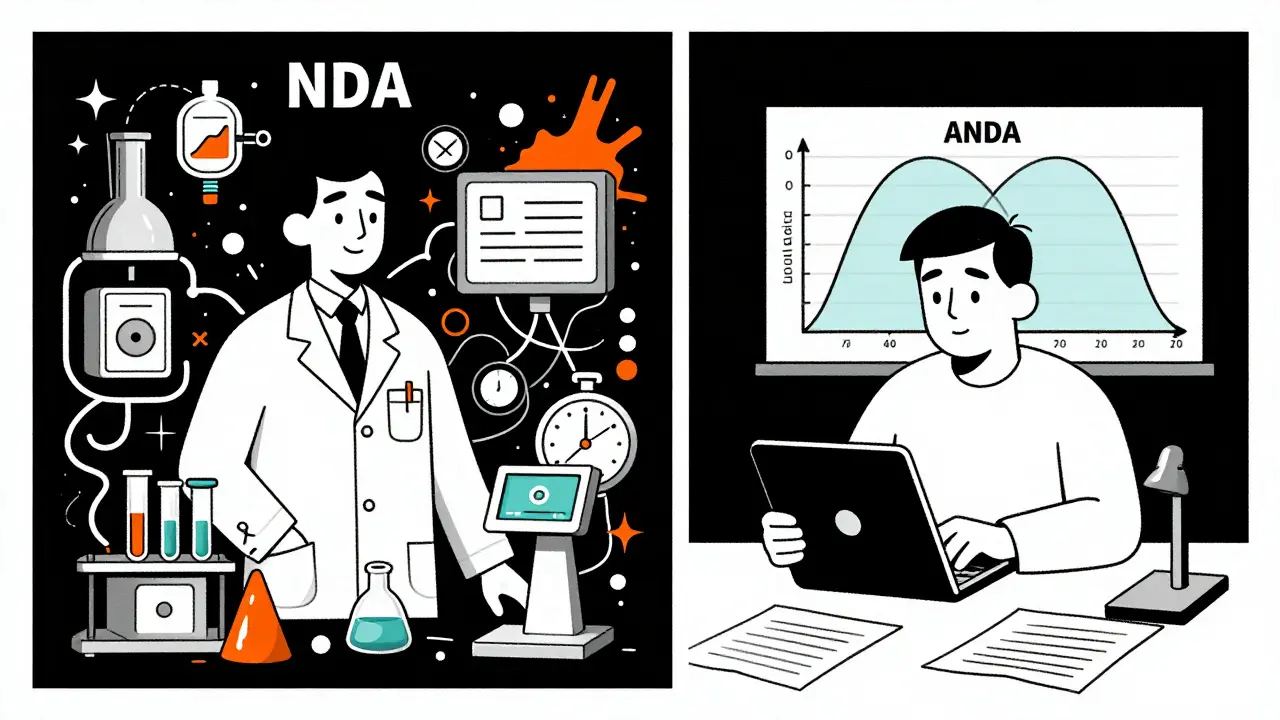
Who Uses the ANDA Pathway? The Players Behind the Scenes
The generic drug market is dominated by a handful of big players: Teva, Viatris (which merged from Mylan), Sandoz, and Sun Pharma. Together, they control nearly half of the U.S. generic market. But thousands of smaller companies also file ANDAs - especially for older, off-patent drugs with high demand. The first company to file an ANDA for a drug and successfully challenge a patent gets 180 days of exclusive rights to sell their version. That’s a huge incentive. When Humira’s patent expired in 2023, 12 different companies rushed to file ANDAs. Within months, the price dropped from over $7,000 per month to under $1,000. The FDA assigns each approved ANDA a unique six-digit number - like ANDA 214,455 for the generic version of Eliquis. You won’t see that number on your prescription bottle, but it’s how the FDA tracks every approved generic drug in the country. As of 2023, over 11,000 ANDAs have been approved.Why the ANDA Pathway Saves Billions - and Lives
The numbers speak for themselves. Generic drugs account for 90% of prescriptions filled in the U.S. But they make up only 23% of total drug spending. That means Americans saved $313 billion in 2023 just by using generics instead of brand names. Over the last decade, the ANDA pathway has saved the U.S. healthcare system more than $2.2 trillion. That’s money that goes back into people’s pockets, insurance premiums, and hospital budgets. Without it, millions of patients would skip doses or not fill prescriptions at all because they couldn’t afford them. The FDA reports that 97% of generic drugs approved through ANDA are therapeutically equivalent to their brand-name counterparts. That’s not just close - it’s nearly perfect. Studies show no difference in effectiveness or side effects between generics and brands for the vast majority of drugs.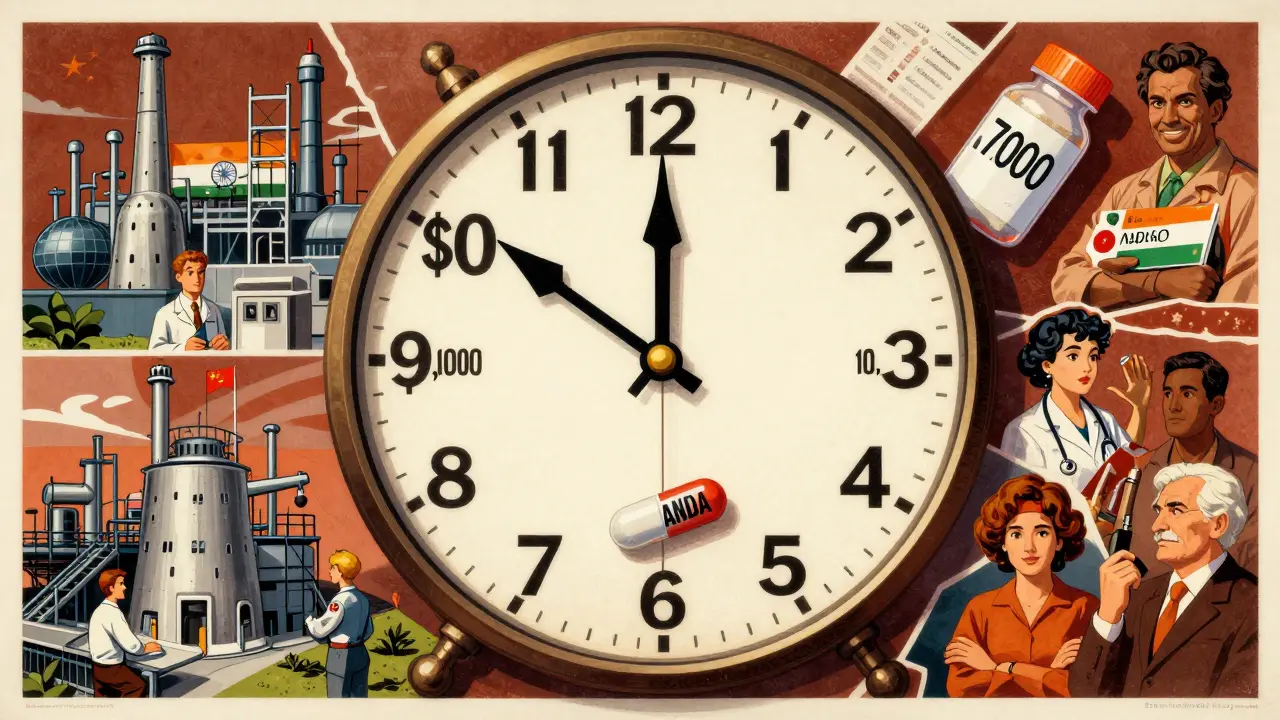
What Can Go Wrong? Common ANDA Failures
Despite the success, many ANDAs get rejected. The most common reasons? Manufacturing issues and flawed bioequivalence data. According to FDA reports, 32% of complete response letters - the official notice that an ANDA needs more work - cite problems with manufacturing controls. That includes inconsistent mixing of ingredients, poor packaging that lets moisture in, or unstable production lines. Another 27% of rejections are due to bioequivalence data that doesn’t meet the 80-125% range. Sometimes the test design was flawed. Other times, the generic formulation just doesn’t dissolve the same way in the stomach. Smaller companies often struggle with the complexity. A 2022 survey found that 68% of generic manufacturers had trouble proving bioequivalence for complex drugs. On average, each ANDA submission gets two or three requests for more information before approval. The FDA has responded by improving guidance, training, and review timelines. Under the latest GDUFA IV agreement, they’re aiming for 90% of ANDAs to be approved on the first try by 2027. Right now, it’s around 65%.What’s Next for ANDAs?
The future of the ANDA pathway is expanding - not shrinking. The FDA is working on new rules for complex generics like nasal sprays, transdermal patches, and long-acting injectables. These drugs are harder to copy, but they’re also more expensive. Making them generic will save billions. Experts warn about risks too. Most generic drug ingredients are made overseas - in India and China. Supply chain disruptions, quality control lapses, or political tensions can delay approvals or cause shortages. In 2022, a single factory shutdown in India caused a nationwide shortage of a common blood pressure medication. Still, the path forward is clear. The Congressional Budget Office predicts that between 2024 and 2033, generic drugs will save the U.S. healthcare system $1.7 trillion. That’s not a guess. It’s based on current trends, patent expirations, and market demand. The ANDA isn’t flashy. It doesn’t make headlines. But every time you refill a prescription for less than $10, you’re seeing the power of a smart, science-based policy that works.Is an ANDA the same as a generic drug?
No. An ANDA is the application submitted to the FDA to get approval for a generic drug. The generic drug is the actual medicine you take. The ANDA is the paperwork that proves it’s safe, effective, and equivalent to the brand-name version.
Can any drug be approved through an ANDA?
No. Only drugs that have already been approved by the FDA as brand-name products can have ANDAs filed for them. Complex drugs like biologics, inhalers, and certain topical creams often require special pathways because standard bioequivalence tests don’t work. These are not eligible for the standard ANDA process.
How long does it take to get an ANDA approved?
The FDA aims to review a standard ANDA within 10 months. But the full process - from developing the drug to submitting the application - usually takes 3 to 4 years. Many applications get rejected the first time and require resubmission, which can add months or even years.
Are generic drugs as safe as brand-name drugs?
Yes. The FDA requires generic drugs to meet the same high standards for quality, strength, purity, and stability as brand-name drugs. Over 97% of generics approved through ANDA are therapeutically equivalent. Millions of people use them every day without any difference in outcomes.
Why are generic drugs so much cheaper?
Generic manufacturers don’t have to repeat expensive clinical trials. They also don’t spend money on marketing or building brand recognition. Their costs are mostly in manufacturing and regulatory compliance. That allows them to sell the same medicine at a fraction of the price - often 80% to 85% less.
Do I need to ask my doctor for a generic?
Not necessarily. In most cases, pharmacists are allowed to substitute a generic for a brand-name drug unless the prescription says "dispense as written" or "no substitution." But if you’re unsure, ask your pharmacist. They can tell you if a generic is available and if it’s right for you.


