
Warfarin Genetic Dosing Estimator
Why This Matters
Standard starting doses can be dangerous if your genetics require a lower dose. This tool estimates your metabolic profile to help discuss precision dosing with your doctor.
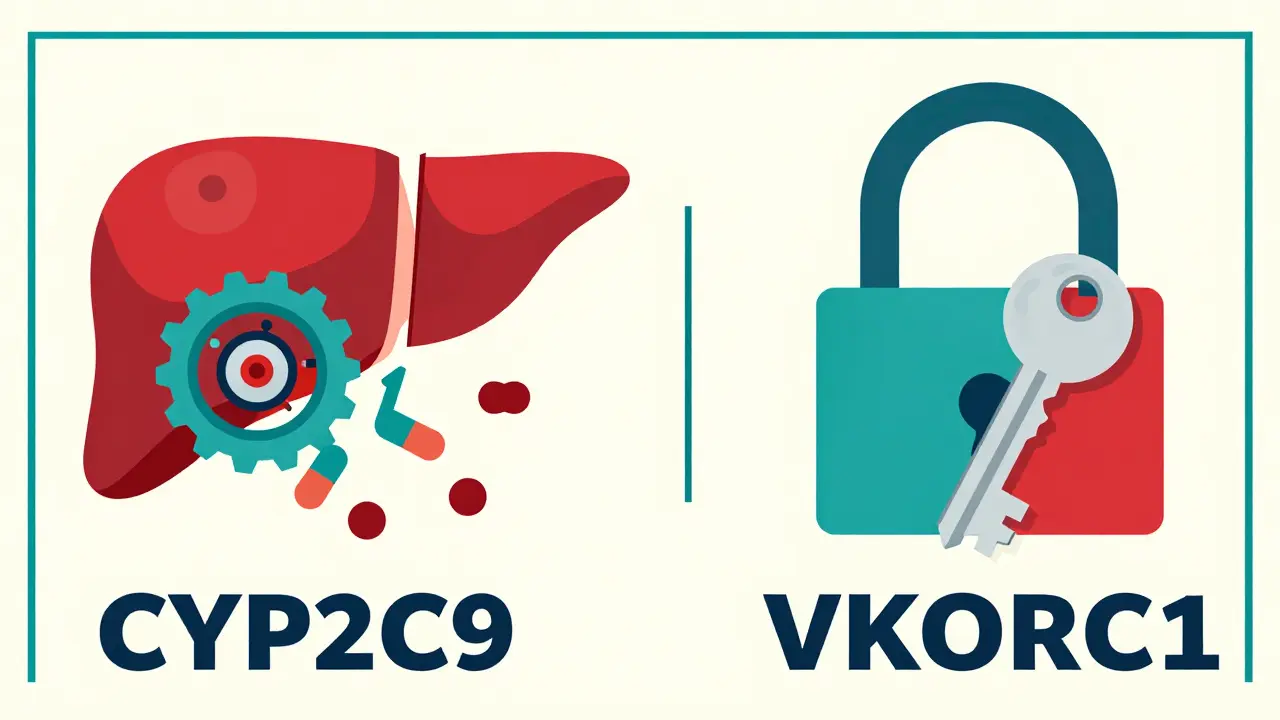
- CYP2C9: Liver enzyme speed.
- VKORC1: Target enzyme amount.
Your Genetic Profile
* Estimates only. Clinical factors like age, weight, and diet also apply.
Clinical Implications
--
Starting blood thinners often feels like walking a tightrope. You take the pill, wait for your INR test, and hope the number falls in that narrow 'therapeutic' window. For millions of people on Warfarin, a widely used oral anticoagulant that prevents blood clots by inhibiting vitamin K-dependent clotting factors, this process involves weeks of guesswork. Why does one person stabilize quickly while another swings between dangerous highs and ineffective lows? The answer isn't just about diet or lifestyle-it’s written in your DNA.
Specifically, two genes play the starring role: CYP2C9 and a liver enzyme gene responsible for metabolizing the active form of warfarin and VKORC1 and the gene encoding the enzyme that warfarin targets to prevent clotting. Understanding how these genetic markers influence your body's reaction to medication can mean the difference between a smooth treatment journey and a hospital visit for bleeding complications.
How Warfarin Works in Your Body
To understand why genetics matter, you first need to know what warfarin actually does. It doesn't dissolve existing clots; it stops new ones from forming. It works by blocking an enzyme called vitamin K epoxide reductase complex subunit 1 (VKORC1). This enzyme is essential for recycling vitamin K, which your liver needs to activate clotting proteins like Factors II, VII, IX, and X.
When warfarin blocks VKORC1, those clotting factors can’t be activated, and your blood takes longer to clot. That’s the goal. But here’s the catch: warfarin comes in two mirror-image forms, called enantiomers. The S-enantiomer is about five times more potent than the R-enantiomer. Your liver has to break down the S-form to clear it from your system. This breakdown job falls primarily to the CYP2C9 enzyme. If your version of CYP2C9 works slowly, the drug stays in your system longer, raising your risk of over-anticoagulation and bleeding.
The Role of CYP2C9 Gene Variants
Most people have the standard "wild-type" version of the CYP2C9 gene, labeled as *1/*1. These individuals metabolize warfarin at a normal rate. However, many people carry variations known as *2 or *3. These aren't rare quirks-they are common enough to significantly impact dosing.
- CYP2C9*2: This variant reduces enzyme activity to about 60-70% of normal. People with this gene still metabolize warfarin, but slower.
- CYP2C9*3: This is the more impactful variant. It slashes enzyme activity to just 5-12% of normal function. If you carry even one copy of this gene (*1/*3), you clear the drug much slower. If you have two copies (*3/*3), your clearance is drastically reduced.
Research published in Clinical Pharmacology & Therapeutics shows that CYP2C9 variants explain about 10-15% of the variability in warfarin dose requirements. In real-world terms, patients with the *3 variant had an 80% reduced clearance of the potent S-warfarin component. A study in the Journal of Thrombosis and Haemostasis found that 68% of patients with CYP2C9 variants experienced an INR greater than 4 during their first three months-a level associated with high bleeding risk-compared to only 42% of those without the variants.
Understanding VKORC1 Polymorphisms
If CYP2C9 controls how fast you remove warfarin, VKORC1 determines how sensitive you are to it. The VKORC1 gene contains a specific spot called the -1639G>A polymorphism (rs9923231). This single letter change in your DNA affects how much of the target enzyme your body produces.
There are three main genotypes for this marker:
- GG Genotype: You produce normal levels of the VKORC1 enzyme. You are less sensitive to warfarin and typically require higher doses to achieve a therapeutic INR.
- GA Genotype: Intermediate sensitivity. You fall somewhere in the middle regarding dose needs.
- AA Genotype: You produce significantly less of the target enzyme-about 40% less than those with the GG genotype. Because there is less enzyme to block, warfarin works much more efficiently on your system. You are highly sensitive to the drug.
This sensitivity accounts for 25-30% of the variation in warfarin dosing among patients. A landmark study in the New England Journal of Medicine highlighted that patients with the AA genotype might need only 5-7 mg per week, whereas GG homozygotes might require 28-42 mg per week. That is a massive six-fold difference driven entirely by genetics.
| Genetic Profile | Metabolic Speed / Sensitivity | Dose Requirement | Risk Profile |
|---|---|---|---|
| CYP2C9 *1/*1 + VKORC1 GG | Normal metabolism, Low sensitivity | High (Standard) | Lower risk of early bleeding |
| CYP2C9 *3 Carrier + VKORC1 AA | Slow metabolism, High sensitivity | Very Low | High risk of supratherapeutic INR |
| CYP2C9 *2 Carrier + VKORC1 GA | Moderate metabolism, Moderate sensitivity | Moderate | Intermediate risk |
Side Effects: When Genetics Meet Reality
The primary side effect of warfarin is bleeding. Minor issues include easy bruising, nosebleeds, or bleeding gums. Major issues involve internal bleeding, gastrointestinal hemorrhage, or intracranial hemorrhage. Genetics directly influence how likely you are to experience these events, especially during the critical first 90 days of therapy.
When doctors start patients on a "standard" dose without considering genetics, they often overshoot for sensitive patients. For someone with the VKORC1 AA genotype and a slow-metabolizing CYP2C9*3 variant, a standard starting dose can push their INR into the danger zone within days. A 2020 systematic review noted that patients with combined high-risk genotypes had an 83% higher risk of having a supratherapeutic INR in the first week compared to wild-type patients.
Conversely, patients with the "resistant" profile (GG genotype and fast metabolism) might not reach a therapeutic INR at all, leaving them vulnerable to strokes or clots. This trial-and-error approach is exactly why pharmacogenetic testing has gained traction. By identifying these risks upfront, clinicians can tailor the initial dose, potentially reducing major bleeding events by up to 32% during the first three months, according to the EU-PACT trial published in The Lancet.
Should You Get Tested?
The debate around routine genetic testing for warfarin is ongoing. Guidelines from the American College of Chest Physicians conditionally recommend against routine testing for everyone, citing inconsistent evidence of broad clinical benefit. However, the Clinical Pharmacogenetics Implementation Consortium (CPIC) recommends testing for patients requiring long-term anticoagulation. The FDA has included pharmacogenetic information in warfarin labeling since 2010, acknowledging the link between these genes and dosing.
So, who benefits most? Patients who are starting warfarin for the first time, especially those with a history of unstable INRs or previous bleeding episodes, stand to gain the most. If you have mechanical heart valves or severe renal impairment, you are likely stuck on warfarin anyway, making precision dosing even more critical.
Cost and access remain barriers. As of mid-2025, testing costs range from $250 to $500 in the United States. Medicare covers the tests under specific CPT codes (81227 for VKORC1 and 81225 for CYP2C9) for eligible patients, but private insurance coverage varies wildly. Many patients report frustration with prior authorization hurdles, despite studies showing that genotype-guided dosing improves patient satisfaction scores significantly.

Alternatives to Warfarin: DOACs
You might wonder if you should avoid warfarin altogether. Direct Oral Anticoagulants (DOACs) like apixaban and rivaroxaban have largely replaced warfarin for conditions like atrial fibrillation because they don’t require frequent INR monitoring and have fewer food interactions. Their pharmacokinetics are more predictable, meaning genetics play a smaller role in their efficacy.
However, warfarin remains the gold standard for certain conditions. If you have a mechanical heart valve, moderate-to-severe mitral stenosis, or end-stage renal disease, DOACs are not approved or effective. In these cases, understanding your CYP2C9 and VKORC1 status becomes a safety necessity rather than a convenience.
Next Steps for Patients
If you are prescribed warfarin, consider asking your doctor about pharmacogenetic testing. Here is how to navigate the process:
- Check Coverage: Call your insurance provider and ask if they cover CPT codes 81225 and 81227 for warfarin initiation. Mention that you want to optimize dosing to reduce bleeding risk.
- Request the Test: Ask your clinician to order a panel that includes both CYP2C9 and VKORC1. Some comprehensive panels also include other drug-gene interactions, which can be helpful if you take multiple medications.
- Wait for Results: Standard turnaround time is 3-5 business days. During this window, do not skip your scheduled INR appointments.
- Review the Algorithm: Once results are back, ensure your doctor uses a CPIC-based dosing algorithm. Don’t just look at the raw genotype; look at the recommended starting dose based on that data.
Remember, genetics are only part of the picture. Age, body surface area, interacting medications (like antibiotics or antifungals), and dietary vitamin K intake still heavily influence your INR. But by removing the guesswork of your baseline sensitivity, you give yourself the best chance at staying safe and stable.
Does genetic testing guarantee I won't bleed on warfarin?
No, genetic testing does not eliminate the risk of bleeding entirely. It helps determine the correct starting dose, which reduces the likelihood of early instability. However, you will still need regular INR monitoring because factors like diet changes, new medications, and illness can alter how your body processes warfarin over time.
How much does warfarin genetic testing cost?
In the United States, out-of-pocket costs typically range from $250 to $500. However, Medicare covers these tests for eligible patients using CPT codes 81225 and 81227. Private insurance coverage varies, so it is essential to verify benefits with your provider before ordering the test.
What is the difference between CYP2C9 and VKORC1?
CYP2C9 is an enzyme in your liver that breaks down warfarin. Variants in this gene affect how fast the drug leaves your body. VKORC1 is the target enzyme that warfarin blocks to prevent clotting. Variants in this gene affect how sensitive your body is to the drug's effects. Together, they determine your ideal dose.
Can I switch to a DOAC if I have bad warfarin genetics?
If your condition allows it, such as non-valvular atrial fibrillation, switching to a DOAC like apixaban or rivaroxaban is often preferred because these drugs have more predictable dosing and fewer genetic interactions. However, if you have a mechanical heart valve or severe kidney disease, you must stay on warfarin, making genetic testing crucial for safety.
How long does it take to get warfarin genetic test results?
Standard commercial labs typically return results within 3 to 5 business days. Some rapid point-of-care tests exist but are less common. During this waiting period, your doctor may start you on a conservative low dose or use a bridging therapy like heparin until your warfarin dose can be precisely adjusted based on your genetic profile.