Imagine buying a life-saving medication, only to find out it contains chalk or sawdust instead of the active ingredient. This isn't a scene from a movie; it is a reality for millions of people worldwide. The World Health Organization estimates that one in ten medical products in low- and middle-income countries is substandard or falsified. Even in developed nations, the threat persists. Understanding how to verify drug authenticity is no longer just a regulatory concern-it is a critical safety skill for patients, pharmacists, and healthcare providers.
The global counterfeit pharmaceutical market is valued at approximately $200 billion annually, according to the OECD. These fake drugs pose serious health risks, ranging from treatment failure to severe toxicity. Fortunately, official tools and resources have evolved significantly. From sophisticated digital serialization systems mandated by law to handheld spectroscopic devices used in the field, there are now multiple ways to ensure you are receiving genuine medication. This guide breaks down these methods, explains who uses them, and tells you what you can do to protect yourself.
Understanding the Global Regulatory Frameworks
Two major regulatory frameworks dominate the landscape of drug verification today: the European Union’s Falsified Medicines Directive (FMD) and the United States’ Drug Supply Chain Security Act (DSCSA). While both aim to combat counterfeit drugs, they operate differently, which affects how verification happens at your local pharmacy.
| Feature | EU Falsified Medicines Directive (FMD) | US Drug Supply Chain Security Act (DSCSA) |
|---|---|---|
| Implementation Date | February 9, 2019 | November 27, 2023 (Full Implementation) |
| Verification Point | At point of patient dispensing (pharmacy) | At each change of ownership (wholesaler/distributor) |
| Patient-Level Check | Mandatory for all prescription meds | Not currently required at dispensing |
| Technology Used | Unique 12-digit serial code + 2D matrix barcode | Electronic Interchangeable Standards (EIS) data exchange |
| Primary Goal | Prevent falsified medicines from reaching patients | Ensure product pedigree and prevent diversion |
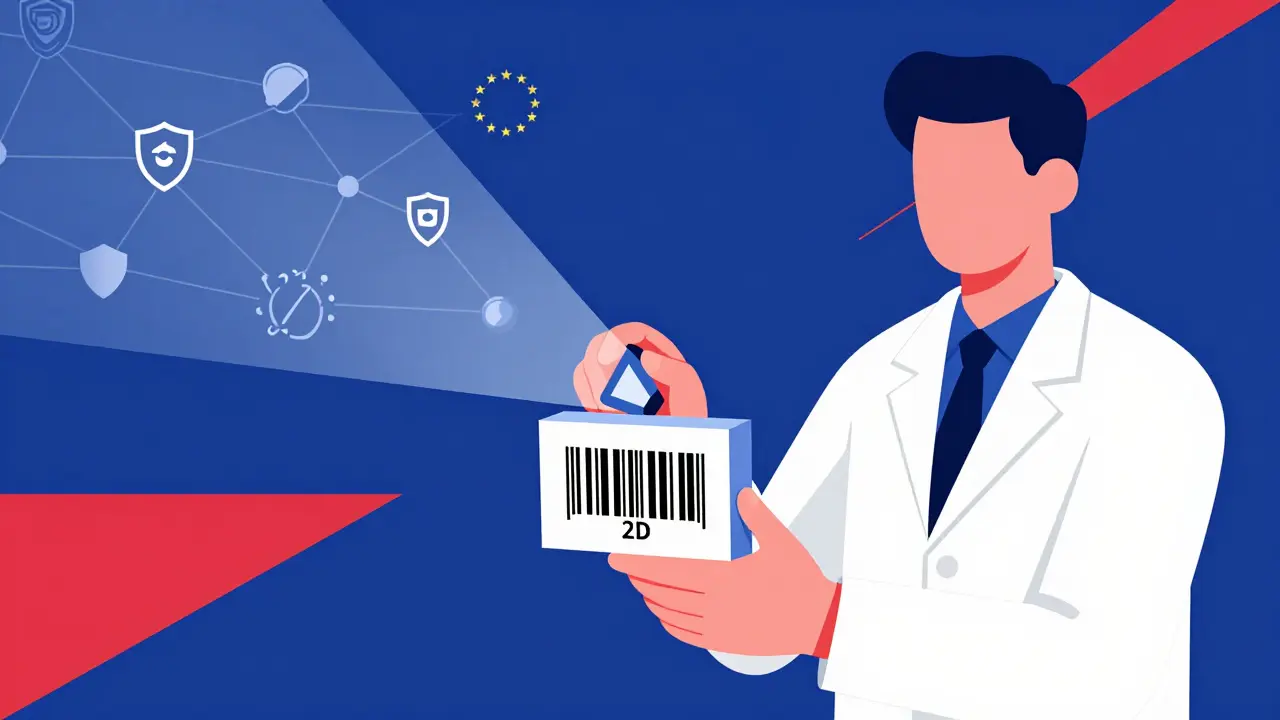
In the European Union, the FMD requires every medicine package to have a unique identifier-a 12-digit serial number and a two-dimensional matrix barcode. When a pharmacist dispenses the drug, they scan this code against a national database. If the code has already been scanned elsewhere, the system flags it as potentially counterfeit. This "decommissioning" process ensures that once a specific pack leaves the supply chain, it cannot be re-entered fraudulently. Studies show that 70% of NHS pharmacists in the UK found this system quick and user-friendly, though initial confusion with warning pop-ups was common.
In contrast, the US DSCSA focuses on the supply chain rather than the final hand-off to the patient. It mandates that manufacturers, wholesalers, and distributors electronically verify products at each transfer of ownership. As of late 2023, the US system relies on interoperable electronic records rather than scanning individual packages at the pharmacy counter. However, the FDA has proposed rules to close this gap, aiming to require patient-level verification by 2027. Until then, US patients rely more heavily on the integrity of the upstream supply chain.
Technologies Behind Drug Authentication
Beyond regulatory databases, several technologies work silently to authenticate drugs. These range from simple visual checks to advanced laboratory-grade analysis.
Serialization and Track-and-Trace Systems
Serialization is the backbone of modern anti-counterfeiting efforts. Each package gets a unique identity, similar to a passport. Technologies like QR codes, RFID (Radio-Frequency Identification), and NFC (Near-Field Communication) tags allow stakeholders to track a drug’s journey from factory to shelf. In field tests conducted by the International Barcode Association in 2022, consumer smartphone scanning of these codes achieved 92% accuracy. For patients, this means that in regions with robust systems, you might eventually scan a QR code on your box to confirm its origin.
Spectral Analysis
For deeper verification, spectral analysis technologies such as Near-Infrared (NIR) spectroscopy and Raman spectroscopy are used. These devices analyze the chemical "fingerprint" of a pill. A handheld NIR scanner can determine if a tablet contains the correct active ingredients without destroying it. According to USP testing data from 2021, these methods achieve 98.7% accuracy in lab settings but drop to 85-92% in field conditions due to environmental factors. Despite this, handheld devices are becoming increasingly robust, with accuracy rates improving from 78% in 2018 to 92% in 2022.
Physical Chemical Identifiers (PCIDs)
Some manufacturers embed authentication directly into the dosage form. PCIDs include special inks, pigments, flavors, or molecular taggants-unique chemical markers added to the drug substance. The FDA released draft guidance on this in January 2021, acknowledging their potential. Molecular taggants provide 99.9% batch-specific identification, making it nearly impossible for counterfeiters to replicate the exact chemical signature. However, this technology increases manufacturing costs by $0.03 to $0.15 per unit, which can impact drug pricing.
How Pharmacists and Healthcare Workers Verify Drugs
If you are a healthcare professional, your role in verification is pivotal. Here is how different professionals approach authenticity checks:
- Community Pharmacists: In the EU, you must scan the 2D matrix code before handing over the medication. Watch for warning pop-ups. If the system says "already dispensed," stop immediately. Do not ignore this alert. In the US, focus on inspecting packaging for tampering and verifying supplier credentials under DSCSA requirements.
- Hospital Pharmacists: You may use automated dispensing cabinets integrated with verification systems. Ensure your software is updated to handle new serialization standards. Training staff takes 16-24 hours, so invest time in learning the protocol.
- Field Health Workers: In low-resource settings, you might use SMS-based verification or handheld NIR devices. Be aware that SMS systems have only 68% effectiveness in areas with poor network coverage. Handheld devices require about 28 hours of training but offer higher accuracy (87% in Ghanaian field tests).
A common challenge reported by 43% of pharmacists during initial FMD implementation was confusing warning screens with "already dispensed" notifications. To mitigate this, many UK hospitals adopted customized notification colors and mandatory documentation of actions taken. If you experience workflow slowdowns-averaging 3.2 seconds per verification-consider adjusting your workflow to batch scans during slower periods.
What Patients Can Do to Protect Themselves
You might wonder, "Can I really tell if my medicine is fake?" While you cannot perform spectral analysis at home, there are practical steps you can take.
- Inspect the Packaging: Look for spelling errors, poor print quality, or damaged seals. Genuine pharmaceutical companies invest heavily in high-quality packaging. If the box feels flimsy or the text is blurry, be suspicious.
- Check for Serialization Codes: In countries with FMD or similar laws, look for the 2D matrix barcode and tamper-evident seal. If the seal is broken or missing, do not use the medication.
- Buy from Reputable Sources: Only purchase medications from licensed pharmacies. Avoid online sellers who offer prices significantly lower than market rate. The FDA warns that counterfeit medicines may contain wrong ingredients, leading to serious health risks.
- Observe the Effect: If a medication does not work as expected or causes unusual side effects, consult your doctor immediately. Do not assume it is just a bad batch; it could be counterfeit.
- Use Official Apps: Some countries have launched mobile apps where you can scan barcodes to verify authenticity. Check if your national health authority offers such a tool.
Remember, Dr. Sarah Thompson, Director of Global Security at Pfizer, noted that "It really takes laboratory testing to confirm 100% if a medication is authentic or counterfeit." While field methods are good, they are not perfect. Your best defense is vigilance and sourcing from trusted channels.
Emerging Trends and Future Developments
The fight against counterfeit drugs is evolving rapidly. Several trends will shape the next decade of drug verification:
AI-Powered Anomaly Detection: The European Medicines Agency is piloting AI systems to detect irregularities in verification data. Early results from 23 NHS hospitals show a 40% improvement in detecting counterfeit patterns. This means systems will become proactive, flagging suspicious batches before they reach patients.
Blockchain Integration: Blockchain technology creates an immutable ledger of a drug’s journey. Currently, 22% of top 50 pharma companies use blockchain solutions, achieving 94.3% verification accuracy. While implementation costs average $2.7 million, the long-term benefits in transparency are significant. Companies like Chronicled and IBM are leading this space.
DNA Barcoding: Alveron Pharma is trialing DNA barcodes embedded in pills. These microscopic genetic markers are unique to each batch and extremely difficult to forge. If approved, this could revolutionize on-dose authentication.
Public Spectral Libraries: The USP-FDA collaboration aims to create public spectral libraries for 1,200 essential medicines by 2025. This will allow anyone with a compatible handheld device to verify drugs against a standardized reference, democratizing access to verification tools.
Challenges and Limitations
Despite technological advances, challenges remain. System downtime averages 2.3 hours monthly per pharmacy, causing frustration. Expired products are sometimes misidentified as counterfeit in 7.8% of verifications, leading to unnecessary waste. In low-income countries, less than 35% have implemented basic track-and-trace infrastructure, leaving vulnerable populations exposed.
Human error is also a factor. The WHO estimates that 72% of counterfeit detection failures stem from human mistakes rather than technological flaws. Proper training and clear protocols are essential. As Professor David Bartram of Oxford University pointed out, "SMS verification systems fail in regions with poor connectivity, leaving vulnerable populations unprotected." Investment in portable, offline-capable devices is crucial for global equity.
Conclusion: Staying Vigilant
Verifying drug authenticity is a shared responsibility. Governments set the rules, manufacturers build the safeguards, and pharmacists execute the checks. But as a patient, you are the last line of defense. By understanding these tools and staying alert, you contribute to a safer global supply chain. The goal is clear: by 2030, McKinsey projects 95% global adoption of comprehensive authentication systems. Until then, stay informed, buy smart, and never hesitate to question the source of your medication.
How can I check if my medication is counterfeit at home?
While you cannot perform laboratory tests at home, you can inspect the packaging for spelling errors, poor print quality, or broken seals. In countries with serialization laws, look for a 2D matrix barcode. If available, use official government apps to scan the code. Always purchase from licensed pharmacies and report any suspicious medications to your local health authority.
What is the difference between the EU FMD and US DSCSA?
The EU Falsified Medicines Directive (FMD) requires scanning a unique code on every medicine package at the pharmacy before giving it to the patient. The US Drug Supply Chain Security Act (DSCSA) focuses on verifying products between manufacturers, wholesalers, and distributors electronically, but does not currently require scanning at the point of patient dispensing. The FDA plans to introduce patient-level verification by 2027.
Are handheld scanners accurate for detecting fake drugs?
Handheld spectroscopic devices like NIR scanners are highly accurate in lab settings (98.7%) but slightly less so in field conditions (85-92%). They are effective for checking chemical composition but require proper training and calibration. For most consumers, relying on serialized barcodes and reputable sources is more practical than owning personal scanners.
Why are some medicines more likely to be counterfeited?
Medicines for chronic conditions (like diabetes or hypertension), painkillers, erectile dysfunction treatments, and antibiotics are frequently targeted because they are high-demand, often purchased repeatedly, and sometimes bought online discreetly. Counterfeiters exploit these markets for profit, putting patients at risk of ineffective or harmful treatments.
What should I do if I suspect my medication is fake?
Stop taking the medication immediately. Contact your pharmacist or doctor to discuss alternative treatments. Report the incident to your national health authority (such as the FDA in the US or EMA in Europe). Provide details about where you bought the drug and keep the packaging as evidence. Your report helps authorities track and shut down counterfeit operations.