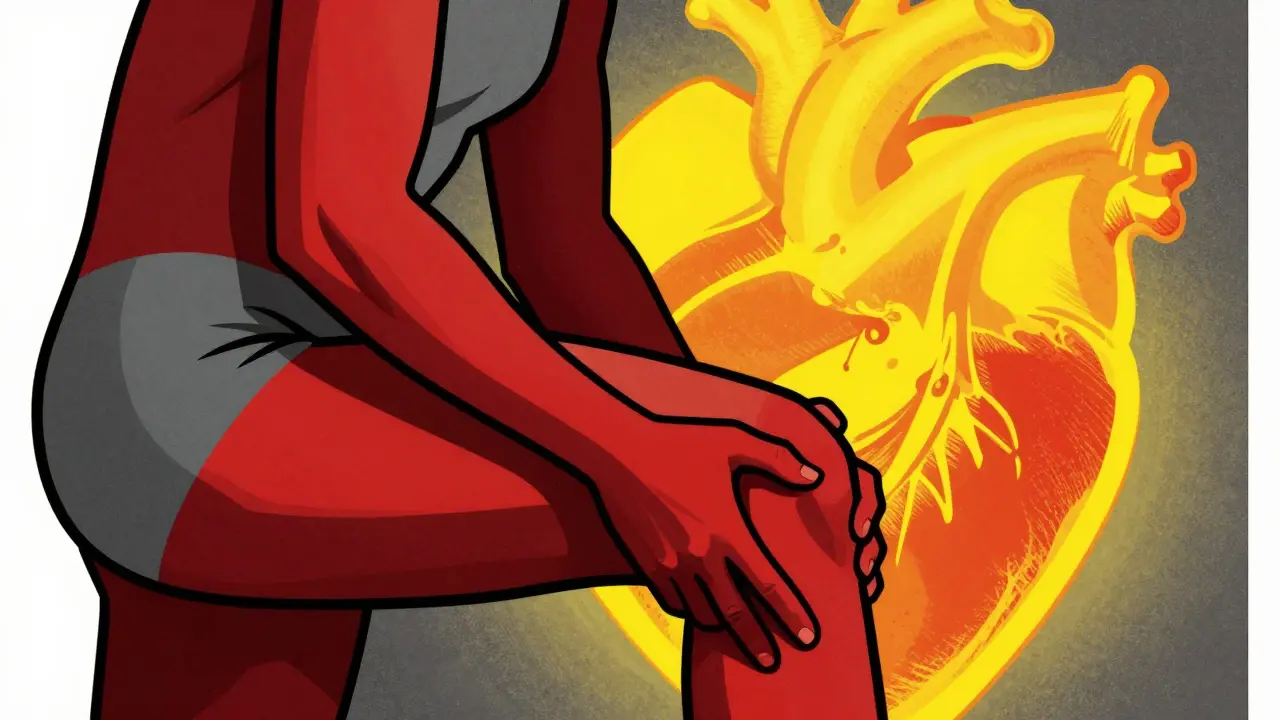
Statin Myopathy Risk Calculator
This tool estimates your risk of developing statin-induced muscle pain based on scientific evidence from clinical studies. Your results will guide you on when to discuss these concerns with your healthcare provider.
Personal Risk Factors
Answer the following questions to assess your risk level
Your Personal Risk Assessment
Based on the information you provided, here's your risk level
Your current risk of statin-induced muscle pain appears to be low. Continue to monitor for symptoms, especially if you start a new medication or increase your statin dose.
Based on data from the American Heart Association 2024 Scientific Statement
Quick Summary: What You Need to Know
- Statin-induced myopathy affects up to 30% of people taking cholesterol medication, ranging from mild pain to severe muscle breakdown.
- Distinguishing between myalgia (pain only) and myositis (inflammation with enzyme spikes) is critical for proper treatment.
- A rare autoimmune form called immune-mediated necrotizing myopathy requires immunosuppressive drugs, not just stopping the statin.
- Genetic factors like the SLCO1B1 gene can significantly increase your risk of developing these side effects.
- Switching to a different statin or adjusting the dose often resolves symptoms for the majority of patients.
When Cholesterol Meds Hurt: The Reality of Statin Pain
Statins are the backbone of modern heart disease prevention. They save lives by lowering LDL cholesterol and reducing the risk of heart attacks and strokes. However, for many, this life-saving benefit comes with a painful trade-off. You might start taking your pill to protect your arteries, only to find your legs feeling like lead or your shoulders aching for no apparent reason. This isn't just "getting older" or "working out too hard." It could be your medication.
According to the American College of Cardiology, muscle-related issues affect up to 30% of statin users. That is one out of every three people. While most cases are mild, ignoring the signs can lead to serious complications. The condition is broadly called statin-induced myopathy, which is a spectrum of muscle-related adverse effects directly associated with hydroxymethylglutaryl-coenzyme A (HMG-CoA) reductase inhibitor therapy. Understanding the difference between a sore muscle and a dangerous reaction is the first step to managing your health without compromising your heart protection.
The Spectrum of Muscle Trouble: From Aches to Breakdown
Not all muscle pain is created equal. Medical professionals categorize these reactions based on severity and blood test results. Knowing which category you fall into helps your doctor decide the next move. The spectrum generally ranges from simple discomfort to severe tissue damage.
- Myalgia: This is the most common form, affecting between 10% and 29% of users. You feel muscle pain, weakness, or cramping, but your blood tests show normal levels of muscle enzymes. It is uncomfortable but usually not dangerous to the muscle tissue itself.
- Myositis: This occurs in about 0.5% of users. Here, you have muscle pain accompanied by elevated creatine kinase (CK) levels. CK is an enzyme released when muscle cells are damaged. Levels here are typically between 10 to 40 times the upper limit of normal.
- Rhabdomyolysis: This is the severe end of the spectrum, occurring in 0.01% to 0.1% of cases. It involves massive muscle breakdown, CK levels exceeding 40 times the normal limit, and potential kidney injury due to myoglobinuria.
- Immune-Mediated Necrotizing Myopathy (IMNM): A rare but distinct condition where the immune system attacks the muscle. It affects about 2 to 3 people per 100,000 statin users.
The distinction matters because the treatment differs wildly. Myalgia might just need a dose change, while IMNM requires aggressive immune suppression. If you stop the statin and the pain goes away in a week or two, you likely had simple myopathy. If symptoms persist for months after stopping, it points toward the immune-mediated form.

Why Does This Happen? The Mechanism Inside Your Muscles
To understand the pain, you have to look at what statins actually do inside your body. They block an enzyme called HMG-CoA Reductase, which is the rate-limiting enzyme in the mevalonate pathway responsible for producing cholesterol. While this lowers cholesterol, it also disrupts other essential pathways in your muscle cells.
One major culprit is Coenzyme Q10 (CoQ10), which is a vital component of the electron transport chain in mitochondria. Studies show that taking 40 mg of simvastatin daily can decrease CoQ10 levels by 40%. CoQ10 is crucial for producing ATP, the energy currency of your cells. Without enough energy, your muscles fatigue and ache. Another factor is protein prenylation. When this process is impaired, calcium levels inside muscle cells can spike from a normal 100 nM to 150-200 nM. This excess calcium activates enzymes that literally eat away at muscle proteins.
Furthermore, research published in Arteriosclerosis, Thrombosis, and Vascular Biology found that statins can upregulate the ubiquitin-proteasome pathway by 300-400%. This pathway is responsible for tagging old proteins for destruction. When it goes into overdrive, it accelerates muscle protein degradation, especially if you combine the medication with eccentric exercise stress, like heavy lifting or running downhill.
Diagnosis: Why It Takes So Long
Getting a correct diagnosis can be frustrating. On patient support forums, 68% of people with the immune-mediated form reported being misdiagnosed initially as having fibromyalgia or chronic fatigue syndrome. The average delay in diagnosis is over 11 months. This delay happens because symptoms are vague. You feel weak, but you don't have a fever or a rash.
The diagnostic gold standard involves a combination of blood work and imaging. Your doctor will measure your Creatine Kinase (CK), which is an enzyme found in heart, brain, and skeletal muscle that leaks into blood when muscle is damaged. If CK is high, they may order an electromyography (EMG) or muscle MRI. For the immune-mediated form, a muscle biopsy is often necessary. Dr. Robert Phillips, a leading researcher in the field, notes that biopsy reveals characteristic necrosis with scarce inflammatory infiltrate in 85% of cases.
Blood tests for anti-HMGCR antibodies are also critical. If you test positive for these antibodies, it confirms the autoimmune nature of the condition. Genetic testing for the SLCO1B1 gene, which is a gene encoding a transporter protein that affects how statins enter liver cells. can also help predict risk. A specific variation, rs4149056, increases the risk of simvastatin myopathy from 0.6% to 1.4%. African Americans, for instance, have an 1.8 times higher risk than Caucasians, potentially linked to these genetic transporters.
| Condition | Incidence Rate | CK Levels | Key Symptoms |
|---|---|---|---|
| Myalgia | 10-29% | Normal | Pain, weakness, cramping |
| Myositis | 0.5% | 10-40x Normal | Pain, elevated enzymes |
| Rhabdomyolysis | 0.01-0.1% | >40x Normal | Severe pain, dark urine, kidney risk |
| Immune-Mediated | 2-3 per 100k | >2,000 IU/L | Progressive weakness, persistent after stopping |
Managing the Pain: Treatment Strategies
If you are experiencing these symptoms, the first step is almost always to stop the medication under medical supervision. For simple myalgia, symptoms typically resolve within 1 to 2 weeks of discontinuation. However, for the immune-mediated form, 50% of patients continue experiencing symptoms for 6 to 12 months even after stopping the drug. This is why distinguishing the type is so vital.
For those who cannot tolerate one statin, switching often works. A 2021 study in the American Journal of Cardiology showed that 73% of patients who couldn't handle simvastatin could tolerate rosuvastatin. This is because different statins have different pharmacokinetics. Some are water-soluble, while others are fat-soluble, affecting how they distribute in your body. Intermittent dosing is another option. The IMPROVE-IT trial demonstrated that 40% of patients with myalgia could tolerate taking their statin every other day rather than daily.
In the case of immune-mediated necrotizing myopathy, simply stopping the statin isn't enough. You need immunosuppressive therapy. Regimens combining corticosteroids like prednisone with methotrexate or mycophenolate mofetil achieve remission in 60-70% of cases within 6 to 12 months. Time is critical here. Patients treated within 6 months of symptom onset achieve complete remission in 65% of cases, compared to only 28% when treatment is delayed beyond a year.
Supplements are often suggested, but the evidence is mixed. CoQ10 supplementation is popular, but a 2015 Cochrane review found that only 3 out of 7 randomized trials showed significant symptom improvement. It might help some, but it is not a guaranteed cure. Newer therapies are emerging, such as complement inhibitors like ravulizumab, which showed a 75% response rate in refractory cases in a 2022 pilot study.

Prevention and Future Directions
As we move through 2026, the focus is shifting toward personalized medicine. The 2024 American Heart Association Scientific Statement predicts a 30-40% reduction in myopathy incidence through pharmacogenomic-guided prescribing within the next few years. This means testing your DNA before starting a statin to see if you carry the high-risk SLCO1B1 variant. If you do, your doctor might choose a statin that doesn't rely on that specific transporter.
Beyond genetics, reviewing your medication list is essential. Drug interactions can skyrocket your risk. Medications like amiodarone inhibit the CYP3A4 enzyme, which processes many statins. This inhibition can increase statin exposure in your blood by 300-500%, turning a safe dose into a toxic one. Always tell your doctor about every supplement and prescription you take.
Long-term viability is a concern. A 2023 Circulation study estimated that myopathy-related discontinuation increases 10-year cardiovascular event risk by 25% in high-risk patients. This underscores the need to find a balance. The goal isn't to avoid statins at all costs, but to find the specific regimen that protects your heart without destroying your muscles. Regular monitoring of CK levels and thyroid function can catch issues early before they become severe.
Frequently Asked Questions
Can muscle pain from statins go away on its own?
For simple myalgia, symptoms often resolve within 1 to 2 weeks after stopping the medication. However, if the pain persists beyond 3 months, it could indicate immune-mediated necrotizing myopathy, which requires medical intervention.
Is CoQ10 supplementation effective for statin muscle pain?
Evidence is inconsistent. A 2015 Cochrane review found that only 3 out of 7 randomized trials demonstrated significant symptom improvement with CoQ10 supplementation. It may help some patients but is not a guaranteed solution.
What blood tests are needed to diagnose statin myopathy?
Doctors typically measure Creatine Kinase (CK) levels to check for muscle damage. For suspected autoimmune cases, testing for anti-HMGCR antibodies is crucial. Thyroid function and vitamin D levels are also checked to rule out other causes.
Can I switch to a different statin if one causes pain?
Yes, statin rotation is a common strategy. Studies show that 73% of patients intolerant to simvastatin can tolerate rosuvastatin. Different statins have different chemical structures and metabolic pathways.
Does exercise make statin muscle pain worse?
Eccentric exercise stress can accelerate muscle protein degradation in statin users. While general activity is good, intense resistance training or downhill running might exacerbate symptoms in susceptible individuals.
Next Steps and Troubleshooting
If you suspect your medication is causing muscle issues, do not stop taking it abruptly without consulting your healthcare provider. Sudden cessation can impact your cardiovascular risk profile. Instead, schedule an appointment to discuss your symptoms. Keep a log of when the pain occurs, what activities trigger it, and how severe it is on a scale of 1 to 10.
Bring a list of all your current medications to your appointment. Ask specifically about drug interactions, particularly with antibiotics, antifungal medications, or heart rhythm drugs like amiodarone. If your doctor orders a CK test, ensure you haven't engaged in strenuous exercise 48 hours prior, as this can falsely elevate the results.
For those diagnosed with immune-mediated myopathy, seek a referral to a neuromuscular specialist immediately. Early immunosuppression is the key to preventing permanent muscle weakness. If you are simply experiencing myalgia, ask about trying a lower dose or an alternate-day dosing schedule before giving up on statin therapy entirely. Balancing heart health and muscle comfort is possible with the right approach.


