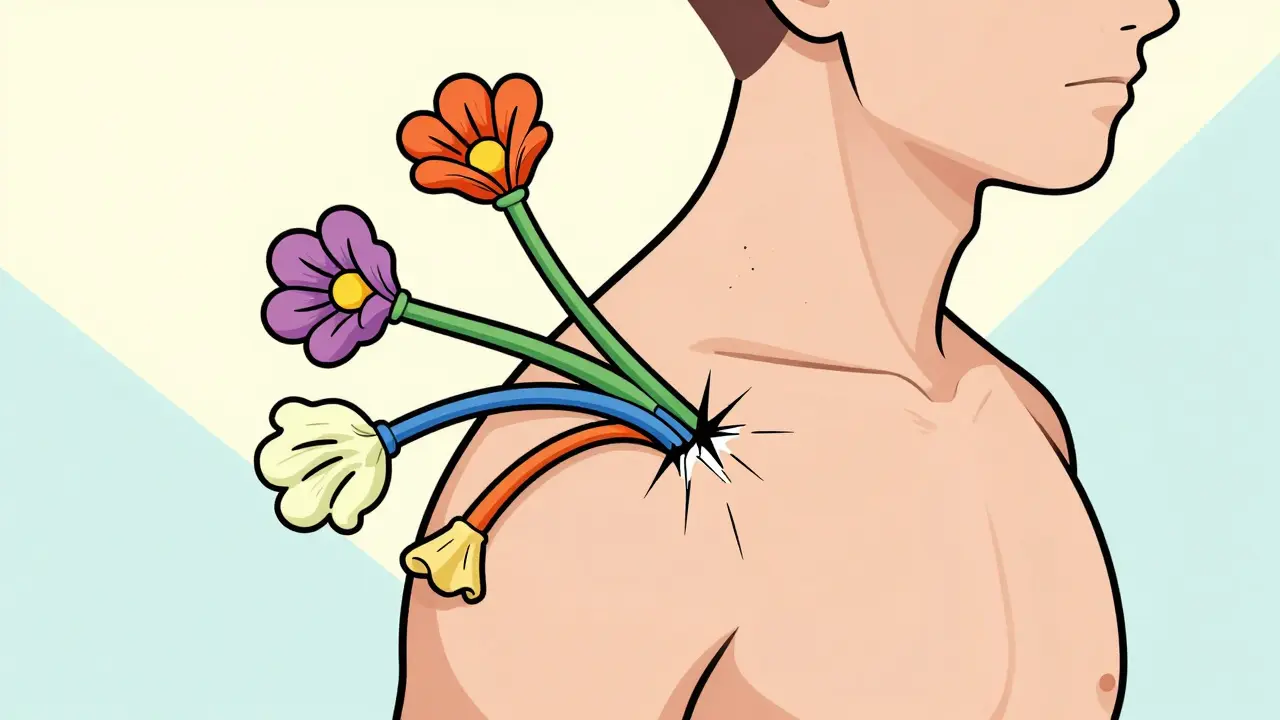
When your shoulder starts hurting every time you reach for a coffee cup or comb your hair, it’s not just a bad day - it could be a rotator cuff tear. This isn’t a rare issue. In fact, about 1 in 5 adults over 60 have a tear without even knowing it. But for active people, athletes, or those who lift heavy things regularly, a torn rotator cuff can turn simple movements into pain bombs. The good news? We know more now than ever about how to find these tears, heal them without surgery, or fix them with the least invasive methods possible.
What Exactly Is a Rotator Cuff Tear?
The rotator cuff isn’t one muscle - it’s four. The supraspinatus, infraspinatus, teres minor, and subscapularis. These tendons wrap around the top of your arm bone (humerus) like a sleeve, holding it steady in the shoulder socket. When one or more of these tendons get torn, either from a fall, overuse, or just aging, the shoulder loses its stability. That’s when pain, weakness, and that annoying clicking or popping start.
Here’s the twist: not all tears cause symptoms. A 2019 study found that over half of people over 60 with no shoulder pain still had a tear on MRI. That means the body can sometimes adapt. But if you’re active, or the tear gets bigger, it won’t stay silent for long.
How Do Doctors Find a Rotator Cuff Tear?
It starts with your hands - not a machine. A good orthopedic doctor will check your range of motion, strength, and pain triggers using simple tests. The Empty Can Test (raising your arm straight out, thumb down) checks the supraspinatus. The Hawkins-Kennedy Test (bending your arm at 90 degrees and rotating inward) looks for impingement. These aren’t fancy - but they’re accurate.
Then comes imaging. And here’s where things get practical.
X-rays are always the first step. They won’t show the tear - tendons don’t show up on X-rays. But they’ll show bone spurs, arthritis, or changes in joint alignment that could be contributing. Every single patient gets one.
For the actual tear, you have two real options: ultrasound or MRI.
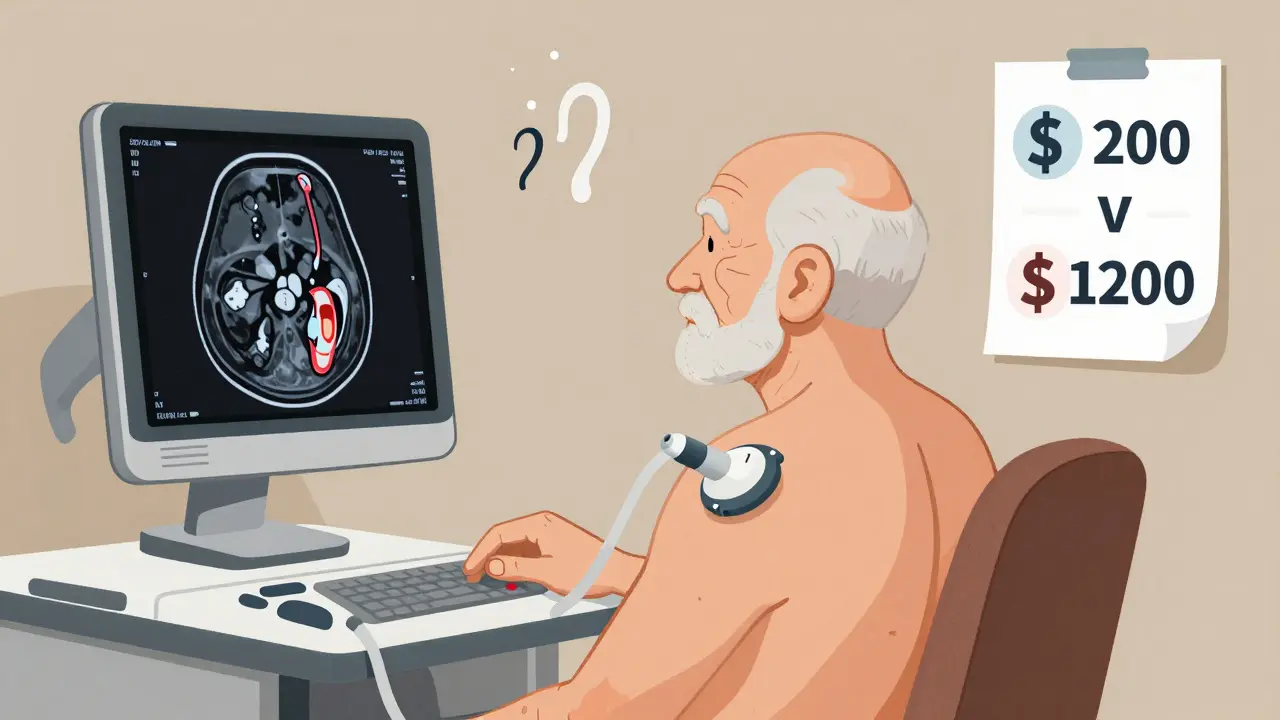
Ultrasound is faster, cheaper, and often more comfortable. It costs about $200-$400, while MRI runs $500-$1,200. You can sit up, move your arm during the scan, and see the tendon stretch and snap in real time. Experts at the University of Washington say it’s the most efficient way to check the cuff. Sensitivity? Around 87-91% for full-thickness tears. That’s almost as good as MRI.
But MRI gives you a full 3D map. It shows the size of the tear, how retracted the tendon is, and whether the muscle has started turning to fat - a sign the tear’s been there too long. MRI accuracy hits 92% for full-thickness tears. It’s the gold standard for surgical planning.
So which do you pick? If you’re young, active, and have clear symptoms, ultrasound is a smart first move. If you’re older, have a complex case, or surgery is being considered, go straight to MRI. And if you have a pacemaker or metal implants? Skip MRI. Ultrasound is your only safe bet.
Can You Heal a Rotator Cuff Tear Without Surgery?
Yes - and many people do.
A 2021 study in the Journal of Orthopaedic & Sports Physical Therapy found that 85% of people with partial-thickness tears got back to normal function with physical therapy alone. That’s not a fluke. It’s repeatable.
Rehab isn’t just “do some stretches.” It’s a three-phase plan:
- Weeks 1-6: Passive motion - Your therapist moves your arm for you. No muscle effort. Goal: prevent stiffness.
- Weeks 6-12: Active-assisted motion - You start moving your arm with help (bands, pulleys). Strength begins to return.
- After 12 weeks: Strengthening - Resistance bands, light weights, scapular control. This is where you rebuild the shoulder’s engine.
Most people stop at phase two. But phase three is critical. Without it, the shoulder may feel better, but it won’t handle lifting, reaching, or throwing again.
Here’s the catch: if you have a full-thickness tear larger than 1 cm, especially if you’re under 65 and active, rehab alone often fails long-term. The tendon doesn’t heal on its own. It just gets bigger.
Surgical Repair: What’s the Best Option?
When surgery is needed, arthroscopic repair is the norm. In 2022, 90% of all rotator cuff surgeries in the U.S. were done this way.
Arthroscopic means small incisions, a camera, and tiny tools. No big cut. No hospital stay. You’re usually home the same day.
Compared to old-school open surgery, arthroscopic repair has:
- 30% fewer complications
- 25% faster return to daily tasks
- Same strength and function outcomes
Recovery? It’s not quick. But it’s faster than before. In the 1990s, you’d be locked in a sling for 6 weeks. Now? Most surgeons let you start gentle passive motion the day after surgery. That’s huge. Early motion reduces scar tissue and keeps the joint from freezing.
After surgery, rehab follows the same three-phase plan - but with stricter timing. You’ll be working with a physical therapist for 4-6 months. The goal isn’t just to move - it’s to rebuild strength in the right order so the tendon reattaches properly.
What About Patch Augmentation and PRP?
For massive tears - where the tendon is completely gone or too damaged to reattach - surgeons sometimes use a patch. Think of it like a biological Band-Aid. It’s a biologic material (from human or animal tissue) that helps the body heal the gap. It’s not magic, but for some, it’s the only way to avoid shoulder replacement.
Platelet-rich plasma (PRP) injections? They sound promising. You get your own blood spun down, then injected into the tear. The idea: more healing cells. But the evidence? Weak. A 2021 Cochrane Review found only moderate support. It might help a little - but it’s not a substitute for rehab or surgery.
Long-Term Outcomes: What Can You Expect?
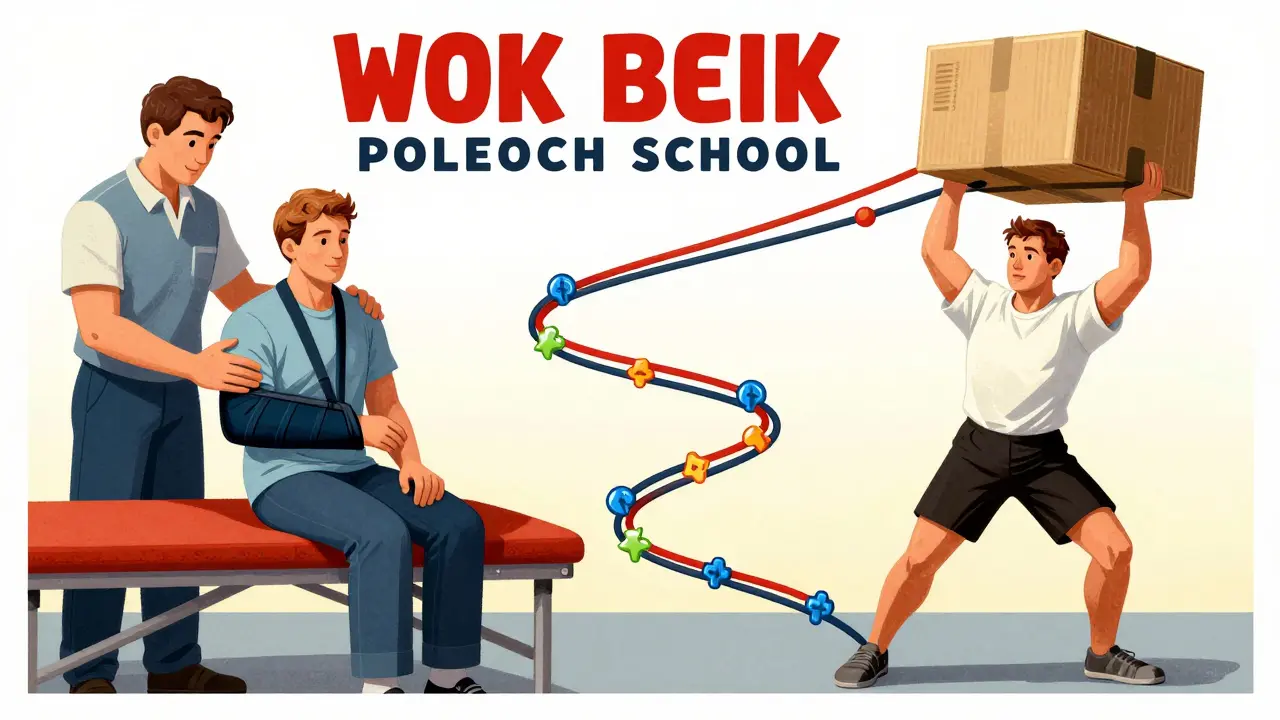
Five years after arthroscopic repair, 82% of patients report being satisfied. That’s high. But not perfect.
Retear rates? They depend on size:
- Small tears (<1 cm): 12% retear rate
- Large tears (1-3 cm): 18% retear rate
- Massive tears (>3 cm): 27% retear rate
If you’re over 65, have a big tear, smoke, or have diabetes - your risk goes up. That’s why timing matters. Waiting too long lets the muscle turn to fat. Once that happens, even perfect surgery won’t restore full strength.
What Should You Do Right Now?
If you’ve got shoulder pain that won’t quit:
- Don’t ignore it. Rotator cuff tears don’t heal on their own.
- See a physical therapist first. Get a movement assessment. Try rehab for 6-8 weeks.
- Only get an MRI if rehab fails or you’re young and active with a sudden tear.
- If surgery is recommended, choose an arthroscopic surgeon with high volume - outcomes are better.
- Don’t rush rehab. Skipping phases = higher retear risk.
Most people don’t need surgery. But if you do, modern techniques make recovery realistic. The goal isn’t just pain relief - it’s getting back to what you love.


