
Blood Thinner Reversal Agent Finder
Select your current medication below to see the appropriate reversal protocol, mechanism of action, and potential risks.
Imagine you are taking a daily medication to keep your blood from clotting. It saves your life by preventing strokes. But what happens if you fall hard, hit your head, or start bleeding heavily from the gut? That same medicine that protects you can suddenly become a danger. This is where blood thinner reversal comes in. It is not just about stopping the drug; it is about actively neutralizing its effect so your body can stop bleeding. For millions of people on anticoagulants, understanding this process is the difference between life and death.
If you or a loved one takes blood thinners, you need to know that help exists beyond just "stopping" the pill. Specific antidotes have changed emergency medicine dramatically since 2015. We will break down exactly how these reversal agents work, which ones match which drugs, and what doctors look for when seconds count.
Why Reversal Matters More Than Ever
Blood thinners, medically known as anticoagulants, are essential for conditions like atrial fibrillation (AFib). They prevent clots that cause heart attacks and strokes. However, they carry a trade-off: increased bleeding risk. In the United States alone, major bleeding events related to newer oral anticoagulants lead to over 100,000 hospitalizations every year. About 15% to 20% of these cases are fatal.
The problem used to be worse. For decades, patients on warfarin had Vitamin K and prothrombin complex concentrates (PCC) to reverse effects quickly. But when newer drugs called NOACs (Novel Oral Anticoagulants) came out, there were no specific antidotes for them. Doctors had to guess or use non-specific treatments that weren't always effective. That gap closed recently with targeted reversal agents designed to bind directly to specific drugs.
The Specific Antidotes: Matching Drug to Reversal Agent
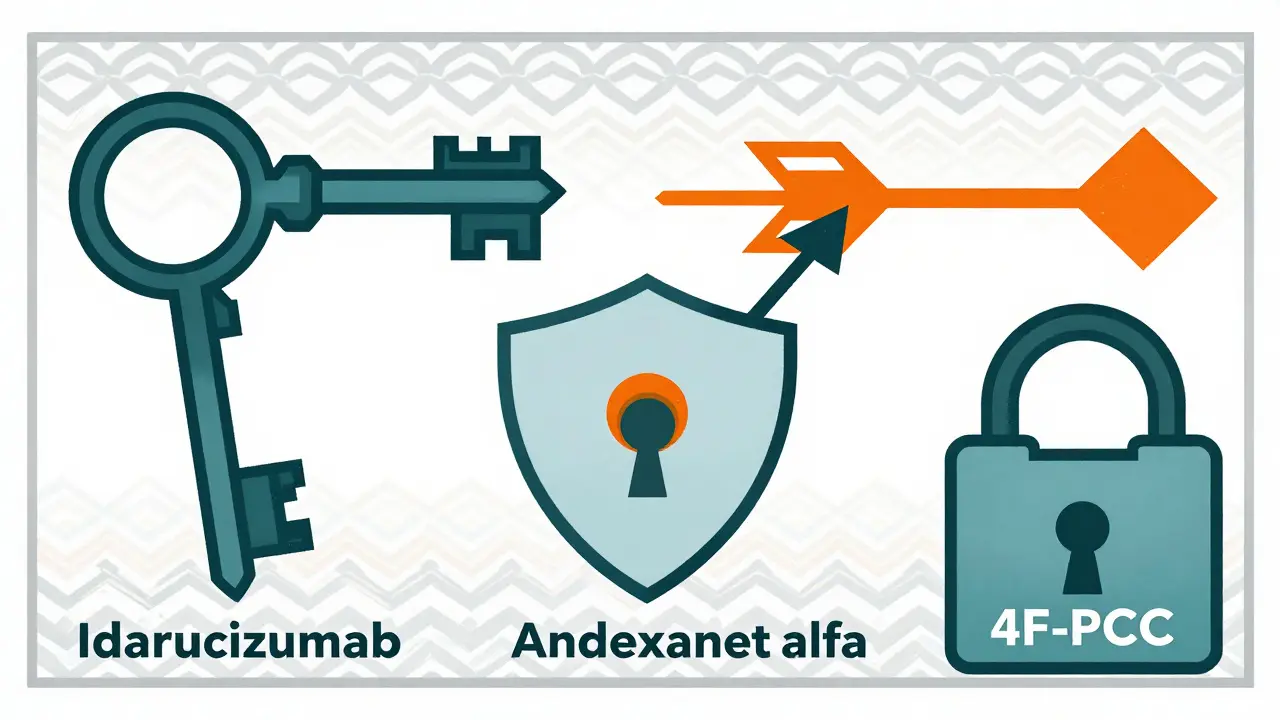
You cannot reverse all blood thinners with one shot. The reversal agent must match the specific anticoagulant. Think of it like a key fitting a lock. Using the wrong key won't open the door, and using the wrong reversal agent might not stop the bleeding-or could even cause new clots.
Here is how the current landscape looks:
- Dabigatran (Pradaxa): Reversed by Idarucizumab (Praxbind).
- Rivaroxaban (Xarelto), Apixaban (Eliquis), Edoxaban (Savaysa): Reversed by Andexanet alfa (Andexxa).
- Warfarin (Coumadin): Reversed by Vitamin K and Four-Factor Prothrombin Complex Concentrate (4F-PCC).
Let’s look closer at the two newest players: Idarucizumab and Andexanet alfa.
Idarucizumab: The Dabigatran Neutralizer
Approved by the FDA in October 2015, Idarucizumab was a game-changer. It is a monoclonal antibody fragment that binds directly to dabigatran. It doesn’t just slow it down; it neutralizes it completely. Clinical trials showed it achieved 100% median maximum percentage reversal of dabigatran’s effect almost instantly. Doctors administer it as two 2.5-gram IV boluses within 15 minutes.
The catch? It wears off. In about 23% of patients, dabigatran levels rise again after 24 hours. This "rebound" can cause recurrent bleeding. If you receive this drug, you need close monitoring for at least a day or two. Ten patients in major trials needed extra doses because of this rebound effect.
Andexanet Alfa: The Factor Xa Inhibitor Antidote
For those on Xarelto, Eliquis, or Savaysa, Andexanet alfa received FDA approval in May 2018. It works differently. It is a modified version of Factor Xa itself-a decoy. The blood thinner binds to the Andexanet instead of your real Factor Xa, freeing up your body’s natural clotting ability.
In the ANNEXA-4 trial, it stopped bleeding in 83% of participants. The median time to stop gastrointestinal bleeding was 2.5 hours. However, it comes with risks. Studies show a higher rate of thromboembolic events (new clots) compared to other methods-about 14% versus 8% for 4F-PCC. Because of this risk and its high cost, hospitals often reserve it for the most severe, life-threatening bleeds.
| Reversal Agent | Target Drug(s) | Mechanism | Hemostasis Rate | Key Risk |
|---|---|---|---|---|
| Idarucizumab | Dabigatran | Direct binding | ~90% | Rebound bleeding (23%) |
| Andexanet alfa | Rivaroxaban, Apixaban, Edoxaban | Decoy Factor Xa | ~75-83% | Thromboembolism (14%) |
| 4F-PCC | Warfarin, sometimes NOACs | Clotting factor replacement | ~77% | Cost-effective but less specific |
The Non-Specific Option: 4F-PCC
Not every hospital has Idarucizumab or Andexanet alfa in stock. These drugs are expensive-Idarucizumab costs around $3,800 per vial (you need two), and Andexanet alfa runs about $17,900 per treatment. In contrast, Four-Factor Prothrombin Complex Concentrate (4F-PCC) costs between $1,500 and $3,000.
4F-PCC contains the actual clotting factors your body needs. It works well for warfarin reversal. For NOACs, it acts as a "non-specific" backup. Recent meta-analyses show it achieves effective hemostasis in 77% of intracranial hemorrhage cases, similar to Andexanet alfa. Many community hospitals rely on 4F-PCC because it is cheaper and widely available, even if it isn't a perfect molecular match for the drug causing the bleed.
What Happens in an Emergency?
If you end up in the ER with major bleeding while on blood thinners, here is what the medical team does:
- Stop the Anticoagulant: Obviously, you don't take your next dose.
- Identify the Drug: They check your records or run lab tests. Dilute thrombin time checks for dabigatran. Anti-Factor Xa activity checks for Xa inhibitors.
- Assess Severity: Is it a minor cut or a brain bleed? Intracranial hemorrhage and massive gastrointestinal bleeding require immediate reversal.
- Administer Reversal Agent: If specific agents are available and indicated, they give them via IV. This usually happens within 2 hours of bleeding onset for best results.
- Monitor Closely: You stay in the hospital. Doctors watch for re-bleeding (especially with Idarucizumab) or new clots (especially with Andexanet alfa).
Time is tissue. In brain bleeds, every hour counts. Neurosurgeons note that faster hemostasis leads to better outcomes. Idarucizumab, for instance, allows surgeons to operate in under 2 hours on average, whereas older methods took longer.

Future Solutions: The Universal Antidote?
Doctors hope for a simpler future. Right now, having three different reversal protocols is complex. Enter Ciraparantag (PER977). This experimental drug is in Phase III trials. It promises to be a "universal" reversal agent. It works by binding to heparin, low molecular weight heparin, and all direct oral anticoagulants. Early trials showed it reversed edoxaban within 5 to 10 minutes. If approved, it could simplify emergency care drastically.
Until then, we rely on the tools we have. The market for these agents is growing fast-expected to hit $1.9 billion by 2028-driven by an aging population and more people prescribed AFib medications.
Practical Tips for Patients
Knowing your meds is half the battle. Here is what you should do today:
- Carry Information: Wear a medical alert bracelet or keep a card in your wallet listing your exact blood thinner name and dose.
- Tell Every Doctor: Dentists, surgeons, and ER staff need to know immediately. Do not assume they checked your chart.
- Ask About Risks: Talk to your cardiologist about your personal bleeding risk. If you fall often or have stomach issues, discuss whether your current drug is the safest choice.
- Know Your Hospital: Ask if your local hospital stocks specific reversal agents like Praxbind or Andexxa. If not, ask about their protocol for 4F-PCC.
Reversal agents are powerful tools, but they are not magic bullets. They address the symptom (bleeding) but not the underlying condition (like AFib). After the emergency passes, you and your doctor will need to decide whether to restart anticoagulation. Stopping forever might put you at risk for stroke; restarting might put you at risk for bleeding. It is a delicate balance.
How quickly does Idarucizumab work?
Idarucizumab works almost instantly. It achieves complete reversal of dabigatran's anticoagulant effect within minutes of administration. However, because its effect wears off after 24 hours in some patients, monitoring is required to ensure bleeding does not return.
Is Andexanet alfa safe for everyone?
Andexanet alfa is effective but carries a higher risk of thromboembolic events (new blood clots) compared to other reversal methods. About 14% of patients experience these complications. It is typically reserved for life-threatening bleeding situations due to this risk and its high cost.
Can I reverse my blood thinner at home?
No. Reversal agents require intravenous administration in a hospital setting with continuous monitoring. You cannot self-administer these drugs. If you suspect severe bleeding, go to the nearest emergency room immediately.
What is the difference between 4F-PCC and specific reversal agents?
Specific agents like Idarucizumab and Andexanet alfa target the exact molecule of the blood thinner. 4F-PCC provides general clotting factors and is non-specific. While 4F-PCC is cheaper and widely available, specific agents often provide faster and more predictable reversal for their matching drugs.
Will I need to restart blood thinners after reversal?
Often, yes. Reversal stops the immediate bleeding threat, but it does not cure the condition requiring the blood thinner (such as atrial fibrillation). Your doctor will evaluate your risk of stroke versus bleeding to decide when and if to resume anticoagulation therapy.