
When a drug is highly variable-meaning its effects differ dramatically from person to person-standard bioequivalence studies often fail. You can’t just give half the subjects the brand drug and half the generic, wait a few weeks, and call it done. For drugs like warfarin, levothyroxine, or clopidogrel, that approach doesn’t work. The variability is too high. That’s where replicate study designs come in. They’re not just a fancy upgrade. They’re the only way to reliably prove a generic version is safe and effective when the original drug behaves unpredictably in the body.
Why Standard Designs Fail for Highly Variable Drugs
The classic two-period, two-sequence crossover (TR, RT) has been the gold standard for decades. But it assumes that variability between subjects is mostly consistent. For drugs with a within-subject coefficient of variation (ISCV) under 30%, that’s fine. You need about 24 to 30 people, run two cycles, and you’ve got your answer. But when ISCV hits 40% or 50%, things fall apart. Why? Because the natural differences in how one person absorbs or metabolizes the drug swamp out the small differences between the brand and generic. You’d need 80, 100, even 120 subjects to get enough statistical power. That’s expensive. It’s slow. And ethically, it’s hard to justify asking so many people to go through multiple dosing periods for a drug that already has wide swings in response. That’s the problem replicate designs solve. Instead of giving each subject the test and reference drug once each, you give them multiple doses of each. That lets you measure how much the drug varies within the same person across time-not just between people. And once you know that, you can stretch the bioequivalence limits based on how variable the reference drug is. That’s called reference-scaled average bioequivalence, or RSABE.Three Types of Replicate Designs-And When to Use Each
There are three main replicate designs used today, each with different strengths and regulatory acceptance.- Three-period full replicate (TRT/RTR): Subjects get the test drug once and the reference drug twice, or vice versa. This design estimates variability for both the test and reference products. It’s the sweet spot for most highly variable drugs with ISCV between 30% and 50%. The FDA and EMA both accept it. Industry surveys show 83% of CROs prefer this design because it balances power and practicality. You need at least 24 subjects, with 12 completing the RTR arm.
- Four-period full replicate (TRRT/RTRT): Each subject gets both drugs twice. This gives you the most precise estimates of variability for both formulations. It’s required for narrow therapeutic index (NTI) drugs like warfarin, where even tiny differences can be dangerous. The FDA mandates this for NTI drugs. But it’s longer, more expensive, and has higher dropout risk. Only use it when absolutely necessary.
- Three-period partial replicate (TRR/RTR/RRT): Subjects get the reference drug twice, but the test drug only once. You can only estimate variability for the reference drug-not the test. The FDA accepts this for RSABE, but the EMA doesn’t. It’s cheaper and faster than full replicate designs, but you lose information. Use it only if you’re confident the test drug’s variability won’t be higher than the reference’s.
Here’s what you need to know: if your drug’s ISCV is below 30%, stick with the standard 2x2 design. If it’s between 30% and 50%, go with TRT/RTR. If it’s above 50%, or if it’s an NTI drug, use TRRT/RTRT. Don’t guess-base your choice on pilot data or published pharmacokinetic profiles.
How Replicate Designs Cut Costs and Time
Let’s say you’re testing a drug with 50% ISCV and a 10% formulation difference. A standard 2x2 crossover would need 108 subjects to reach 80% power. A four-period full replicate? Just 28. That’s a 74% reduction in participants. That’s not just money saved. It’s faster approvals. Fewer people exposed to repeated dosing. Less strain on clinical sites. In 2023, the FDA reported that 68% of HVD bioequivalence studies used replicate designs-up from 42% in 2018. Why? Because they work. Approval rates for properly designed replicate studies are 79%. For non-replicate attempts on HVDs? Only 52%. One CRO manager shared a real example: their levothyroxine study used a TRT/RTR design with 42 subjects and passed on the first submission. Their previous attempt with a 2x2 design? 98 subjects, and it failed. That’s $1.2 million saved in recruitment, dosing, and lab analysis.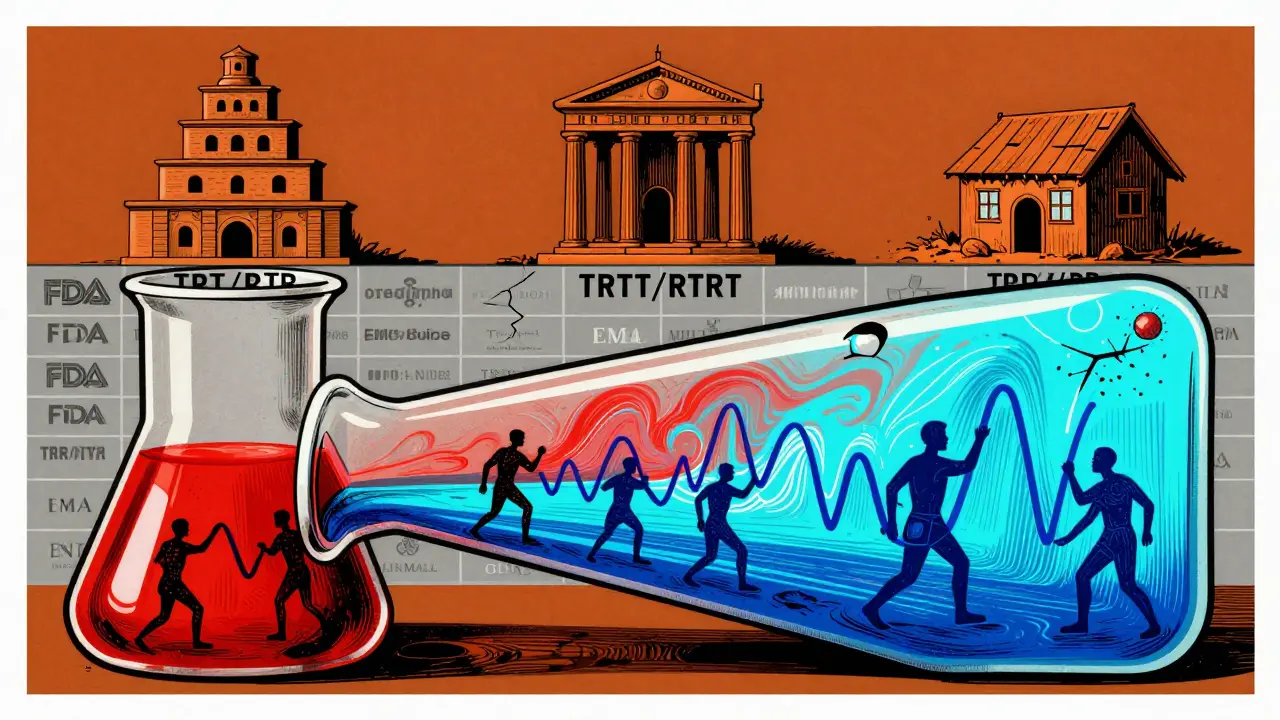
The Hidden Costs and Pitfalls
Replicate designs aren’t magic. They come with real challenges. First, subject burden. More visits. Longer washout periods. If the drug has a long half-life-say, 24 hours or more-you might need a 14-day washout between periods. That stretches the study out to 8-12 weeks. Dropout rates? Average 15-25%. That means you have to recruit 20-30% more people than your target just to account for no-shows and withdrawals. Second, statistical complexity. You can’t just plug the data into Excel. You need mixed-effects models that account for sequence, period, and subject effects. You need to calculate reference-scaled limits using FDA or EMA formulas. Most teams use Phoenix WinNonlin or the R package replicateBE (version 0.12.1). The CRAN download count for that package hit 1,247 in Q1 2024-proof it’s the industry standard. Third, regulatory mismatch. The FDA accepts partial replicate designs. The EMA does not. If you’re planning a global submission, you’ll need to design for the strictest standard. Many companies now default to full replicate designs to avoid rejection in Europe. And don’t forget training. Pharmacokinetic analysts need 80-120 hours of specialized training to run these analyses correctly. A 2022 AAPS workshop found that 40% of early replicate study failures were due to incorrect statistical models-not bad data.Regulatory Trends and the Future
Regulators are catching up. The FDA’s 2024 draft guidance proposes requiring four-period full replicate designs for all HVDs with ISCV above 35%. That’s a shift from their current flexibility. The EMA still allows three-period designs but is moving toward more alignment. The International Council for Harmonisation (ICH) is working on a new addendum expected in late 2024 to standardize RSABE across the U.S., EU, Japan, and others. That’s good news. Right now, a study approved in the U.S. might get rejected in Europe simply because it used a partial replicate design. Emerging trends include adaptive designs. Imagine starting with a replicate study, but if early data shows the drug isn’t as variable as expected, you can switch to a simpler analysis. Pfizer’s 2023 proof-of-concept used machine learning to predict sample size needs with 89% accuracy using historical BE data. That could cut costs even further. The global bioequivalence market hit $2.8 billion in 2023. Replicate studies now make up 35% of HVD assessments-up from 18% in 2019. WuXi AppTec, PPD, and Charles River dominate the space. But the real winners are the CROs that specialize in statistical rigor. BioPharma Services, for example, holds 9% of the niche market-not because they run the most studies, but because they get them approved.
Getting Started: A Practical Checklist
If you’re planning your first replicate study, here’s what to do:- Review published PK data for the reference drug. What’s the ISCV? If it’s below 30%, skip replicate designs.
- For ISCV between 30% and 50%, choose a three-period full replicate (TRT/RTR). For ISCV above 50% or NTI drugs, go with four-period (TRRT/RTRT).
- Recruit 20-30% more subjects than your power analysis says you need. Plan for dropouts.
- Ensure washout periods are long enough-especially for drugs with long half-lives. Use half-life x 7 as a rule of thumb.
- Use Phoenix WinNonlin or R’s replicateBE package. Don’t try to code your own model unless you’re a biostatistician with regulatory experience.
- Document your statistical plan in the protocol. Include the RSABE formula, acceptance criteria, and how you’ll handle missing data.
- For global submissions, design for the EMA’s stricter rules. Use full replicate even if the FDA accepts partial.
There’s no shortcut. But with the right design, you can avoid the trap of wasting months-and millions-on a study that was doomed from the start.
Frequently Asked Questions
What’s the difference between full and partial replicate designs?
Full replicate designs (like TRT/RTR or TRRT/RTRT) give each subject multiple doses of both the test and reference drugs, allowing you to estimate variability for both. Partial replicate designs (like TRR/RTR/RRT) only give the test drug once, so you can only measure variability for the reference drug. Full replicates are more powerful and accepted globally. Partial replicates are faster and cheaper but only accepted by the FDA, not the EMA.
Why do I need more subjects if the study is longer?
Longer studies mean more chances for people to drop out. Even with good screening, 15-25% of participants leave before finishing. If you need 30 completers, you should recruit 36-40 to start with. It’s not about power-it’s about logistics.
Can I use a parallel design instead of a replicate design?
Parallel designs (separate groups for test and reference) are rarely acceptable for bioequivalence. They require double the sample size because they can’t account for within-subject variability. They’re only used for drugs with very long half-lives or when crossover isn’t ethical-like with toxic drugs. For HVDs, they’re statistically underpowered and almost always rejected by regulators.
Is RSABE the same as ABEL?
Yes and no. RSABE (reference-scaled average bioequivalence) is the umbrella term. ABEL (average bioequivalence with expanding limits) is the specific method used by the EMA. The FDA uses RSABE with slightly different scaling formulas and thresholds. Both adjust bioequivalence limits based on the reference drug’s variability, but the math and acceptance criteria differ. Don’t assume they’re interchangeable.
What software should I use to analyze replicate study data?
The industry standard is the R package replicateBE (version 0.12.1), which is open-source and specifically built for RSABE analysis. Phoenix WinNonlin is also widely used, especially in regulated environments. Avoid general statistical tools like SPSS or SAS unless you have a validated, regulatory-approved protocol. Most submissions are rejected for using incorrect models.
What happens if my study fails RSABE?
If you don’t meet RSABE criteria, you can still try conventional bioequivalence limits (80-125%). But for HVDs, that’s rarely possible without massive sample sizes. Most teams go back, reanalyze their data, check for protocol violations, and sometimes run a new study with a different design. It’s costly, so getting the design right upfront is critical.


