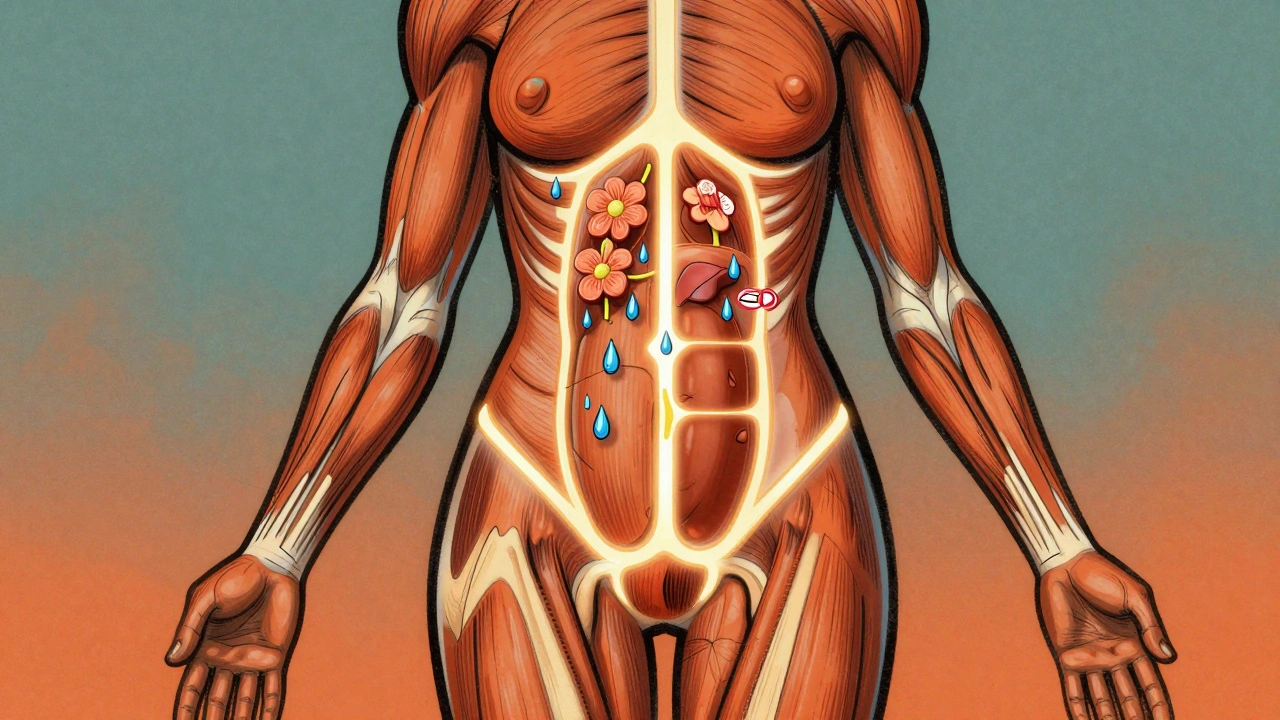
Polycystic Ovary Syndrome (PCOS) affects about 1 in 10 women of childbearing age. For many, the biggest struggle isn’t just irregular periods or acne-it’s the inability to get pregnant. The root cause? Often, it’s not the ovaries themselves, but what’s happening in the body’s metabolism. High insulin levels, insulin resistance, and chronic anovulation go hand in hand in PCOS. That’s where metformin comes in.
What Metformin Actually Does in PCOS
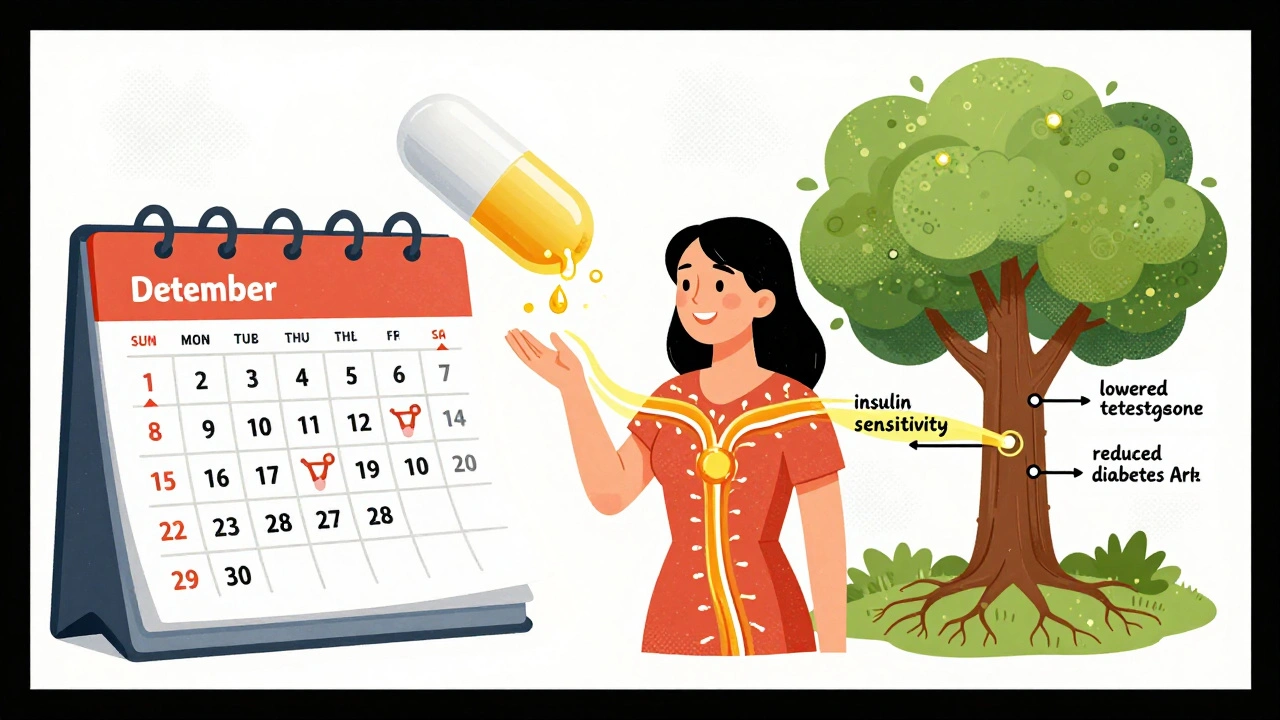
Metformin isn’t a fertility drug. It’s a diabetes medication-first developed in the 1950s-that works by making your body more sensitive to insulin. In women with PCOS, the body produces too much insulin because cells don’t respond to it properly. This excess insulin tells the ovaries to make more testosterone, which shuts down ovulation and causes symptoms like facial hair, acne, and weight gain.
Metformin breaks that cycle. It reduces glucose production in the liver, slows down sugar absorption in the gut, and helps muscle cells take up glucose more efficiently. The result? Lower insulin levels. And when insulin drops, testosterone drops too. That’s the key. No more insulin overload → no more ovarian chaos → a better chance of ovulating on your own.
Does Metformin Really Help You Ovulate?
Yes-but not for everyone, and not always alone.
Studies show metformin improves ovulation rates significantly compared to no treatment. A 2012 Cochrane review of 44 trials found women taking metformin were over 2.5 times more likely to ovulate than those on placebo. More recent data from 2023 confirms this: about 50-60% of women with PCOS start ovulating regularly after 3-6 months of consistent use.
But here’s the catch: metformin alone is slower and less effective than other options. In a 2023 study of 72 infertile women with PCOS, letrozole plus metformin led to ovulation in 89% of cases. Metformin by itself? Only 69%. That’s a big difference.
So if you’re trying to get pregnant fast, metformin isn’t your best first move. But if you’re insulin resistant, overweight, or have prediabetes, it’s a powerful tool-even a necessary one.
Metformin vs. Clomiphene vs. Letrozole
For years, clomiphene citrate (Clomid) was the go-to drug for PCOS infertility. Then came letrozole (Femara), which is now recommended as first-line by the American Society for Reproductive Medicine (ASRM) because it has higher pregnancy and live birth rates.
So where does metformin fit?
It doesn’t replace them. It supports them.
- Clomiphene alone: Works well for ovulation, but doesn’t fix insulin resistance. Risk of multiple pregnancies is higher.
- Letrozole alone: Best for getting pregnant quickly. Higher live birth rates than clomiphene.
- Metformin alone: Slower, less reliable for pregnancy, but improves long-term metabolic health and reduces OHSS risk during IVF.
- Metformin + letrozole: The sweet spot for many. Combines ovulation power with metabolic support.
A 2023 network meta-analysis found that combining metformin with clomiphene improved ovulation rates more than clomiphene alone. And when women didn’t respond to clomiphene, adding metformin boosted their chances of pregnancy by up to 50%.
Who Benefits Most from Metformin?
Not all women with PCOS have the same problem. There are subtypes.
Metformin works best in women with:
- Insulin resistance (confirmed by fasting insulin or HOMA-IR test)
- Normal or only mildly elevated BMI (non-obese PCOS)
- High fasting glucose or prediabetes
- History of failed clomiphene treatment
Surprisingly, research from 2023 suggests that non-obese women with PCOS and insulin resistance may benefit more from metformin than obese women. That flips the old assumption that weight loss is the only path to success. Even women at a healthy weight can have severe insulin resistance-and metformin helps them most.
On the flip side, if your insulin levels are normal and you’re not insulin resistant, metformin won’t help much. That’s why testing matters. Don’t guess-test.

How to Take Metformin for PCOS
Most doctors start low and go slow.
Typical protocol:
- Start with 500 mg once daily with dinner.
- After 1 week, increase to 500 mg twice daily.
- After another week or two, go to 500 mg three times daily (1,500 mg total).
- Many end up on 2,000 mg daily, split into two doses.
Extended-release (XR) versions like Glucophage XR are easier on the stomach. They cause 40% fewer side effects like nausea and diarrhea-common in the first 2-4 weeks. Most people’s gut adjusts by month two.
Don’t stop if you feel sick at first. Stick with it. Side effects fade. But if they don’t, talk to your doctor about switching to XR.
It takes at least 3 months to see changes in your cycle. Some women get their first period back after 6 weeks. Others take 4-6 months. Track your cycles. Use ovulation predictor kits. Get a progesterone test around day 21 to confirm ovulation.
Metformin and Pregnancy: Should You Keep Taking It?
This is a big question. Many doctors stop metformin once you get a positive pregnancy test. Others keep it going through the first trimester.
Why? Because insulin resistance doesn’t vanish when you get pregnant. In fact, it gets worse. And that raises the risk of miscarriage, gestational diabetes, and preeclampsia in women with PCOS.
A 2023 meta-analysis of 12 trials found that women who kept taking metformin through the first trimester had higher clinical pregnancy rates and lower miscarriage rates than those who stopped. The drug is classified as Category B-no harm shown in animal studies, and no clear risk in humans.
Still, decisions vary. Some OB-GYNs prefer to discontinue it. Others keep it going until 12-16 weeks. Talk to your provider. If you have a history of miscarriage or gestational diabetes, continuing metformin may be worth considering.
Other Benefits Beyond Fertility
Metformin doesn’t just help you ovulate. It helps you feel better.
Studies show it reduces:
- Hirsutism (excess hair growth) by 20-30% over 6-12 months
- Acne severity
- Triglycerides and LDL cholesterol
- Fasting blood sugar and HbA1c
It’s a safer long-term option than birth control pills for women who don’t want hormonal contraception. Birth control masks symptoms. Metformin treats the root cause.
And the long-term payoff? It may lower your risk of type 2 diabetes. The REPOSE trial showed a 30% reduction in diabetes incidence over 3 years in PCOS women on metformin. That’s huge. PCOS increases your diabetes risk by 4-7 times. Metformin can change that trajectory.
Cost and Accessibility
Metformin is cheap. Generic versions cost $4-$10 a month in the U.S. Clomiphene runs $30-$50. Letrozole? $50-$100. And you need prescriptions for those. Metformin? Often covered by insurance, and available at Walmart for $4.
It’s one of the most cost-effective treatments in reproductive endocrinology. For women without insurance, it’s often the only realistic option.
What the Research Still Doesn’t Know
Metformin’s been used for over 70 years. But its exact mechanism in PCOS? Still not fully understood. We know it activates AMPK, a cellular energy sensor, which improves insulin sensitivity. But how that connects to ovarian function? That’s still being mapped out.
Also, there’s conflicting data on live birth rates. One Cochrane review says metformin improves live births. Another says the effect is small and not statistically meaningful in some studies. Why? Because PCOS is so variable. Some women respond dramatically. Others don’t respond at all.
That’s why personalized care matters. You need testing-not assumptions.
Real-World Experience: What Women Say
On Reddit’s r/PCOS, hundreds of women share their stories:
- “Started metformin at 500mg. Diarrhea for 2 weeks. Switched to XR. No more gut issues. Period came back at 3 months.”
- “Took metformin for 8 months. Didn’t get pregnant. Then added letrozole. Pregnant at month 2.”
- “My doctor said I didn’t need it because I’m thin. But my insulin was sky-high. Metformin fixed my acne and my cycles. Best decision I made.”
These aren’t outliers. They’re the norm. The key is consistency. And patience.
Final Takeaway: Metformin Is a Tool, Not a Miracle
Metformin won’t magically make you pregnant. But if you have insulin resistance-and most women with PCOS do-it’s one of the most powerful tools you have.
It’s not the fastest path to pregnancy. But it’s the safest, cheapest, and most sustainable. It doesn’t just help you ovulate. It helps you heal.
If you’re trying to conceive and have PCOS, ask your doctor for an insulin test. If your levels are high, metformin should be part of your plan-even if you’re not overweight. Combine it with letrozole if you need faster results. Stick with it for at least 3 months. And don’t underestimate the power of fixing your metabolism before chasing pregnancy.
Because sometimes, the best way to get pregnant isn’t to force ovulation.
It’s to let your body work the way it was meant to.


