Licorice Root Glycyrrhizin Calculator
Calculate Your Glycyrrhizin Exposure
Results
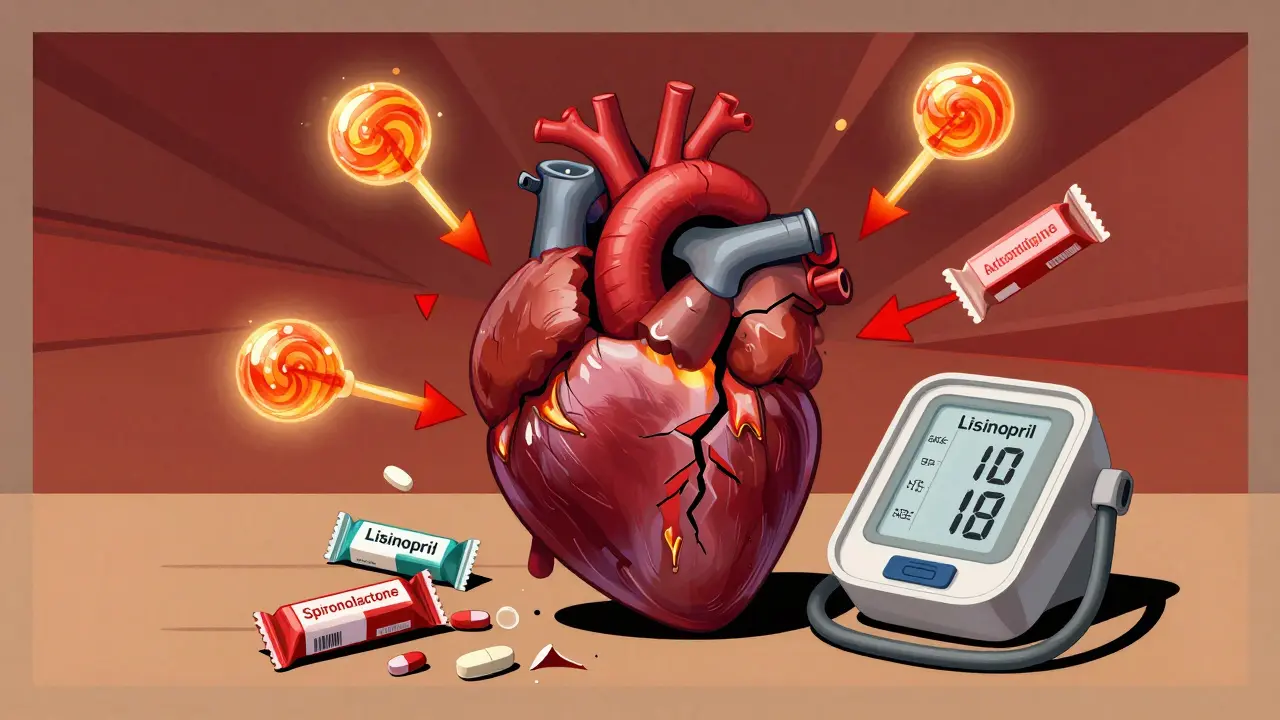
It’s not just caffeine or salt that can mess with your blood pressure meds. If you’re taking medication for high blood pressure and you’ve been sipping licorice tea, munching on black licorice candy, or popping herbal supplements labeled "licorice root," you might be quietly sabotaging your treatment - even if you feel fine.
There’s a compound in real licorice root called glycyrrhizin that doesn’t just sweeten your tea. It interferes with how your body handles sodium, potassium, and fluid balance in a way that directly cancels out the effects of most blood pressure medications. This isn’t a rare side effect. It’s a well-documented, clinically proven interaction that’s sent people to the ER - and it’s happening more often than you think.
How Licorice Root Knocks Out Your Blood Pressure Pills
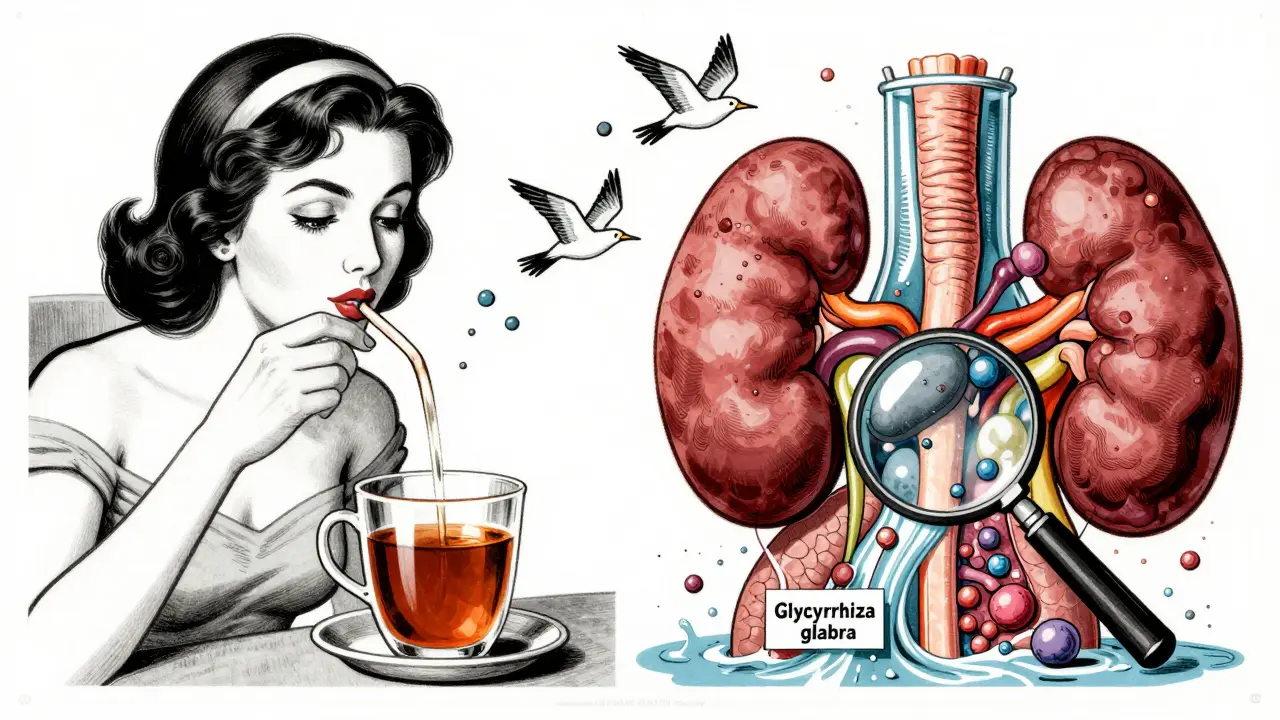
Glycyrrhizin breaks down in your body into glycyrrhetic acid, which shuts down an enzyme called 11β-hydroxysteroid dehydrogenase type 2. That enzyme normally keeps cortisol - your stress hormone - from acting like aldosterone, a hormone that tells your kidneys to hold onto salt and water. When that enzyme is blocked, cortisol starts mimicking aldosterone. Result? Your body holds onto more sodium, loses potassium, and your blood volume goes up. That’s the exact opposite of what your blood pressure meds are trying to do.
Studies show this isn’t theoretical. People consuming more than 100 mg of glycyrrhizin per day - roughly the amount in 50 grams of real licorice candy - see systolic blood pressure jump by 10 to 30 mmHg within weeks. In some cases, it spikes so high it triggers chest pain, arrhythmias, or even heart failure.
And it doesn’t matter what kind of blood pressure medicine you’re on:
- ACE inhibitors (like lisinopril): Effectiveness drops by 30-50%
- ARBs (like losartan): Effectiveness drops by about 25%
- Calcium channel blockers (like amlodipine): Control worsens by 15-20%
- Potassium-sparing diuretics (like spironolactone): Can become completely useless within 7-10 days
The problem isn’t just the sugar. It’s the chemistry.
Most "Licorice" Candy Doesn’t Have Licorice - But Some Does
Here’s where things get tricky. In the U.S., about 95% of black licorice candy you find in stores doesn’t contain real licorice root at all. It’s flavored with anise oil, which tastes similar but has zero glycyrrhizin. So if you’re eating Twizzlers or similar brands, you’re probably fine.
But if you’re buying imported licorice, herbal teas, or supplements labeled "Glycyrrhiza glabra," "licorice extract," or "licorice root," you’re getting the real thing. And that’s where the danger lies.
One 2019 case series found that 6 out of 8 patients who developed dangerous hypertension while on blood pressure meds had been consuming products they thought were just "flavored" with licorice - but the label clearly said "licorice root." They didn’t realize that "licorice" on the ingredient list meant active, dangerous glycyrrhizin.
It’s Not Just Candy - It’s Everywhere
People think they’re safe if they only eat candy occasionally. But licorice root is hiding in places you wouldn’t expect:
- Herbal cough syrups and throat lozenges
- Dietary supplements for digestion, liver health, or adrenal support
- Traditional Chinese medicine formulas (25% contain licorice root)
- Some herbal laxatives (30% contain it)
- Even certain tobacco products
A 2018 survey found that nearly one in three herbal laxatives and one in four Chinese herbal blends include licorice root - often without clear warnings. And because supplements aren’t required to list glycyrrhizin content in the U.S., you can’t tell how much you’re getting. One product might have 5 mg per serving. Another, with the same label, might have 50 mg. That’s a tenfold difference.
What Happens When You Stop?
You might think, "I’ll just stop eating licorice and my blood pressure will go back to normal." But it’s not that simple.
Glycyrrhizin has a half-life of about 14 hours, but its effects on your kidneys and hormone receptors can linger for up to two weeks after you stop. That means even if you quit cold turkey, your blood pressure might stay high for days - or even weeks - while your body clears the compound and resets its sodium balance.
That’s why some patients need to be hospitalized after they stop licorice. Their blood pressure doesn’t drop right away, and their potassium levels stay dangerously low. In one documented case, a patient’s potassium dropped to 2.8 mmol/L (normal is 3.5-5.0) after just 10 days of daily licorice tea, leading to muscle weakness, heart palpitations, and a trip to the ER.
Who’s at Risk - And Who Might Not Even Know It
You don’t have to be a licorice junkie to be at risk. A 2022 analysis found that about 1 in 8 people taking blood pressure meds who regularly consume real licorice root end up with uncontrolled hypertension severe enough to require emergency care.
It’s especially dangerous if you’re on:
- Spironolactone or eplerenone (potassium-sparing diuretics)
- Any medication that already lowers potassium
- Multiple blood pressure drugs (polypharmacy increases risk)
- Older adults (reduced kidney function makes it harder to clear glycyrrhizin)
And here’s the kicker: many people don’t realize they’re consuming it. A Reddit user posted about their blood pressure spiking from 130/80 to 185/105 after drinking licorice tea daily for two weeks. Their doctor didn’t even ask about herbal teas. They assumed it was just "flavoring."
What You Should Do Right Now
If you’re on blood pressure medication, here’s what to do:
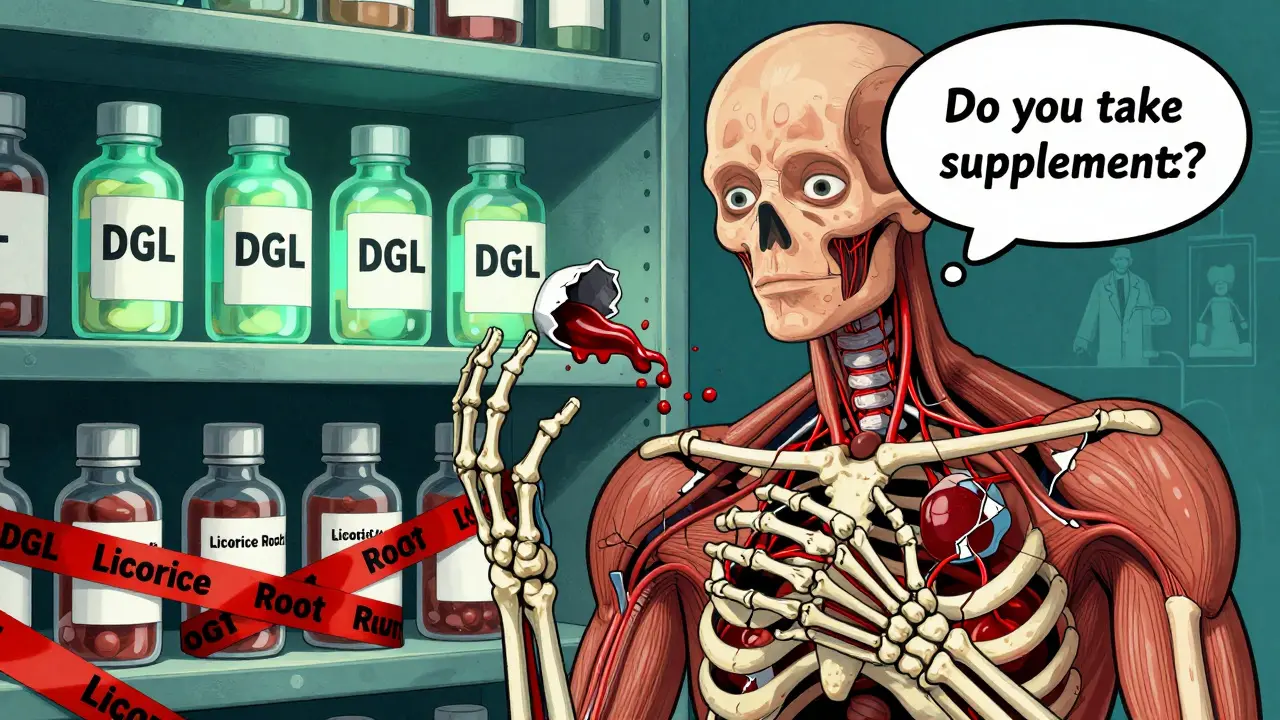
- Check every product you take. Look for "Glycyrrhiza glabra," "licorice root," or "licorice extract" on the ingredient list. If it’s there, stop using it.
- Ask your pharmacist. Bring in your supplements, teas, and cough syrups. Pharmacists can tell you if they contain glycyrrhizin - most don’t check labels unless asked.
- Switch to DGL. If you need licorice for digestive issues (it’s commonly used for heartburn or ulcers), choose deglycyrrhizinated licorice (DGL). It’s processed to remove glycyrrhizin and doesn’t affect blood pressure.
- Get your potassium checked. If you’ve been consuming licorice root in the past 30 days, ask your doctor for a serum potassium test. Levels below 3.5 mmol/L mean your body is already struggling.
- Don’t assume "natural" means safe. Just because it’s a plant doesn’t mean it won’t interfere with your meds. Licorice root is a powerful bioactive compound - not a harmless flavor.
The Bottom Line
There’s no safe amount of real licorice root if you’re taking blood pressure medication. The American Heart Association, the Merck Manual, and the European Food Safety Authority all agree: avoid it completely.
The FDA doesn’t require warning labels on licorice supplements in the U.S., so the burden is on you. Read every label. Ask questions. Don’t trust "natural" claims. And if you’ve been consuming licorice root - even once a week - talk to your doctor. Your blood pressure might be higher than you think, and your meds might be working half as hard as they should.
This isn’t about cutting out candy. It’s about protecting your heart. One small ingredient can undo months of careful treatment. Don’t let it.
Can I still eat black licorice candy if I’m on blood pressure medication?
Most black licorice candy sold in the U.S. (like Twizzlers) uses anise oil, not real licorice root, so it’s generally safe. But always check the ingredient list. If it says "licorice extract," "Glycyrrhiza glabra," or "licorice root," avoid it. Imported candies, herbal brands, or organic versions are far more likely to contain real licorice.
How long does it take for licorice to affect blood pressure meds?
Effects can show up in as little as a few days, but most people see noticeable changes in blood pressure within 1-2 weeks of daily consumption. The more you consume, the faster it happens. Some people with sensitive systems see spikes after just 3-4 days.
Is deglycyrrhizinated licorice (DGL) safe with blood pressure meds?
Yes. DGL is processed to remove glycyrrhizin - the compound that causes the interaction. It’s commonly used for stomach issues and doesn’t raise blood pressure or lower potassium. Just make sure the product clearly states "deglycyrrhizinated" on the label. Regular licorice supplements are not safe.
Can licorice root cause low potassium even if I’m not on diuretics?
Yes. Glycyrrhizin forces your kidneys to excrete potassium regardless of whether you’re on a diuretic. Studies show potassium levels can drop by 0.5-1.5 mmol/L after just a few weeks of daily use. This can cause muscle cramps, fatigue, irregular heartbeat, and even dangerous heart rhythms - even in people not taking any blood pressure meds.
Why don’t more doctors warn patients about licorice root?
Many doctors assume patients know to avoid it, or they don’t ask about herbal supplements. A 2021 study found that only 37% of supplement labels in the U.S. warn about blood pressure interactions. Patients often don’t think of licorice tea or herbal capsules as "medications," so they don’t mention them. It’s up to you to bring it up - especially if you’re taking more than one blood pressure drug.
Are there any blood pressure meds that don’t interact with licorice root?
No. All major classes of blood pressure medications - ACE inhibitors, ARBs, beta-blockers, calcium channel blockers, and diuretics - are affected by licorice root’s effects on sodium and potassium balance. Even if a drug works through a different mechanism, the fluid retention and low potassium caused by glycyrrhizin will still make it less effective.


