Counterfeit drugs and unqualified practitioners are serious threats to patient safety. One of the most effective ways to protect yourself or your organization is to verify that a pharmacist or pharmacy technician holds a valid, active license. But with 56 different regulatory bodies across the United States, knowing where and how to check can feel overwhelming. You might wonder if a quick Google search is enough, or if you need to dig deeper into official government databases.
The truth is, verifying a pharmacy license isn't just a bureaucratic checkbox; it's a critical step in ensuring healthcare quality. Whether you are a hiring manager at a hospital, a patient checking your local pharmacist's credentials, or a pharmacist expanding practice to new states, understanding the landscape of state pharmacy boards and national verification tools is essential. This guide breaks down exactly how these systems work, the differences between them, and how to use them effectively to avoid costly mistakes.
Who Regulates Pharmacists? Understanding State Pharmacy Boards
In the United States, there is no single federal agency that issues pharmacy licenses. Instead, regulation happens at the state level. Each of the 50 states, plus the District of Columbia, Puerto Rico, Guam, and the U.S. Virgin Islands, has its own State Pharmacy Board, which is a regulatory agency established by state legislation to oversee pharmacy practice within its jurisdiction. The first such board was created in Massachusetts in 1878, setting a precedent for public protection through professional oversight.
Today, these 56 boards collectively regulate approximately 350,000 pharmacists and 300,000 pharmacy technicians. Their primary mandate is simple but vital: protect public health. They do this by enforcing standards of competence, ethics, and legal compliance. If a pharmacist prescribes incorrectly, sells controlled substances illegally, or practices without a license, the state board is the entity responsible for investigating and disciplining them.
Because each board operates under its own state laws, the rules can vary significantly. For example, continuing education requirements, application fees, and even the specific titles for license types differ from one state to another. Maryland charges between $150 and $542 for initial licensure, while the District of Columbia charges a flat $355. These variations mean that a license valid in Texas does not automatically grant practice rights in California, making verification a multi-step process for many professionals.
How to Check a License on State Board Websites
For the most authoritative information, you should always go directly to the source: the state board’s official website. Most boards have transitioned to online verification systems. According to the National Association of Boards of Pharmacy (NABP), 48 of the 56 jurisdictions offer web-based license lookups. This makes it easier than ever to confirm a practitioner's status, but you need to know what you are looking for.
Here is a general step-by-step process for using a state board’s verification tool:
- Find the Official Site: Search for "[State Name] Board of Pharmacy" and ensure you are on a .gov domain. Beware of third-party sites that may charge fees for free information.
- Locate the Verification Section: Look for links labeled "License Lookup," "Verify a License," or "Public Registry."
- Enter Search Criteria: Most systems require at least one identifier. Common options include the licensee’s full name, license number, or profession type (e.g., Pharmacist, Technician, Intern).
- Review the Results: Pay close attention to the status. A license can be "Active," "Suspended," "Revoked," "Probation," or "Expired."
- Check Disciplinary History: Many state portals link to disciplinary actions. This section reveals past violations, fines, or restrictions on practice.
Let’s look at Maryland as an example. Their system allows searching by 11 different criteria, including city and zip code. However, they warn that "less is more"-entering too many filters can sometimes yield no results if there’s a minor data mismatch. In contrast, the District of Columbia’s system requires either the complete license number or the full first and last name, warning that partial information leads to inaccurate results.
A crucial limitation of state websites is that they only show licenses issued by that specific state. If a pharmacist holds licenses in five different states, you must visit five different websites to get the full picture. This fragmentation is where national tools become valuable.
NABP Verify: The National Alternative
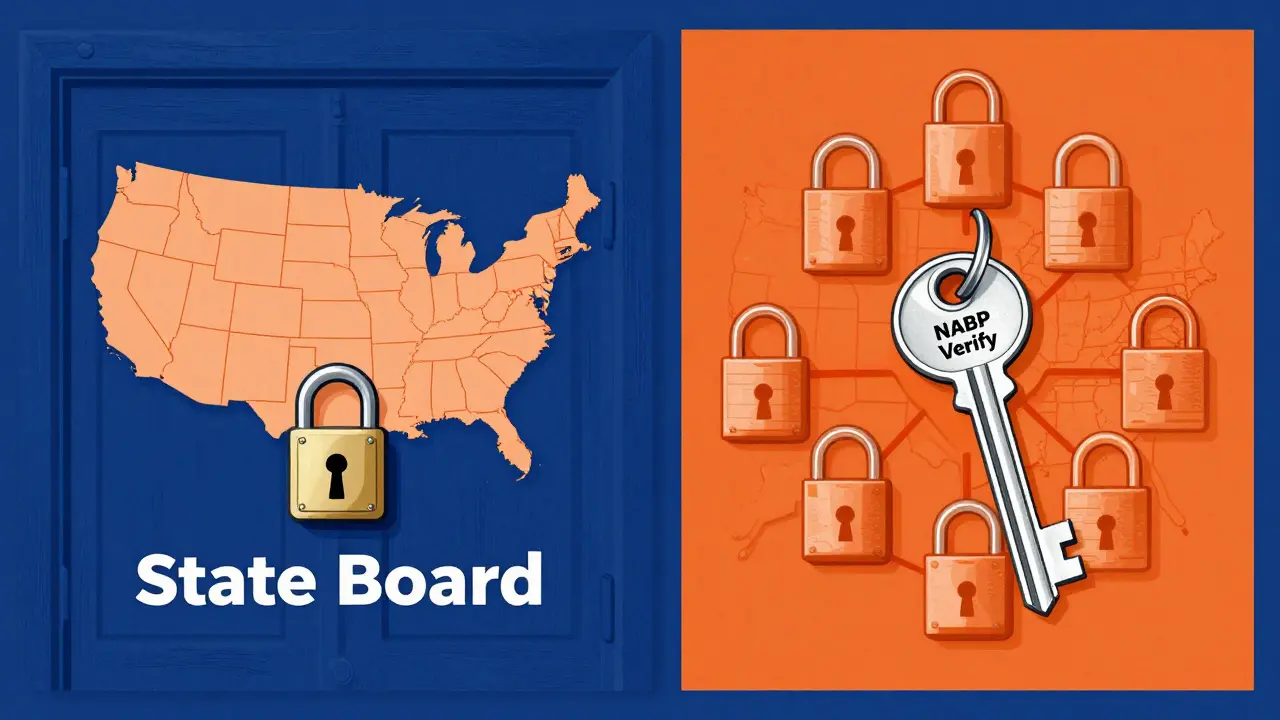
To address the complexity of multi-state practice, the National Association of Boards of Pharmacy (NABP) offers a centralized credentialing service called NABP Verify that monitors license status across participating states. Launched in 2000 and expanded significantly in recent years, NABP Verify provides a single dashboard for tracking multiple licenses.
Why use NABP Verify instead of just checking state sites?
- Cross-State Monitoring: It aggregates data from 68% of regulatory boards that participate in the License Verification Exchange (LVE). This means you can see if a practitioner is licensed in Ohio, Florida, and New York all in one place.
- Digital Badges: Practitioners can share a digital badge that visually certifies their compliance, which is useful for employers and patients who want quick visual confirmation.
- Ongoing Alerts: Unlike a one-time state check, NABP Verify offers ongoing monitoring. If a license is suspended or revoked in any participating state, subscribers receive alerts.
However, there is a catch. NABP Verify costs $59 annually. For individuals or small pharmacies doing occasional checks, this might not be cost-effective compared to free state lookups. Additionally, while NABP is highly reliable, the state board remains the legal authority. In disputes or legal proceedings, the state record is the final word.
| Feature | State Board Website | NABP Verify |
|---|---|---|
| Cost | Free | $59/year |
| Coverage | Single State Only | Multi-State (Participating Boards) |
| Legal Authority | Primary Source (Official) | Secondary Source (Aggregated) |
| Update Speed | Varies (Often 7-14 days lag) | Dependent on State Reporting |
| Best For | Patient checks, Single-state hires | Hospitals, Multi-state practitioners |
The Problem with Real-Time Data and Delays
One of the biggest frustrations with license verification is the lack of real-time accuracy. Dr. Susan Cornell, a pharmacy law expert, has noted that state board systems often lack immediate updates, creating dangerous gaps where a practitioner might appear licensed when they are actually under investigation.
Data shows that pharmacy boards have a slower update cycle for disciplinary actions compared to medical boards. On average, it takes 14.3 days for a pharmacy board to update a disciplinary status, versus 12.4 days for medical boards. While this seems like a small difference, in high-stakes healthcare environments, those days matter.
User experiences reflect this frustration. On Reddit’s r/pharmacy community, users have reported delays of up to three weeks for new license statuses to appear after passing exams. Conversely, some states like D.C. are praised for efficiency, with verification letters issued in two business days. When relying on these systems, always keep in mind that the database is a snapshot in time, not a live feed.

Practical Tips for Accurate Verification
To ensure you are getting accurate information, follow these best practices:
- Use Full Names: Middle initials and maiden names can cause search failures. If you don’t find a match, try variations of the name.
- Check Multiple Sources: For critical hires, verify via the state board and cross-reference with NABP if possible.
- Look Beyond "Active": An "Active" status doesn’t guarantee clean history. Always click through to view disciplinary records.
- Beware of Grace Periods: Some states allow licenses to remain "Active" during renewal grace periods. Confirm the expiration date explicitly.
- Contact the Board Directly: If the online system is unclear or outdated, call the board. Maryland, for instance, offers telephone support during business hours for complex queries.
Employers are increasingly adopting strict policies. The American Pharmacists Association (APhA) recommends verifying licenses directly through state boards prior to employment, rather than relying solely on third-party services. In fact, 78% of hospitals now require primary source verification through state boards.
Future Trends: Compacts and Technology
The landscape of pharmacy licensing is evolving. The Interstate Pharmacy Licensure Compact (IPLC), operational since 2017, now includes 23 participating states. This compact streamlines verification for practitioners who move or practice across state lines, allowing a single license to be recognized in multiple jurisdictions.
Technologically, we are moving toward greater interoperability. The NABP Horizon Report predicts that 90% of state boards will implement real-time verification updates by 2025, aiming to reduce the current 7-14 day lag. Additionally, cybersecurity is becoming a priority, with reports showing a 22% increase in attacks on state health agency databases in 2022. As these systems digitize further, protecting the integrity of license data will be paramount.
For now, the combination of diligent state board checks and awareness of national tools like NABP Verify remains the gold standard. By understanding these resources, you play a direct role in maintaining the safety and integrity of the pharmaceutical supply chain and patient care.
Is it free to verify a pharmacy license?
Yes, verifying a pharmacy license through official state board websites is almost always free. However, national services like NABP Verify charge an annual fee (currently $59) for multi-state monitoring and digital badges.
How long does it take for a license status to update?
Update times vary by state. On average, disciplinary actions take about 14.3 days to reflect in state databases. New license activations can take anywhere from a few days to three weeks depending on the board's processing speed.
Can I verify a pharmacy technician's license?
Yes, state boards regulate both pharmacists and pharmacy technicians. You can search for technicians using the same public lookup tools, selecting "Pharmacy Technician" as the profession type. NABP also plans to expand its Verify service to include technicians.
What is the Interstate Pharmacy Licensure Compact?
The IPLC is an agreement among 23 participating states that allows pharmacists to practice in multiple states with a single license. It simplifies verification for multi-state practitioners but requires the home state to be part of the compact.
Why should I check NABP instead of just the state board?
If a practitioner works in multiple states, checking each state board individually is time-consuming. NABP Verify aggregates data from participating boards, offering a centralized view of a practitioner's licensing status across jurisdictions.