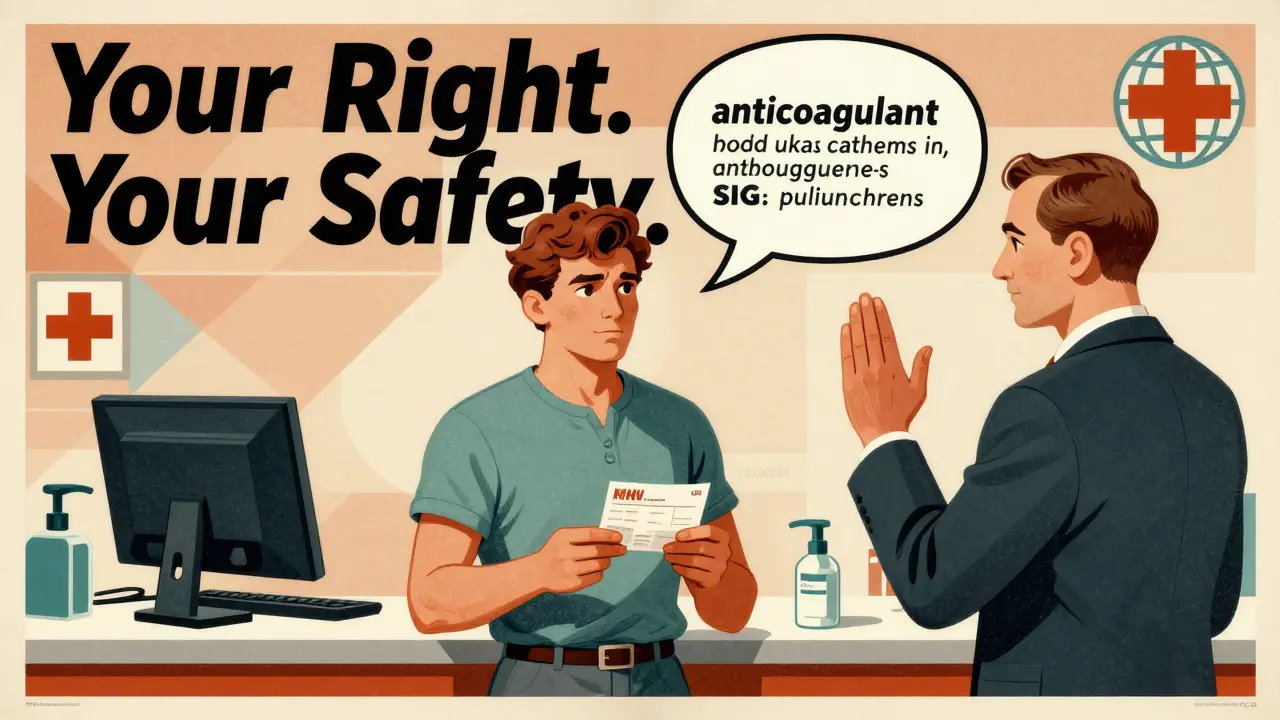
When you or a loved one gets a new prescription, understanding how to take it correctly isn’t just helpful-it’s life-saving. But if English isn’t your first language, you might not fully hear or understand what the pharmacist is telling you. That’s where professional translator services come in. By law, pharmacies that accept federal funds must provide free language assistance during medication counseling. This isn’t optional. It’s not a favor. It’s a legal requirement under the Affordable Care Act and the Civil Rights Act.
Why Language Help Matters for Medications
A 2012 study from the University of California, San Francisco found that patients with limited English proficiency (LEP) experience medication errors at three times the rate of English-speaking patients when no interpreter is used. These errors aren’t minor. They can mean taking too much, too little, or mixing drugs that shouldn’t be taken together. One wrong dose of blood pressure medicine or insulin can land someone in the hospital-or worse. The problem isn’t just about speaking the same language. It’s about medical terms. Words like “anticoagulant,” “adverse reaction,” or “take on an empty stomach” don’t translate easily. Even someone who speaks fluent English might not know what “SIG: one tablet by mouth twice daily” means. That’s why trained medical interpreters are required-not just anyone who speaks two languages.What the Law Says About Interpreter Services
Section 1557 of the Affordable Care Act (2010) makes it clear: if a pharmacy gets federal money-which includes most chain pharmacies, Medicaid providers, and many independent ones-they must offer free language services. This includes both spoken interpreters and translated written materials. The law doesn’t allow pharmacies to charge patients for these services. It also bans using family members, friends, or untrained staff as interpreters during medication counseling. In 2022, a national pharmacy chain paid $1.2 million in penalties after the federal government found they were routinely skipping interpreter services. That’s not an isolated case. Since 2016, the Office for Civil Rights has settled 47 language access violations in healthcare, and enforcement is growing. California’s SafeRx program goes even further: pharmacists there must use an interpreter-either in person or over the phone-during every prescription counseling session, free of charge.How to Ask for an Interpreter
You don’t have to wait for the pharmacist to offer. You can-and should-ask directly. Here’s how:- When you’re handed your prescription, say: “I need a professional interpreter to explain how to take this medication.”
- If they offer to use your child, spouse, or a coworker, say: “I understand, but I need a trained medical interpreter. It’s my right under federal law.”
- Ask: “Do you have phone, video, or in-person interpreter services?”
- Don’t leave until you’re sure you understand the instructions. If you’re still unsure, ask them to repeat it or show you a translated handout.
Pharmacies are required to have access to interpreters in at least 10 languages, and many offer 50+ through services like RxTran. If they say they don’t have one, ask them to call immediately. Most telephonic services connect within 30 seconds.
Types of Interpreter Services Available
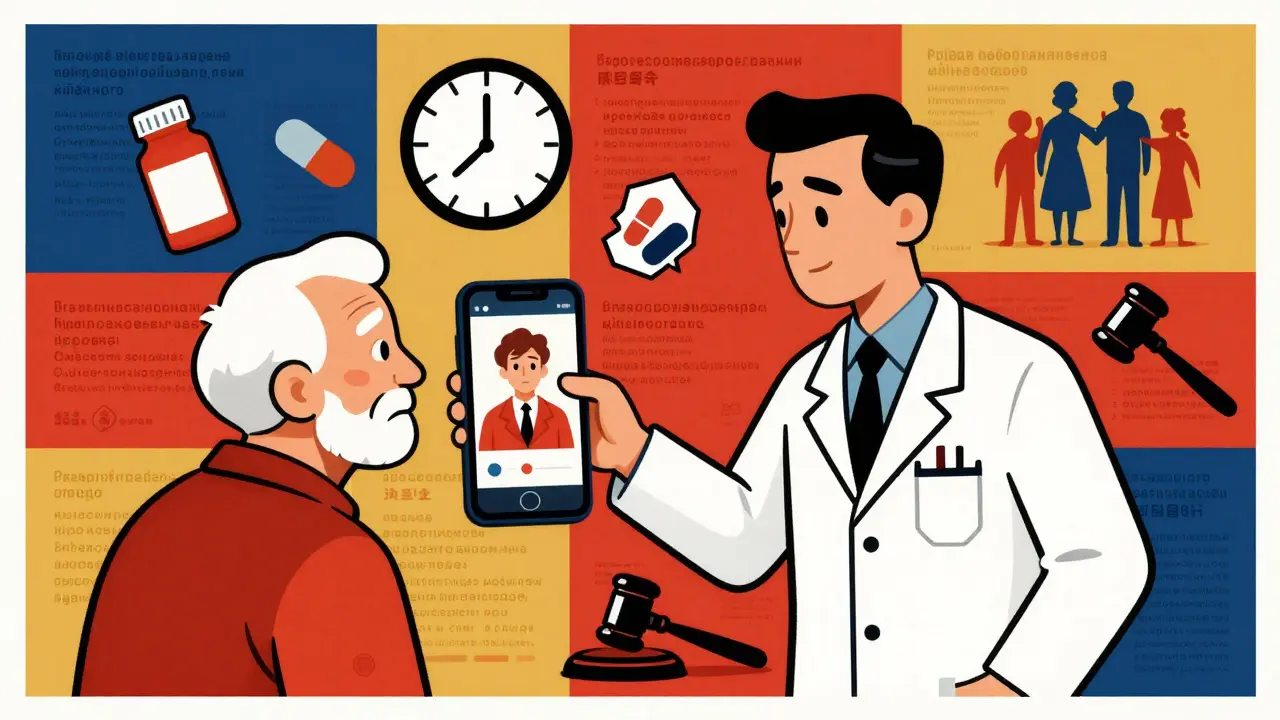
There are three main ways pharmacies provide interpretation:- Phone interpreting: Fast, cheap, and available 24/7. Costs about $2.50-$3.50 per minute. Good for simple instructions. But older patients or those with hearing issues often struggle with phone-only communication.
- Video interpreting: You see the interpreter on a screen. This helps with nonverbal cues-like pointing to a pill bottle or showing hand gestures for dosage. Costs $3-$5 per minute. Used by 65% of healthcare facilities as of 2023.
- In-person interpreters: The gold standard. Especially useful for complex medications, multiple drugs, or patients with cognitive issues. Costs $45-$75 per hour. Only practical in larger cities or hospitals.
California has standardized translated instructions (called SIGs) for five languages: Spanish, Chinese, Korean, Russian, and Vietnamese. These are printed right on the label. But even those aren’t perfect. A 2022 state report found that Russian-speaking patients often found dosage instructions confusing because the grammar didn’t match how medical terms are structured in Russian.
What Makes an Interpreter Qualified?
Not every bilingual person is qualified to interpret medical instructions. The American Translators Association says a professional medical interpreter must:- Complete at least 40 hours of specialized medical training
- Pass a certification exam
- Understand medical terminology in both languages
- Follow strict confidentiality rules
A 2022 University of Arizona study found that only 12% of pharmacy staff who called themselves “bilingual” could correctly translate basic medication terms like “take with food” or “do not crush.” That’s why using family members is so dangerous. A 2021 JAMA Pediatrics study showed that using untrained interpreters increases the risk of serious medication errors by 49%.
What to Do If the Pharmacy Refuses
If a pharmacy refuses to provide an interpreter, you have options:- Ask to speak with the pharmacist in charge or the store manager.
- Call the pharmacy’s corporate customer service line and ask for a supervisor.
- File a complaint with the U.S. Department of Health and Human Services (HHS) Office for Civil Rights. You can do this online at ocrportal.hhs.gov.
- If you’re on Medicaid or Medicare, contact your state’s Medicaid office-they can intervene on your behalf.
Don’t be afraid to speak up. In 2023, a CVS internal survey showed that 67% of pharmacy techs tried to handle LEP patients without interpreters when busy. That’s not just bad service-it’s illegal. You’re not being difficult. You’re protecting your health.

What Pharmacists Need to Know
If you’re a pharmacist or pharmacy staff, here’s how to do it right:- Use a standardized question to identify language needs: “What language do you speak at home?”
- Access an interpreter through an approved vendor-phone, video, or in-person. Don’t rely on Google Translate or untrained staff.
- Document the service: Record the language requested, the type of interpreter used, the duration, and confirm the interpreter’s qualifications.
- Use billing code T-1013 for interpreter services when filing claims with Medicaid. This code lets you get reimbursed up to 75% for services provided to children in non-English households.
Training takes only 2-4 hours. Most pharmacies now use RxTran, Language Line, or similar services that offer pre-translated patient handouts and SIGs. California’s system, which includes translated warning labels for common drugs like warfarin and metformin, is a model others are trying to copy.
What’s Changing in 2025 and Beyond
New rules took effect on January 1, 2025: AI tools like Google Translate or ChatGPT can no longer be used to translate prescription labels or medication instructions-even if they seem accurate. Human review is mandatory. This is because machine translation often misses nuance, like the difference between “take once daily” and “take every 24 hours.” California is expanding its translated labels to include Tagalog and Arabic, responding to growing populations in Los Angeles and the Bay Area. Meanwhile, Medicaid enrollment for LEP patients hit 11.3 million in early 2024, up from 8.9 million in 2020. That’s driving more enforcement. Smaller pharmacies are struggling. Nearly half say they can’t afford full-time interpreters. But they don’t need to. Telephonic services cost less than a cup of coffee per patient. The real barrier isn’t money-it’s awareness.Final Tips for Patients
- Never accept “I’ll just write it down” if you don’t understand. Writing doesn’t fix confusion. - Bring a list of all your medications, even over-the-counter ones, to every visit. - Ask for a printed copy of the translated instructions. Keep it with your pill bottle. - If you’re helping an elderly parent or relative, insist on an interpreter-even if they say they “get by.” - If you’re unsure whether your pharmacy is compliant, call your state’s Board of Pharmacy. They track compliance.Medication counseling isn’t just about handing out pills. It’s about making sure you know how to use them safely. Language shouldn’t be a barrier to that. You have the right to understand. And the pharmacy has the legal duty to make sure you do.


