
The FDA doesn't just wait for reports to roll in; they use a multi-layered strategy that blends "passive" reporting (waiting for doctors to tell them) and "active" surveillance (digging into healthcare data). If you've ever wondered why a drug's label suddenly gets a new "black box warning" years after it was released, you're seeing this system in action. Here is exactly how the process works from the moment a drug leaves the lab and enters your pharmacy.
The Safety Net: How FAERS Works
At the heart of the FDA's strategy is the FDA Adverse Event Reporting System or FAERS, a massive database that tracks side effects and medication errors reported by the public and healthcare providers. Think of FAERS as a giant digital suggestion box for safety. Since 1969, it has collected over 30 million reports. While it's the primary tool for spotting new risks, it relies heavily on people choosing to report issues.
Most of the data in FAERS comes from spontaneous reports-meaning a doctor or patient noticed something and decided to flag it. However, this creates a gap called "underreporting." A 2023 study in JAMA Network Open pointed out that these systems often catch only 1% to 10% of actual adverse events. To make sense of this mountain of data, the FDA uses a tool called InfoViP a decision-support software that uses machine learning and natural language processing to filter out noise and identify true safety signals. This helps experts quickly spot patterns, like a sudden spike in liver issues among patients taking a specific blood pressure medication.
Active Surveillance and the Sentinel Initiative
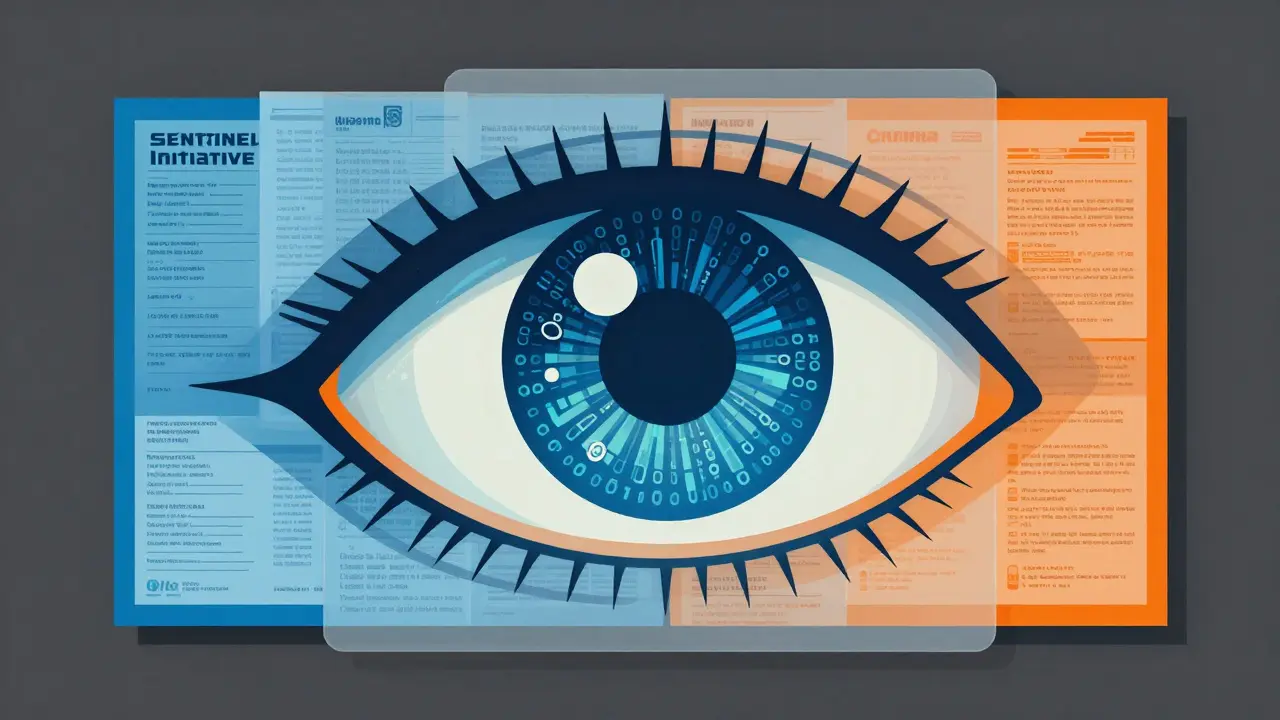
Because passive reporting has holes, the FDA launched the Sentinel Initiative a proactive surveillance system that queries electronic health records and insurance claims to monitor drug safety in near real-time. Instead of waiting for a doctor to send a report, the FDA can essentially "ask" a database of over 300 million patients if a certain drug is linked to a specific health event.
This shift from reactive to proactive is a game-changer. For example, if the FDA suspects a drug is causing rare heart valve issues, they don't have to hope a cardiologist reports it. They can run a query across massive datasets to see if there's a statistically significant increase in heart valve failures among users of that drug compared to non-users. This is significantly faster and more accurate than old-school reporting. By 2030, experts predict that 75% of safety signals will be caught this way, compared to just 35% today.
What Happens When a Safety Signal Is Detected?
When the FDA sees a pattern-a "safety signal"-they don't just panic and pull the drug. They trigger a rigorous, interdisciplinary review. A team of 15 to 20 experts, including epidemiologists, statisticians, and pharmacologists, dives into the data to determine if the drug actually caused the event or if it was just a coincidence.
Depending on what they find, the FDA takes a few different paths. They might request a label change to add a new warning, or they might implement a Risk Evaluation and Mitigation Strategy or REMS, a specialized program for high-risk drugs that requires extra steps, like mandatory patient registries or specialized physician certification, to ensure safe use. As of 2024, about 78 drugs are under REMS programs, protecting roughly 20 million patients annually. In extreme cases, if the risks outweigh the benefits, the medication is withdrawn from the market entirely.
Manufacturer Obligations and Legal Requirements
The burden of safety isn't just on the government. Pharmaceutical companies are legally required to keep a close eye on their products. Under federal regulations, manufacturers must report any serious and unlabeled adverse events to the FDA within 15 days.
The FDA also often mandates "postmarketing studies" as a condition for approval. These are essentially "Phase 4" trials that happen while the drug is already being sold. However, this isn't always a smooth process. A 2021 assessment in JAMA Internal Medicine found that only 58% of these required studies were finished on time, with some delays stretching over three years. To fight the "file drawer problem"-where companies might hide negative data-the FDA requires Periodic Safety Update Reports (PSURs) every 6 to 12 months.
Comparing the FDA's Approach to Global Standards
The US isn't the only player in the game. The European Medicines Agency (EMA) and Health Canada have their own systems, and while they share goals, the methods differ. The FDA's Sentinel system is generally considered more advanced in terms of raw data access than the EMA's EU-ADR project.
| Feature | FDA (United States) | EMA (European Union) |
|---|---|---|
| Primary Database | FAERS | EudraVigilance |
| Active Surveillance | Sentinel (300M+ patients) | EU-ADR (~100M patients) |
| Serious Event Reporting | 15-day mandatory window | 15 days (unexpected), 90 days (expected) |
| Review Process | Internal interdisciplinary teams | Heavy reliance on external committees |
The Real-World Struggle: Why Reporting Fails
Despite the high-tech tools, the system has a human problem. Doctors are exhausted. Many oncologists and specialists report that the process of filing a MedWatch report feels disconnected from their actual clinical workflow. When a doctor is seeing 20 patients a day, taking 17 minutes to fill out a form for one side effect feels like an eternity.
Patients are even less likely to report. Only about 6% of FAERS reports come directly from consumers. Many people simply don't know where to go or assume their doctor already handled it. This creates a "blind spot," especially for rare diseases. If a drug is used by only 10,000 people, it takes much longer to spot a pattern-sometimes nearly five years-compared to a block-buster drug used by millions, where a signal can be spotted in about two years.
The Future of Safety: AI and Genomics
The FDA is moving toward a future where safety monitoring is almost invisible and instantaneous. The recently launched Sentinel 2.0 initiative is incorporating genomic data from 10 million patients. This means the FDA could eventually tell you, "This drug is safe for most people, but based on your specific DNA, you have a 20% higher risk of a skin rash," before you even take the first pill.
We're also seeing a push toward blockchain-based reporting to make the data more transparent and harder to manipulate. With the explosion of complex biologics and gene therapies-which are growing at 40% year-over-year-the old way of waiting for a phone call from a doctor won't work. The system is evolving from a "warning light" that goes off after the crash into a "collision avoidance system' that prevents the crash from happening in the first place.
What is a safety signal in drug monitoring?
A safety signal is a reported piece of information on a possible causal relationship between an adverse event and a drug. It's not a proven fact yet, but a "red flag" that prompts the FDA to start a formal scientific investigation to see if the drug is actually causing the problem.
How can I report a side effect to the FDA?
The easiest way for patients and providers to report is through the MedWatch program. You can submit a report online via the FDA's website, by mail, or by phone. Reporting helps the FDA identify risks that weren't caught during clinical trials.
What is the difference between passive and active surveillance?
Passive surveillance (like FAERS) relies on people voluntarily reporting side effects. Active surveillance (like the Sentinel Initiative) involves the FDA proactively searching through electronic health records and insurance claims data to find patterns without waiting for a report.
Does the FDA always pull a drug if a side effect is found?
No. The FDA weighs the risks against the benefits. If a drug saves lives but causes a mild side effect in 1% of people, they will likely just update the warning label. They only withdraw a drug if the risk of harm outweighs the clinical benefit it provides to the population.
What is a REMS program?
A Risk Evaluation and Mitigation Strategy (REMS) is a special safety plan the FDA requires for certain medications with serious safety concerns. This might include requiring doctors to be specially certified to prescribe the drug or requiring patients to undergo regular blood tests while taking it.


