Combination Therapy Risk Assessor
Your Situation
Risk Assessment
Key Risks Identified:
Recommendation:
Click "Assess My Risk" to see personalized recommendations
Understanding the Science
Why Combination Often Fails:
- PPIs suppress 90-98% of acid production
- H2 blockers need histamine activity to work
- With PPIs active, minimal histamine remains
- Result: Diminishing returns with added risks
When It Might Be Appropriate:
- Documented nocturnal acid breakthrough
- Failed twice-daily PPI therapy
- Confirmed by 24-hour pH monitoring
- Temporary use (4-8 weeks) under supervision
It’s a quiet Tuesday morning in the hospital pharmacy. A nurse hands you two pills for your stomach pain: one is a proton pump inhibitor (PPI), like omeprazole, and the other is an H2 blocker, like famotidine. You pop them both down without thinking. It feels like extra insurance against heartburn, right? But what if that “extra insurance” is actually working against you?
You are not alone. Roughly 15% to 20% of hospitalized patients receive this exact combination every day. In the U.S., this practice costs the healthcare system about $1.5 billion annually in unnecessary spending. More importantly, recent data suggests that taking these two powerful acid-suppressing drugs together might do more harm than good for most people. Let’s look at why this happens, who it affects, and when-if ever-it makes sense.
How These Medications Actually Work
To understand why mixing them is tricky, you first need to see how they fight acid differently. They don’t just take turns; they attack the problem from different angles, but their timing clashes.
Proton pump inhibitors (PPIs) are the heavy hitters. Drugs like omeprazole (Prilosec) or pantoprazole (Protonix) irreversibly block the H+/K+ ATPase proton pump-the final step in acid production. Think of it as turning off the faucet completely. However, PPIs only work on active pumps. Since new pumps are created constantly, it takes 2 to 5 days for a PPI to reach its full effect. Once there, though, it suppresses acid by 90% to 98% for a full 24 hours.
H2 blockers (like cimetidine/Tagamet or famotidine/Pepcid) work faster but last shorter. They block histamine receptors on gastric parietal cells, which tells the stomach to stop making acid. This cuts acid secretion by about 50% to 70%. The kick-in time is quick-within an hour-but the effect wears off in 6 to 12 hours.
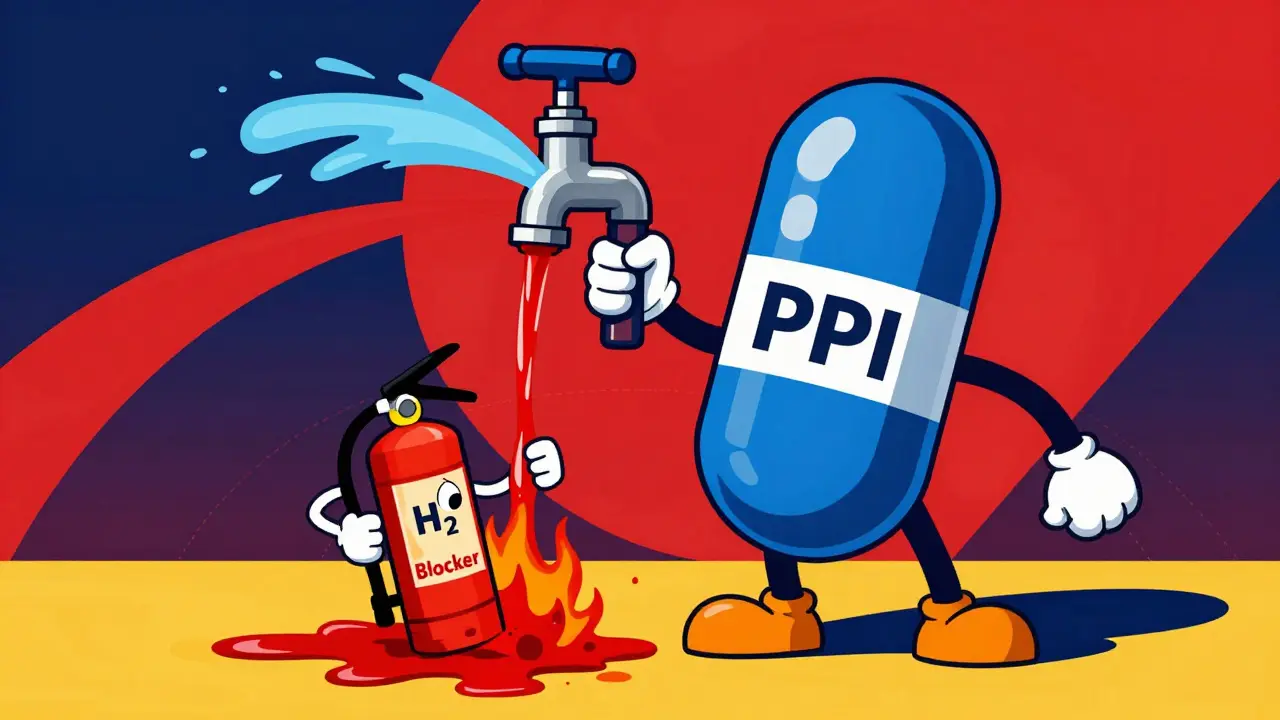
Here is the catch: H2 blockers need some histamine activity to be effective. When a PPI has already shut down nearly all acid production, there is very little histamine stimulation left for the H2 blocker to target. It’s like bringing a fire extinguisher to a room where the fire has already been put out by a flood. The result? Diminishing returns.
| Feature | PPIs (e.g., Omeprazole) | H2 Blockers (e.g., Famotidine) |
|---|---|---|
| Mechanism | Ireversibly blocks proton pumps | Competitively blocks histamine H2 receptors |
| Onset of Action | 2-5 days for max effect | Within 1 hour |
| Duration | 24-hour suppression | 6-12 hours |
| Acid Reduction | 90-98% | 50-70% |
| Best For | Severe GERD, erosive esophagitis | Mild-moderate heartburn, nocturnal symptoms |
The Hidden Risks of Combination Therapy
When doctors prescribe both, they often hope for better control over stubborn nighttime heartburn. But the science says otherwise. A landmark study published in JAMA Internal Medicine analyzed nearly 80,000 ICU patients and found that using PPIs was associated with a 30% higher risk of hospital-acquired pneumonia compared to using H2 blockers alone. The risk of Clostridium difficile infection also jumped by 32%.
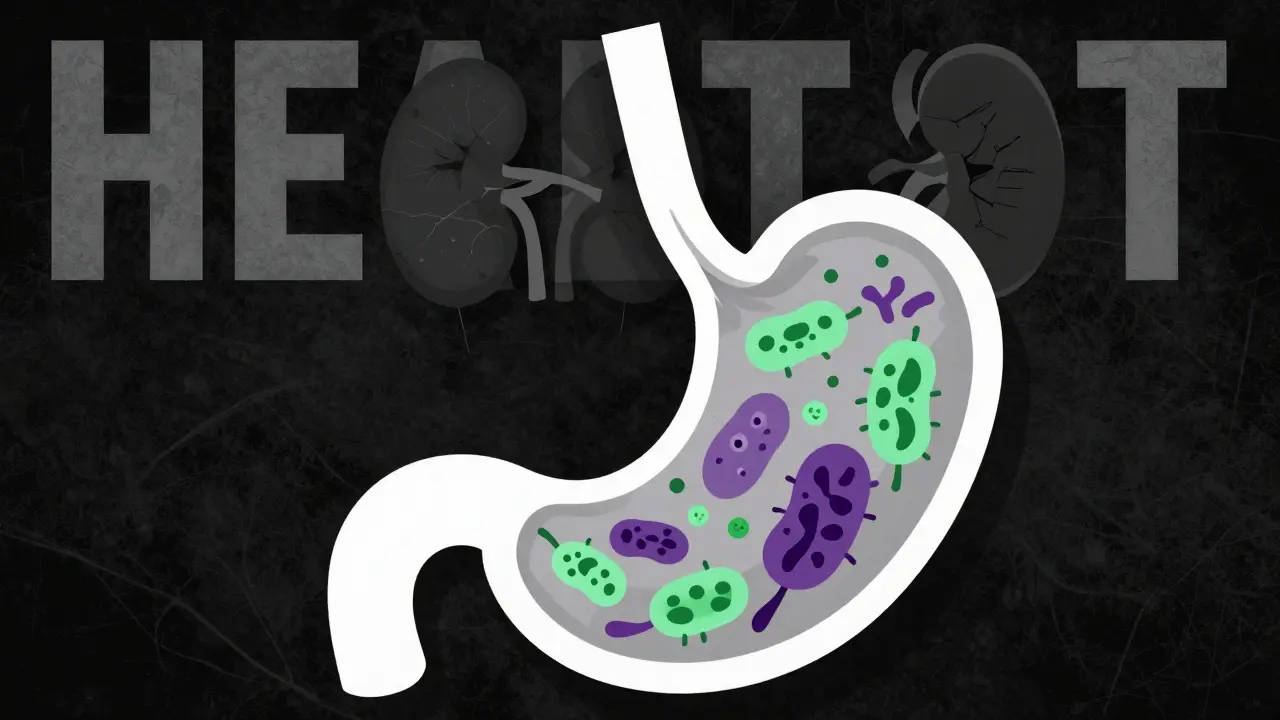
Adding an H2 blocker to a PPI doesn’t necessarily double these risks, but it does keep your stomach environment overly alkaline for longer periods. Stomach acid isn’t just for digestion; it’s a barrier against bacteria. When you neutralize it too much, pathogens can survive and multiply. This is particularly dangerous for elderly patients or those with weakened immune systems.
Another concern is kidney health. A 2021 study in BMC Nephrology followed over 3,600 patients with chronic kidney disease. Those on PPIs had a 28% higher risk of progressing to end-stage kidney disease compared to those on H2 blockers. While the study didn’t isolate combination therapy specifically, the cumulative stress on renal function from long-term, high-dose acid suppression is a valid worry.
Drug Interactions You Should Know
Not all H2 blockers behave the same way. Older agents like cimetidine (Tagamet) are notorious for interfering with liver enzymes called cytochrome P450. These enzymes break down many common medications, including blood thinners, anti-seizure drugs, and certain antidepressants. If cimetidine slows down these enzymes, levels of those other drugs can build up to toxic levels in your body.
Newer H2 blockers like famotidine (Pepcid) and nizatidine have much less impact on these enzymes, making them safer companions if you must combine therapies. However, even with famotidine, adding it to a PPI adds another pill to your daily routine, increasing the chance of missed doses or accidental overdoses.
Consider this scenario: You’re taking warfarin for blood thinning. Your doctor adds a PPI for your ulcers. Then, seeing your heartburn persist, they add cimetidine. Suddenly, your INR (a measure of blood clotting time) spikes because cimetidine is blocking the breakdown of warfarin. You’re now at high risk for bleeding. This is a real, documented interaction that clinicians watch closely.
When Is Combination Therapy Actually Appropriate?
Is there any place for using both? Yes, but it’s narrow. The American College of Gastroenterology (ACG) guidelines state that combination therapy should only be considered for patients with documented nocturnal acid breakthrough. This means you’ve tried twice-daily PPIs, followed instructions perfectly, and still wake up with burning chest pain.
Even then, it’s not a free pass. Doctors should confirm this diagnosis with 24-hour pH monitoring showing intragastric pH below 4 for more than 60 minutes between midnight and 6 AM. If confirmed, a low-dose H2 blocker might be added temporarily-usually for 4 to 8 weeks-to see if it helps sleep quality. If symptoms don’t improve, the H2 blocker should be stopped immediately.
For everyone else-those with mild reflux, occasional indigestion, or standard GERD-combination therapy offers no proven benefit. In fact, the AGA Institute explicitly recommends against routine use, noting that the marginal gain doesn’t justify the cost or side effects.
What Patients Are Experiencing
Real-world feedback paints a clear picture. On patient forums like Reddit’s r/GERD community, discussions around “PPI dependence” are frequent. About 42% of users report difficulty stopping PPIs after long-term use, experiencing rebound hyperacidity when they try to quit. Adding an H2 blocker can sometimes mask this rebound, creating a cycle where patients feel they need both drugs forever.
A survey by the ACG found that 31% of patients on combination therapy didn’t know why they were taking two medications. Another 64% couldn’t name potential side effects. This knowledge gap is dangerous. Common complaints include headaches (reported by 23% of PPI users), diarrhea (18%), and vitamin deficiencies (12%), particularly magnesium, calcium, and B12, which require acid for proper absorption.
Steps to Safer Acid Suppression
If you’re currently taking both, don’t stop abruptly. Instead, follow this plan:
- Talk to your doctor. Ask specifically: “Do I truly need both of these?” Request a review of your original diagnosis and current symptoms.
- Try stepping down. Under medical supervision, you might switch to once-daily PPI, then alternate-day dosing, before trying an H2 blocker alone.
- Monitor for rebound. If you stop a PPI, expect worse heartburn for a few weeks. This is normal. Use antacids (like Tums) sparingly during this transition, not more acid suppressors.
- Check for triggers. Often, lifestyle changes-losing weight, elevating the head of your bed, avoiding late meals-are more effective than adding a second drug.
- Schedule a ‘PPI time-out.’ The VA guidelines suggest reassessing need every 90 days. Write this reminder in your calendar.
The Bottom Line
H2 blockers and PPIs are powerful tools, but they aren’t meant to be used together casually. The evidence shows that for most people, combining them provides minimal extra relief while increasing risks of infection, kidney strain, and drug interactions. Save the combination for severe, documented cases under close specialist care. For everyday heartburn, simpler, safer options usually work better.
Can I take famotidine and omeprazole together safely?
Generally, yes, but only if prescribed by a doctor for specific reasons like nocturnal acid breakthrough. For most people, taking both offers little extra benefit and increases side effect risks. Famotidine is safer than older H2 blockers like cimetidine due to fewer drug interactions.
Why do doctors prescribe both H2 blockers and PPIs?
Historically, doctors believed combining mechanisms would provide superior acid control. Today, this practice persists due to habit or lack of updated guidelines, despite evidence showing limited efficacy and higher risks for infections and kidney issues.
What are the biggest side effects of long-term PPI use?
Long-term PPI use is linked to increased risks of Clostridium difficile infection, pneumonia, bone fractures, and deficiencies in magnesium, calcium, and vitamin B12. It may also contribute to chronic kidney disease progression.
How do I know if I have nocturnal acid breakthrough?
You likely have nocturnal acid breakthrough if you experience waking up with heartburn despite taking a PPI twice daily. Confirmation requires 24-hour pH monitoring showing low stomach pH levels during sleep hours.
Is cimetidine safer than famotidine when taken with other drugs?
No. Cimetidine inhibits liver enzymes (cytochrome P450), leading to dangerous interactions with many medications. Famotidine has minimal effect on these enzymes and is generally safer for combination therapy.