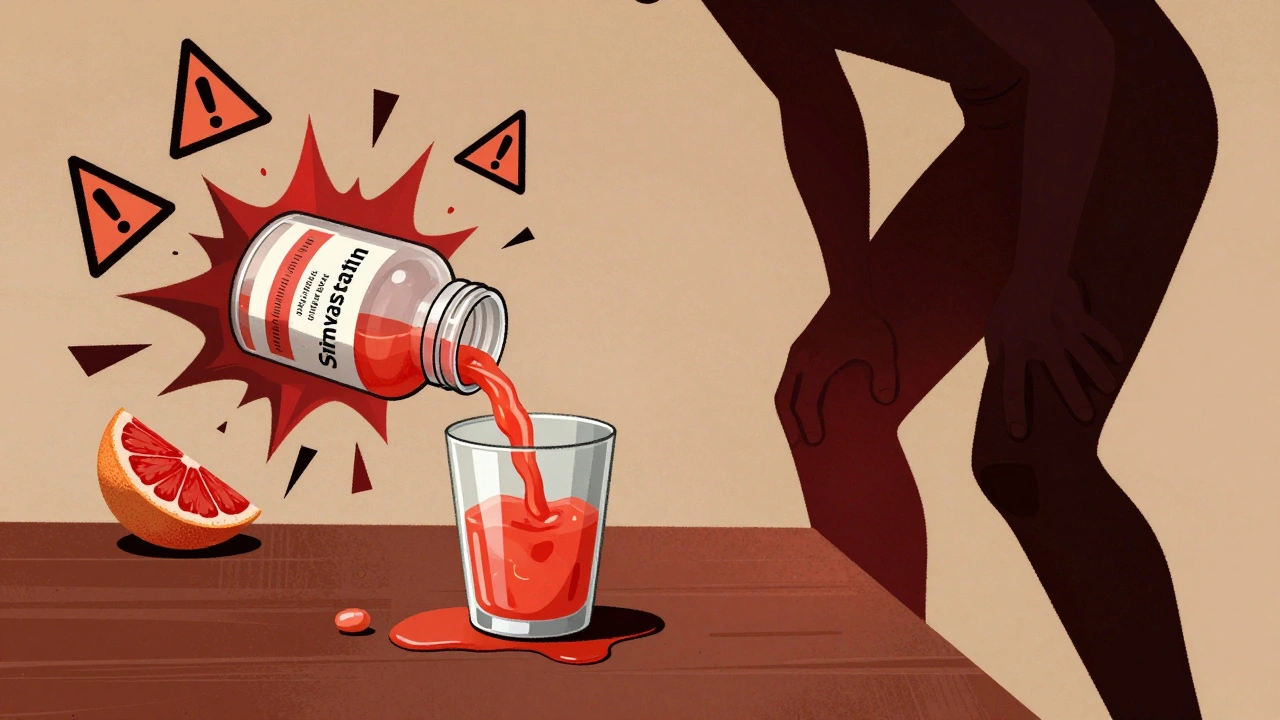
Drinking a glass of grapefruit juice with breakfast might seem like a healthy habit-until you're taking simvastatin. For millions of Americans on this cholesterol-lowering drug, that innocent glass could be setting off a dangerous chain reaction inside the body. The risk? Severe muscle damage, kidney failure, even death. This isn’t a myth. It’s a well-documented, clinically proven interaction that’s been studied for over 25 years-and it’s still catching people off guard.
Why Grapefruit Juice Turns Simvastatin Into a Time Bomb
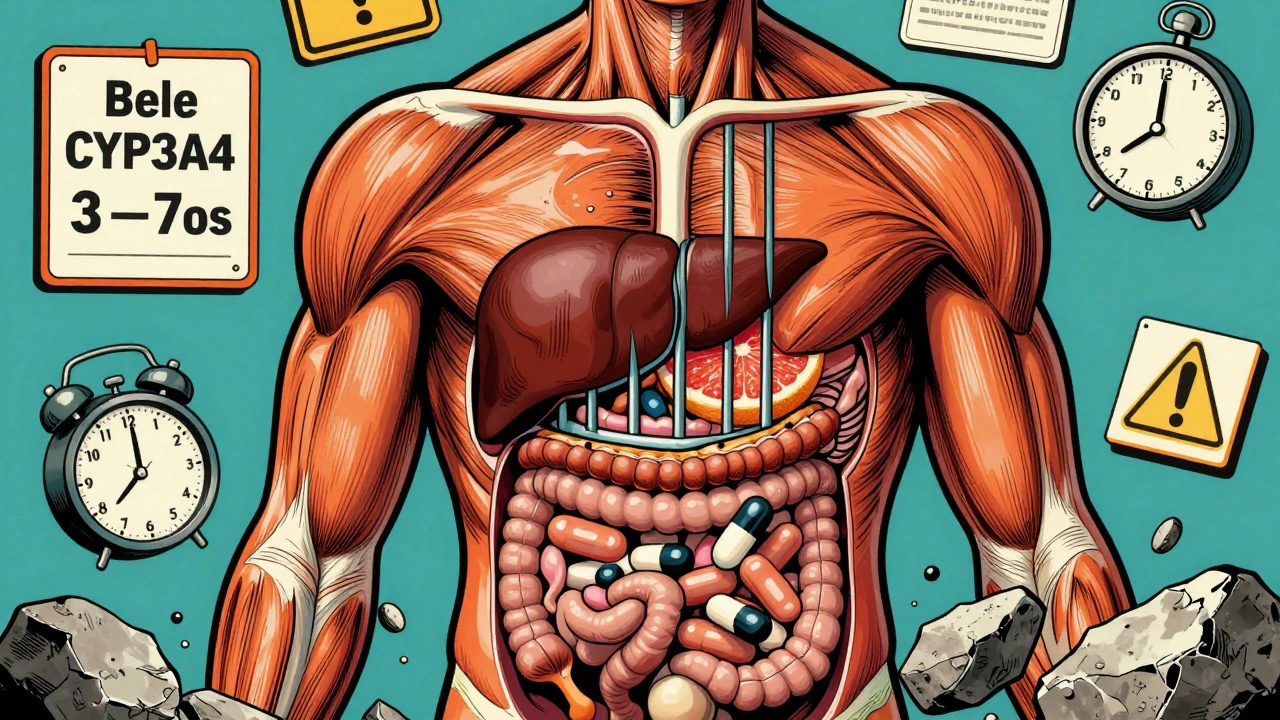
Simvastatin, sold under the brand name Zocor, works by blocking an enzyme in the liver that makes cholesterol. But before it even gets there, it has to pass through the wall of your small intestine. That’s where grapefruit juice steps in-and shuts down a critical cleanup crew: the CYP3A4 enzyme.
This enzyme normally breaks down simvastatin so only a safe amount enters your bloodstream. Grapefruit juice contains chemicals called furanocoumarins-mainly bergamottin and 6',7'-dihydroxybergamottin-that permanently disable CYP3A4 in the gut. The result? Up to 16 times more simvastatin floods into your system than intended. That’s not a typo. A 2004 study in Circulation showed that just 200 mL of grapefruit juice taken with simvastatin spiked drug levels by 16-fold. That’s like taking a 40 mg dose when you were prescribed 5 mg.
And it doesn’t matter if you drink it in the morning and take your pill at night. The enzyme doesn’t bounce back quickly. It takes 3 to 7 days for your body to grow new CYP3A4 enzymes. So even if you space them out, the damage is already done.
What Happens When Too Much Simvastatin Hits Your Muscles
Simvastatin doesn’t just lower cholesterol. It also interferes with a pathway your muscles need to repair themselves. When levels get too high, muscle cells start breaking down. This is called myopathy. In its worst form, it becomes rhabdomyolysis-where muscle tissue dissolves into the bloodstream, clogging your kidneys and potentially causing permanent damage or death.
The risk of rhabdomyolysis from statins alone is low-about 0.1% of users. But with grapefruit juice? That number jumps. Studies show the risk increases by 3 to 5 times when patients regularly drink more than one glass a day. The FDA has issued warnings since 2014, and their 2023 update still says: “Drinking a lot of grapefruit juice while taking simvastatin can cause too much of the drug to stay in your body, increasing your risk for liver and muscle damage that can lead to kidney failure.”
Symptoms don’t show up overnight. You might feel:
- Unexplained muscle aches or tenderness
- Weakness you can’t explain
- Fatigue that doesn’t go away
- Pain in your sides or lower back
- Dark urine or reduced urination
If you’re on simvastatin and notice any of these-especially after drinking grapefruit juice-call your doctor immediately. Waiting could cost you your kidneys.
Not All Statins Are Created Equal
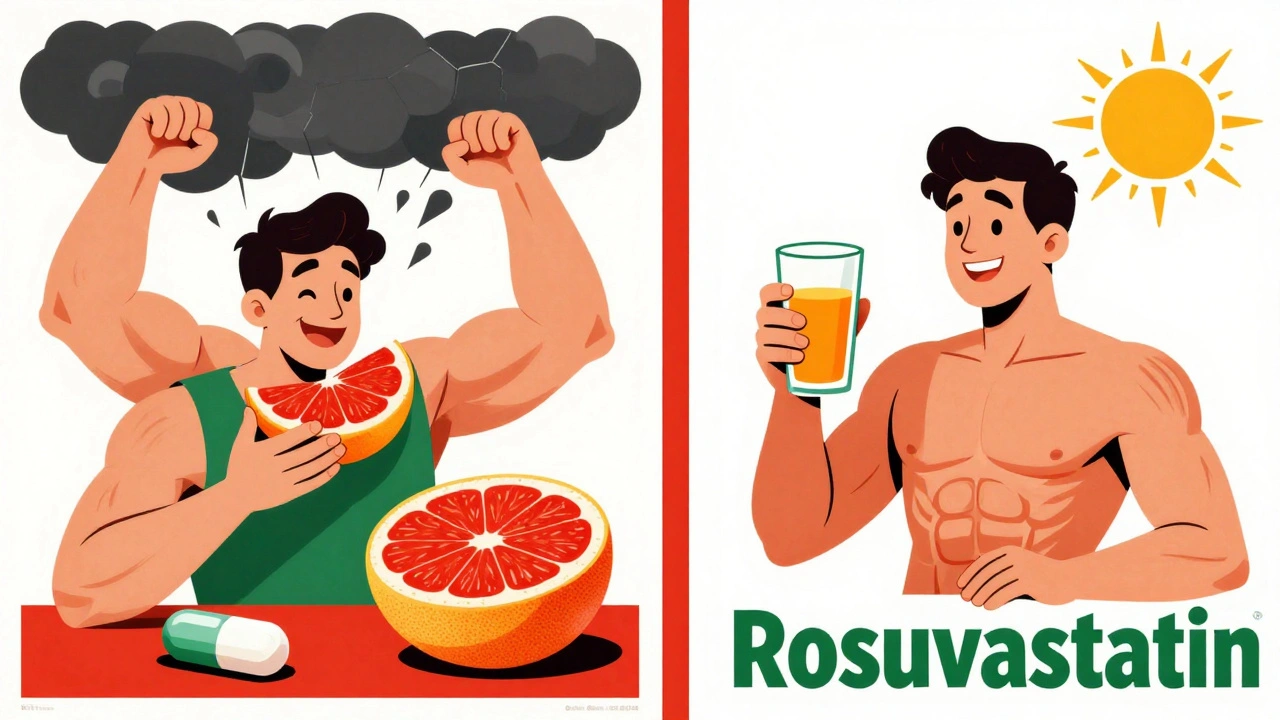
This isn’t a problem with every cholesterol drug. The interaction depends entirely on how the drug is processed in your body. Simvastatin and lovastatin are the worst offenders because they rely almost entirely on CYP3A4. Atorvastatin (Lipitor) has a moderate interaction-up to 3.3 times higher levels with grapefruit juice. But pravastatin (Pravachol) and rosuvastatin (Crestor)? They’re safe.
Why? Because they don’t use CYP3A4. They’re cleared by other pathways-mostly through the kidneys or different enzymes. That’s why the FDA only lists simvastatin and atorvastatin in its grapefruit warnings, not the others.
Here’s how the major statins stack up:
| Statin | Primary Metabolism Pathway | Grapefruit Juice Risk | Safe Alternative? |
|---|---|---|---|
| Simvastatin | CYP3A4 | Very High (up to 16x increase) | No |
| Lovastatin | CYP3A4 | Very High (up to 15x increase) | No |
| Atorvastatin | CYP3A4 | Moderate (up to 3.3x increase) | Possible |
| Pravastatin | Renal (kidney) | None | Yes |
| Rosuvastatin | Minimal CYP3A4 | None | Yes |
| Pitavastatin | Minimal CYP3A4 | None | Yes |
If you love grapefruit and need a statin, ask your doctor about switching to pravastatin or rosuvastatin. You get the same cholesterol-lowering benefits-without the risk.
How Much Is Too Much?
Here’s the confusing part: Not every sip is dangerous. The FDA says the real red zone is more than 1.2 liters per day-that’s about five 8-ounce glasses. At that level, CYP3A4 inhibition hits 47%, and the risk of toxicity climbs sharply.
But here’s what most people don’t realize: Even one glass a day can raise simvastatin levels by 30-40%. For most healthy adults on low doses (10-20 mg), that might not cause problems. But for older adults, people with kidney issues, or those on other medications like amiodarone or calcium channel blockers? That’s enough to tip them into danger.
Dr. Stanley L. Hazen from Cleveland Clinic says: “A half grapefruit or one glass of juice is probably fine for most people who’ve been on statins without side effects.” But he adds: “We can’t predict who will react badly.”
That’s the problem. There’s no blood test to tell you if your CYP3A4 is fully blocked. There’s no genetic screen that says, “You’re extra sensitive.” So the safest advice? Avoid it entirely-if you’re on simvastatin.
What Doctors Actually Recommend
Most cardiologists and pharmacists take a tiered approach:
- If you’re new to simvastatin: Don’t drink grapefruit juice at all. Period.
- If you’ve been on it for years with no side effects: You might be okay with half a grapefruit or one glass of juice-but only if you’re under 65, have healthy kidneys, and aren’t on other interacting drugs.
- If you’re over 65, have kidney disease, or take other meds: Avoid grapefruit completely. Even small amounts can be risky.
Many clinics now use the “five-glass rule”: If you drink more than five 8-ounce glasses of grapefruit juice a day, you’re in the danger zone. But even that’s not foolproof. Some people metabolize drugs slower. Others have a genetic variation that makes CYP3A4 more sensitive. And grapefruit juice isn’t standardized-some brands are stronger than others.
That’s why the American Heart Association says: “The interaction doesn’t represent a great concern unless more than one quart per day is consumed.” But they also admit: “We can’t reliably predict who will develop myopathy.”
So the safest move? Cut it out. Or switch statins.
What About Orange Juice? Or Other Citrus?
Good news: Regular orange juice is safe. So are tangerines, clementines, and most other citrus fruits. The problem is unique to grapefruit and its close relatives-like pomelos and Seville oranges (used in marmalade).
Why? Because only grapefruit contains high levels of those specific furanocoumarins. Other citrus have different compounds that don’t block CYP3A4. So if you’re craving citrus, reach for an orange. Just skip the grapefruit.
What’s Changing? New Grapefruits and Better Guidelines
There’s some hope on the horizon. Researchers at the University of Florida have developed a new grapefruit hybrid called UF Sweetie. It has 87% less bergamottin than traditional varieties. That means it might be safe for statin users in the future.
But it’s not on shelves yet. And even if it were, not everyone will know which variety they’re buying. So for now, the advice stays the same.
Meanwhile, the FDA and American College of Cardiology are pushing doctors to consider switching high-risk patients to safer statins-especially those over 65, with kidney problems, or on multiple medications. Pravastatin and rosuvastatin are now recommended as first-line choices for these groups.
Bottom Line: What You Should Do Today
If you’re on simvastatin:
- Stop drinking grapefruit juice. Even if you’ve been doing it for years.
- Check your prescription label. If it warns about grapefruit, don’t ignore it.
- Ask your doctor about switching. Pravastatin or rosuvastatin work just as well-and won’t interact with your breakfast.
- Know the warning signs. Muscle pain, weakness, dark urine? Call your doctor now.
- Don’t assume you’re safe. You might feel fine. But your muscles? They’re not.
This isn’t about fear. It’s about control. You’re taking simvastatin to protect your heart. Don’t let a glass of juice undo that. Switch the fruit. Switch the drug. Either way-you win.
Can I drink grapefruit juice if I take simvastatin once a week?
No. Even if you take simvastatin only once a week, grapefruit juice still blocks CYP3A4 enzymes for 3 to 7 days. That means the interaction risk remains high no matter how often you take the pill. The enzyme inhibition lasts longer than the drug’s presence in your system.
Is grapefruit seed extract safe with simvastatin?
No. Grapefruit seed extract contains concentrated furanocoumarins-sometimes even more than the juice. It’s not regulated as a food, so potency varies, but the risk is the same or worse. Avoid it completely if you’re on simvastatin.
Can I eat the fruit instead of drinking the juice?
Probably not safer. One whole grapefruit contains the same furanocoumarins as a glass of juice-sometimes more. Eating the fruit delivers the same enzyme-blocking effect. The risk isn’t about form-it’s about the chemicals inside.
What if I accidentally drank grapefruit juice with my simvastatin?
If it was a one-time incident and you’re feeling fine, you’re likely okay. But don’t do it again. Monitor yourself for muscle pain, weakness, or dark urine over the next 48 hours. If any symptoms appear, contact your doctor immediately. Don’t wait.
Are there any over-the-counter supplements that interact with simvastatin like grapefruit juice?
Yes. Red yeast rice contains natural statins and can increase muscle risk. St. John’s wort can reduce simvastatin levels, making it less effective. Garlic supplements and high-dose niacin can also raise myopathy risk. Always tell your doctor about every supplement you take.
What to Do Next
If you’re on simvastatin and drink grapefruit juice, your next step is simple: Call your doctor or pharmacist. Ask if you should switch to pravastatin or rosuvastatin. Most insurance plans cover both, and the switch takes minutes. You’ll keep your cholesterol under control-without the silent danger.
And if you’re not on simvastatin? Still, be aware. Grapefruit juice interacts with over 85 medications-blood pressure drugs, antidepressants, immunosuppressants. It’s not just about statins. It’s about knowing what’s in your body-and what’s in your glass.


