Walking into a facility and seeing a group of FDA investigators in the lobby is enough to make any plant manager break a sweat. But here is the reality: more than 90% of these inspections end with the facility being found in acceptable compliance. The difference between those who breeze through and those who end up with a warning letter usually comes down to one thing: whether they are treating quality as a checklist or as a culture.
If you are preparing for an audit, you aren't just proving you can make a pill; you're proving you can do it exactly the same way every single time, and that you have the paperwork to prove it. For those in the generic space, the stakes are even higher because you have to demonstrate that your process perfectly matches the application you submitted to the government.
The Core Framework: What the FDA is Actually Looking For
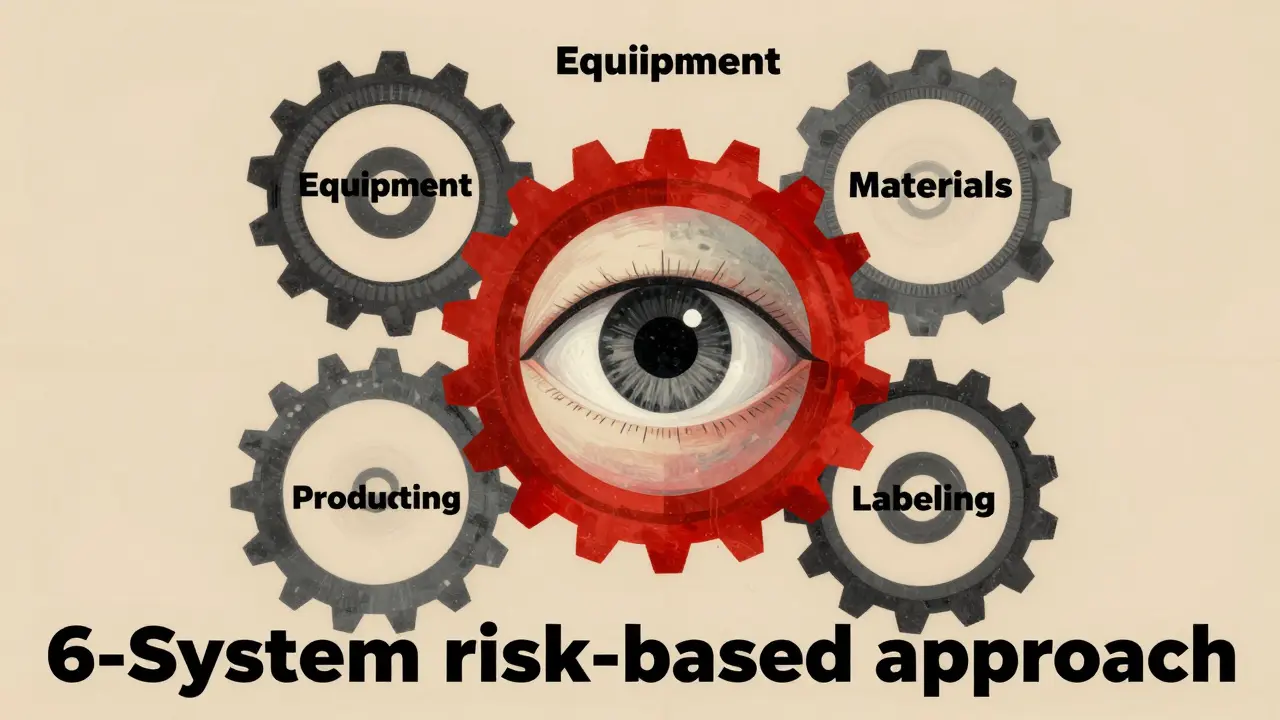
Every inspection is rooted in CGMP is Current Good Manufacturing Practices, the regulations enforced by the FDA to ensure the quality and safety of drug products. Specifically, they are looking for adherence to 21 CFR Part 211. They don't just wander around the plant; they use a 6-System risk-based approach to tear into your operations.
The Quality System is the heart of every audit. The investigators will always check this first because if your quality unit is weak, everything else is suspect. Beyond that, they will pick at least two other systems to dive into deeply. These include:
- Facilities & Equipment: Is the air filtration working? Is the equipment calibrated and cleaned?
- Materials: Where did the raw ingredients come from? Are they stored correctly?
- Production: Do the actual steps on the floor match the written SOPs?
- Packaging & Labeling: How do you ensure the wrong label doesn't end up on the wrong bottle?
- Laboratory Control: Are your testing methods validated, and is the data honest?
Pre-Approval Inspections (PAIs) vs. Routine Audits
Depending on where you are in your product lifecycle, the vibe of the inspection changes. A routine surveillance audit is about maintaining a "state of control." A Pre-Approval Inspection (PAI), however, is a high-stakes verification. If you're applying to sell a new generic drug, the FDA needs to be sure you aren't just promising quality on paper.
During a PAI, the investigators focus on three big questions: Is the site actually ready for commercial production? Is the information in your application identical to what's happening on the floor? Is the data complete and accurate?
| Feature | Routine Inspection | Pre-Approval Inspection (PAI) |
|---|---|---|
| Primary Goal | Ongoing CGMP surveillance | Verify application accuracy |
| Trigger | Risk-based site selection model | New product application (ANDA) |
| Key Focus | System-wide quality culture | Facility readiness for specific drug |
| Critical Metric | Consistent state of control | Consistency between filing and site |
The Red Flag: Understanding Form FDA 483
At the end of the inspection, if the investigator finds a problem, they'll issue a Form FDA 483. This isn't a final judgment, but it is a list of "observations." Think of it as a formal record of where you fell short of 21 CFR Part 211.
For example, if your facility lacks a dedicated quality control unit, the investigator might cite 21 CFR 211.22(a). These observations are listed by significance-the most dangerous failures come first. You usually have 15 business days to respond. This is your chance to save the day. Don't just say "we fixed it." You need to provide a comprehensive corrective action plan that addresses the root cause of the failure.
Modern Shortcuts: The PreCheck Program
The FDA has realized that waiting until a facility is finished to inspect it is a recipe for disaster. To fix this, they launched the PreCheck Program. This is a game-changer for new facilities. It allows manufacturers to get FDA feedback during the design and construction phases rather than hoping for the best at the end.
Through the PreCheck program, you can submit a Type V Drug Master File (DMF). This document gives the FDA a look at your layout, your Pharmaceutical Quality System, and your overall quality management maturity. By the time the actual inspectors arrive, they already know your site, which significantly reduces the risk of a shock 483.
Practical Tips for Inspection Readiness
Being "ready" isn't about a frantic cleaning spree the day before the FDA arrives. It's about creating an environment where an audit is just another Tuesday. If you're scrambling to find a document, the investigator will smell the panic, and they'll start digging deeper.
Start with your documentation. Data integrity is the biggest buzzword in the FDA's current playbook. They are looking for signs of data manipulation or "ghost" records. If a stability sample is stored at 40°C/75% RH, but your logbook has a gap for three days in July, that's a red flag. Ensure your analytical methods on-site match exactly what you filed in your application.
Don't ignore the logistics. Give the inspection team a dedicated, clean space to work. Map out a facility tour route that is logical and showcases your best operations without getting in the way of production. When an investigator sees a well-organized flow, it signals that the management is in control of the process.
Dealing with the Aftermath: Warning Letters and PWLMs
If your response to an FDA 483 is insufficient, you might receive a Warning Letter. This is a serious escalation that can halt product approvals and damage your reputation. However, the FDA has recently introduced more pathways for recovery. As of June 2025, there is clearer guidance on Post-Warning Letter Meetings (PWLMs).
These meetings allow generic drug manufacturers to sit down with the agency and align on the necessary corrective actions. It transforms the relationship from a purely punitive one to a more collaborative effort to ensure patient safety. The goal is always the same: getting the facility back into a "state of control" so the Establishment Inspection Report (EIR) can eventually reflect a positive outcome.
How often does the FDA inspect generic facilities?
The FDA uses a risk-based site selection model. This means they don't follow a strict calendar but instead prioritize sites based on the risk of the products they make, previous compliance history, or sudden spikes in consumer complaints. High-risk facilities will be visited more frequently.
What happens if we disagree with an observation on Form 483?
You have 15 business days to provide a voluntary written response. In this response, you can provide evidence or scientific justification to explain why a particular observation may not be a violation. However, it is generally better to acknowledge the gap and provide a robust plan for correction than to simply argue.
Is the PreCheck program mandatory for new plants?
No, it is a voluntary initiative. However, it is highly recommended for those building new facilities because it provides an early-warning system for design flaws that would otherwise only be caught during a formal PAI, potentially saving millions in reconstruction costs.
What is the '6-System' approach?
It is a methodology where investigators evaluate Quality, Facilities & Equipment, Materials, Production, Packaging & Labeling, and Laboratory Control. The Quality System is always checked, while the other five are sampled based on the risk profile of the site.
How does the FDA verify data integrity during an audit?
Investigators look for ALCOA+ principles (Attributable, Legible, Contemporaneous, Original, and Accurate). They often cross-reference raw data with final reports, check audit trails in software, and verify that stability samples are stored exactly as described in the filed protocols.
Next Steps for Compliance
If you are currently operating a facility, the first move is to conduct a gap analysis. Don't wait for the FDA. Hire an independent auditor to run a mock inspection using the same 6-System approach. Focus specifically on your 21 CFR Part 211 compliance and your data integrity trails.
For those in the design phase, lean into the PreCheck program immediately. Getting your Type V DMF submitted early can be the difference between a smooth launch and a year-long delay in approval. Remember, the FDA isn't looking for perfection-they are looking for a system that can detect its own errors and fix them before a product ever reaches a patient.


