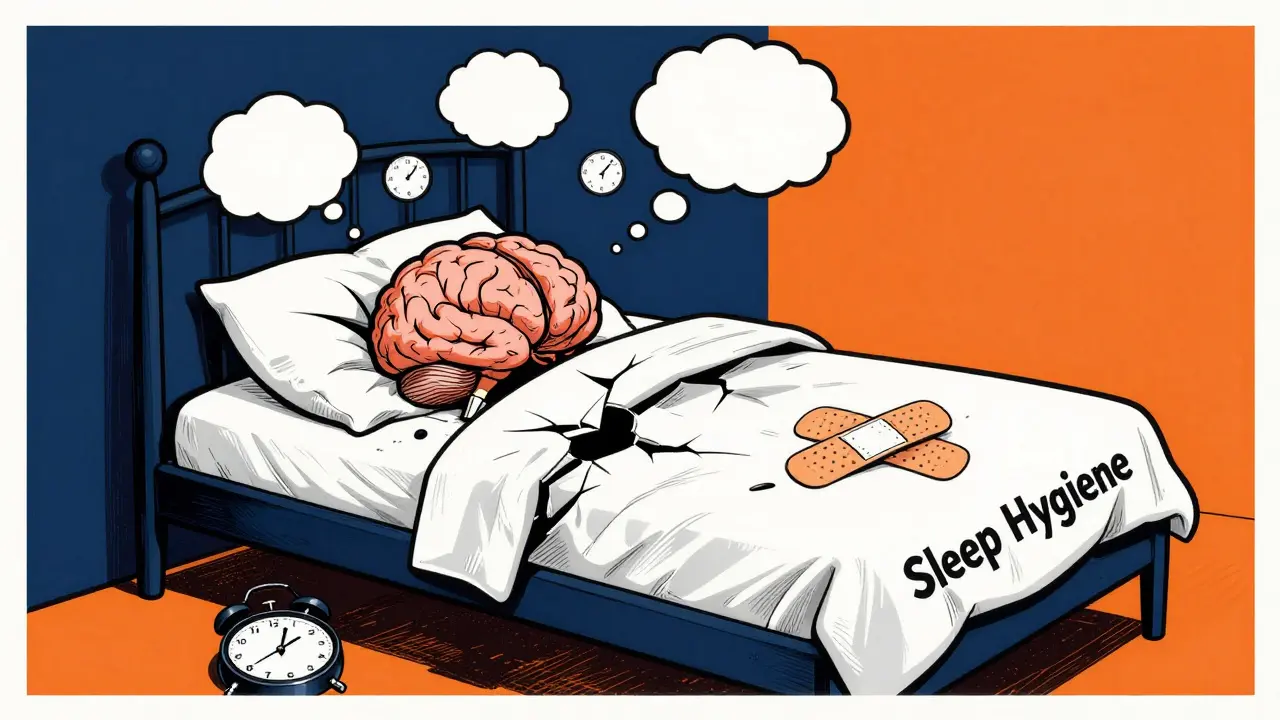
If you’ve been lying awake for hours, counting sheep, checking the clock, and dreading tomorrow’s exhaustion, you’re not alone. But here’s the truth most people don’t tell you: sleep hygiene won’t fix chronic insomnia. Not alone. Not even close.
Chronic insomnia isn’t just about bad habits. It’s a persistent condition-lasting at least three nights a week for three months or more-where your brain gets stuck in a loop of anxiety, frustration, and conditioned wakefulness. You might be doing everything "right": no caffeine after 2 p.m., your room is dark, you don’t scroll before bed. And yet, sleep still slips away. Why? Because sleep hygiene is just one piece of a much bigger puzzle. The real solution? Cognitive Behavioral Therapy for Insomnia (CBT-I).
Why Sleep Hygiene Isn’t Enough
Sleep hygiene sounds simple: avoid screens, keep your bedroom cool, don’t drink alcohol before bed. These are good ideas. But research shows they’re not enough for chronic insomnia.
The American Academy of Sleep Medicine gives sleep hygiene only a moderate evidence rating. That means it might help someone with occasional trouble sleeping, but for someone with insomnia that’s lasted years? It’s like putting a bandage on a broken bone.
Dr. Jack D. Edinger, a leading insomnia researcher, puts it bluntly: "Sleep hygiene education alone is minimally effective for chronic insomnia and should not be offered as standalone treatment." And he’s not alone. The Health.mil Patient Guide (2023) explicitly warns: "Do not use sleep hygiene as a standalone treatment for chronic insomnia."
Why? Because chronic insomnia isn’t caused by a messy bedtime routine. It’s caused by your brain learning to associate your bed with wakefulness. You lie down, think, "I need to sleep," your heart races, you check the time again. That’s not a habit-it’s a conditioned response. And habits can’t be fixed with better rules. They need rewiring.
What Is CBT-I? The Only Treatment With Lasting Results
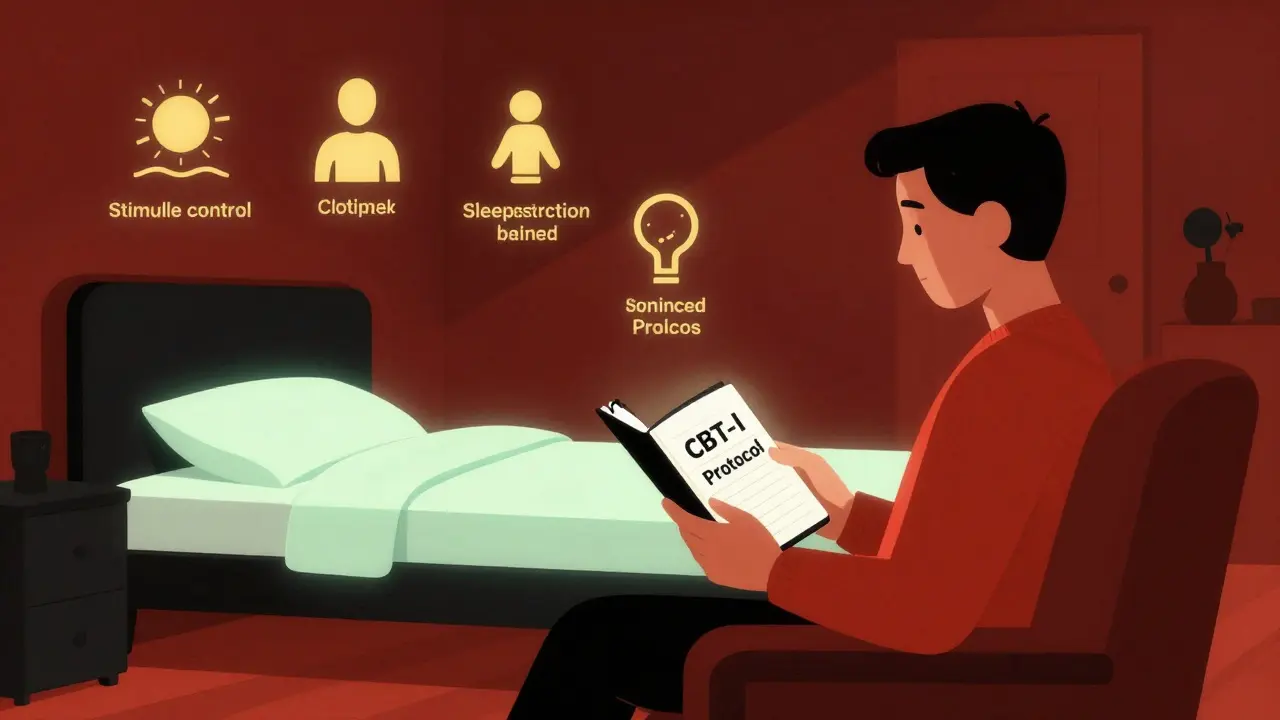
CBT-I is a structured, evidence-based therapy that targets the thoughts and behaviors keeping you awake. It’s not meditation. It’s not hypnosis. It’s a clinical protocol backed by over 100 randomized trials. The American College of Physicians, the American Academy of Sleep Medicine, and the National Institutes of Health all recommend it as the first-line treatment for chronic insomnia.
Here’s what CBT-I actually looks like:
- Stimulus Control Therapy: Your bed is only for sleep and sex. If you can’t fall asleep in 15-20 minutes, get up. Go to another room. Sit quietly. Don’t check your phone. Only return to bed when you feel sleepy. Repeat. This breaks the mental link between your bed and stress.
- Sleep Restriction: You’re not getting enough sleep? Then you’re spending too much time in bed. CBT-I cuts your time in bed to match your actual sleep time. If you only sleep 5 hours, you’re only allowed 5 hours in bed-even if you feel exhausted. This builds up sleep pressure. After a few weeks, as sleep efficiency improves, you slowly add back time. It’s brutal at first. But 62% of users report the first two weeks are the hardest-and the most transformative.
- Cognitive Restructuring: Your brain is full of sleep lies: "I need 8 hours," "If I don’t sleep, I’ll fail," "I’ll never recover." CBT-I helps you challenge these thoughts. One study found cognitive restructuring reduced sleep-related anxiety in 65% of patients. That’s not placebo. That’s rewiring.
- Relaxation Training: Not just deep breathing. This includes progressive muscle relaxation, diaphragmatic breathing, and mindfulness techniques shown to lower nighttime cortisol levels.
- Sleep Hygiene Education: Yes, it’s still included-but now it’s part of a larger plan, not the whole plan.
Most CBT-I programs run for 6-8 weekly sessions. But even a two-session version has shown effectiveness. And now, digital versions like Sleepio and SHUTi are proving just as powerful. A 2021 JAMA Internal Medicine trial found 50-60% of users using these apps reached remission-compared to just 15-20% in control groups.
How CBT-I Beats Medication-Every Time
Many people turn to pills first. Zolpidem. Eszopiclone. Suvorexant. They work-for a while. But after 4-6 weeks, the effects fade. Dependence creeps in. Withdrawal can make insomnia worse.
Here’s what the data says:
| Outcome | CBT-I | Medication |
|---|---|---|
| Sleep onset latency reduction | 18.2 minutes | 12.1 minutes |
| Wake after sleep onset reduction | 27.4 minutes | 15.8 minutes |
| Effectiveness at 12-month follow-up | Still effective | Disappears after stopping |
| Dependence risk | None | High |
CBT-I doesn’t just help you sleep better. It changes your relationship with sleep. Dr. Rachel Manber from Stanford says it best: "CBT-I changes the relationship with sleep, whereas medications merely mask the symptoms."
And it works for everyone. Older adults? Yes. Perimenopausal women? Yes. People with chronic pain or depression? Yes. Dr. Daniel Buysse’s research shows effect sizes of 1.0-1.3 on the Insomnia Severity Index-what experts call "large clinical improvements."
The Real Barriers to Getting CBT-I
Here’s the ugly truth: CBT-I is hard to access.
There are only 0.5 certified CBT-I therapists per 100,000 people in the U.S. In 78% of rural counties, there’s not a single sleep specialist. Insurance often covers only 3 sessions-when 6-8 are needed. One Reddit user wrote: "My insurance only covered 3 of the recommended 6 CBT-I sessions, making it impossible to complete the full protocol."
That’s why digital CBT-I is exploding. Apps like Somryst (FDA-cleared in 2021) have shown 55.4% remission rates. Fitbit now integrates sleep restriction principles into its Sleep Profile feature. The digital CBT-I market is projected to hit $1.2 billion by 2027.
Even big companies are catching on. 37% of Fortune 500 companies now offer CBT-I through employee wellness programs. Why? Because tired employees are less productive, more prone to errors, and take more sick days.
What You Need to Do Right Now
If you’ve had chronic insomnia for months or years:
- Stop relying on sleep hygiene alone. It’s not the problem. It’s not the solution.
- Get an Insomnia Severity Index (ISI) score. Scores of 15-21 mean moderate insomnia. 22-28 mean severe. This tells you how urgent treatment is.
- Try a digital CBT-I program. Sleepio, SHUTi, or Somryst. These are clinically proven. Many are covered by insurance.
- If you can, find a CBT-I-trained therapist. Look for psychologists or sleep specialists certified by the Society of Behavioral Sleep Medicine.
- Be prepared for short-term discomfort. Sleep restriction will make you tired. Stimulus control will feel unnatural. That’s the point. You’re breaking old patterns.
Most people see improvement in 2-4 weeks. Full results take 8-12 weeks. But once it clicks? The change is permanent. One user on r/insomnia said: "After 8 weeks of CBT-I, my sleep efficiency went from 68% to 89%. I fall asleep in 15 minutes instead of 2 hours."
Common Mistakes (And How to Avoid Them)
- "I’ll catch up on sleep on weekends." No. Inconsistent wake times sabotage progress. 68% of beginners fail here. Set the same wake time-even on Saturday.
- "I’ll have one glass of wine to help me sleep." Alcohol fragments sleep. Limit to 1-2 drinks, and stop 4 hours before bed.
- "I’ll just wait until I’m exhausted." You don’t need to be exhausted to sleep. You need sleep pressure. That’s built through restriction, not fatigue.
- "I’m not anxious about sleep." You probably are. Even if you don’t realize it. CBT-I’s cognitive component targets those hidden fears.
And don’t forget: caffeine must be gone by 6 p.m. Fluids after 7 p.m.? Cut them. Nighttime bathroom trips are a silent sleep killer.
What the Future Holds
CBT-I isn’t going away. Dr. Andrew Krystal predicts it will become the standard of care for 90% of chronic insomnia cases within the next decade. AI-driven personalization is already in trials. Apps are learning your sleep patterns, adjusting protocols in real time, and predicting relapse before it happens.
But right now, the most powerful tool you have isn’t in a lab. It’s in your hands. You don’t need a miracle. You need a plan. And CBT-I is the only one that works-for good.
Is CBT-I effective for older adults?
Yes. Multiple studies show CBT-I works just as well for older adults as it does for younger people. Dr. Daniel Buysse’s research found effect sizes of 1.0-1.3 on the Insomnia Severity Index in adults over 60-classifying the improvement as "large" in clinical terms. Unlike medications, which increase fall risk and confusion in seniors, CBT-I has no side effects and improves daytime alertness.
Can I do CBT-I on my own without a therapist?
Yes, but with caveats. Digital CBT-I programs like Sleepio, SHUTi, and Somryst are FDA-cleared and backed by clinical trials. They guide you through all core components: sleep restriction, stimulus control, cognitive restructuring, and relaxation. Success rates are 50-60%. However, if you have depression, PTSD, or severe anxiety, working with a trained therapist is strongly recommended.
How long does it take to see results from CBT-I?
Most people notice small improvements within 2-4 weeks. Sleep onset latency often improves first. The biggest gains-like fewer nighttime awakenings and better sleep efficiency-come after 6-8 weeks. Full benefits typically appear between 8 and 12 weeks. The initial phase (especially sleep restriction) can feel worse before it gets better, but that’s normal.
Why is sleep restriction so hard?
Sleep restriction works by creating mild sleep deprivation to increase your body’s drive to sleep. This means you’ll feel more tired than usual for the first 1-2 weeks. Many people report irritability, brain fog, and daytime fatigue. But this is temporary. As your sleep efficiency improves (meaning you spend more time asleep than awake in bed), your time in bed is gradually increased. The fatigue fades. The sleep improves. It’s the body’s natural way of resetting its sleep clock.
Does insurance cover CBT-I?
Some do-but not always fully. Many insurers cover CBT-I under mental health benefits, but often limit sessions to 3-6. Digital CBT-I apps like Somryst are increasingly covered because they’re FDA-cleared. Check with your provider. If coverage is limited, consider using a Health Savings Account (HSA) or Flexible Spending Account (FSA) to pay out-of-pocket. The long-term savings on medications, doctor visits, and lost productivity often outweigh the upfront cost.
What’s the difference between CBT-I and regular CBT?
Regular CBT (Cognitive Behavioral Therapy) is a broad approach used for anxiety, depression, and other conditions. CBT-I is a specialized version designed specifically for insomnia. It includes sleep-specific techniques like sleep restriction and stimulus control, which aren’t part of general CBT. CBT-I also uses sleep diaries, sleep efficiency calculations, and circadian rhythm targeting-all tailored to sleep disorders. It’s not just CBT for sleep-it’s a unique protocol with its own evidence base.
Chronic insomnia isn’t a life sentence. It’s a learned pattern-and like all learned patterns, it can be unlearned. The science is clear. The tools exist. You don’t need another pill. You need a plan that works. And that plan is CBT-I.


