When you pick up a bottle of antibiotics, blood pressure pills, or diabetes medication, there’s a good chance it was made in Asia. Two countries-India and China-dominate the global supply of generic drugs, while smaller economies like Vietnam and Cambodia are quietly carving out their own niches. This isn’t just about low prices. It’s about who controls the raw ingredients, who can scale production fast, and who can meet strict quality rules from the FDA or WHO. The race between these markets is reshaping how the world gets its medicines.
India: The Pharmacy of the World
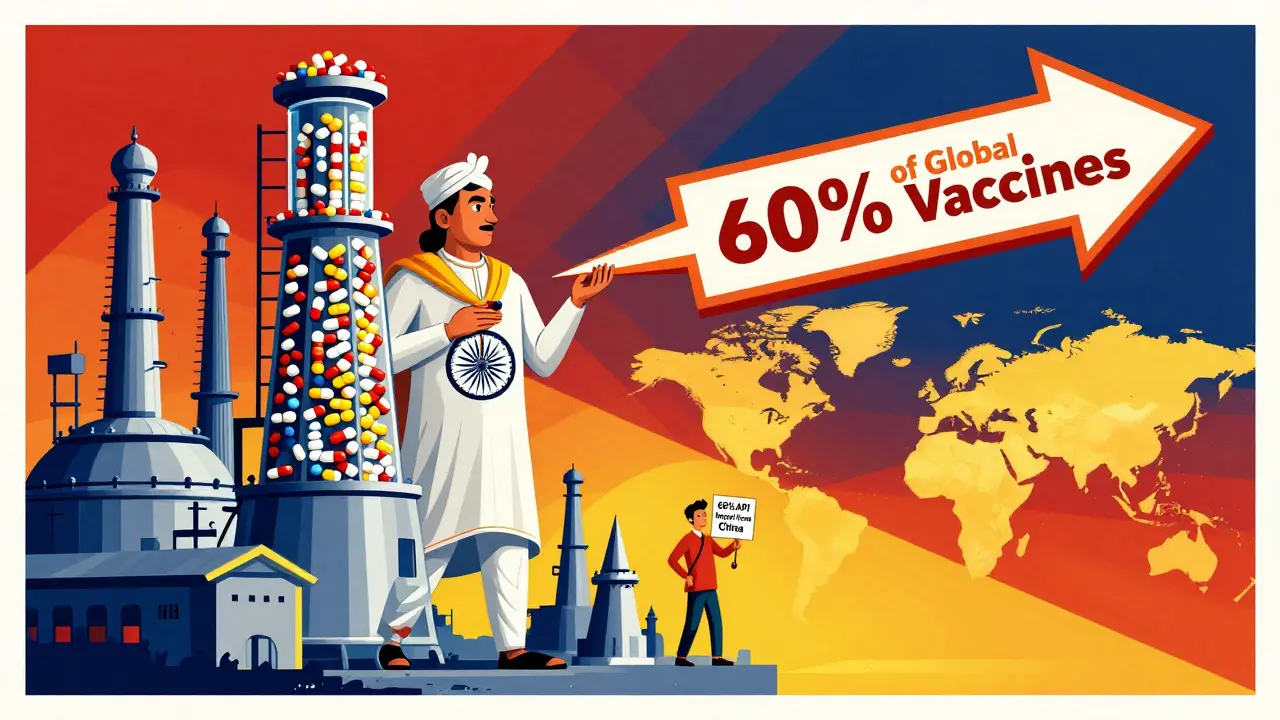
India’s rise as a generic drug powerhouse started in the 1970s, when it changed its patent laws to allow companies to copy drug formulas as long as they used a different manufacturing process. That move turned India into a factory for cheap medicines. Today, it supplies over 60% of global generic vaccine demand and 40% of the U.S. generic drug market, according to the U.S. FDA. That’s more than 24 billion pills a year.
What makes India unique is its focus on volume. Its pharmaceutical market hit $61.36 billion in 2024, but most of that comes from low-margin, high-volume generics. About 75% of its output is conventional generics, mostly small-molecule drugs like antibiotics and antihypertensives. Gujarat and Maharashtra handle most of the production, with Gujarat alone accounting for 35% of output.
India has over 3,000 facilities approved by the FDA, more than any other country. But here’s the catch: only 15% of those can make advanced biologics or biosimilars. Most still rely on older technology. That’s why, despite its massive output, India ranks only 14th in market value globally. It sells a lot, but not much of it is high-priced.
One of India’s biggest weaknesses? It still imports 68% of its Active Pharmaceutical Ingredients (APIs) from China. That’s a dangerous dependency. When China restricts exports or faces regulatory crackdowns, India feels it. That’s why the government launched Pharma 2047 in 2024-a $13.4 billion plan to build 12 new API manufacturing parks and cut that import reliance to 30% by 2030.
China: The Hidden Powerhouse
China’s pharmaceutical market is bigger than India’s-$80.4 billion in 2024-and it’s growing faster in value, even if slower in volume. China doesn’t just make pills. It makes the building blocks. It controls 70% of the global API market. Nearly every generic drug made in India, the U.S., or Europe starts as a chemical compound produced in a factory in Jiangsu or Zhejiang.
China’s strategy shifted after joining the WTO in 2001. It moved from being a low-cost producer to a high-volume, high-tech manufacturer. Today, 25% of its pharmaceutical output is traditional Chinese medicine, 10% is biologics, and 5% is innovative drugs. That’s a big jump from just a decade ago. Between 2020 and 2024, 45% of new pharma facilities in China were built specifically for biologics production, according to CaixaBank Research.
China’s FDA approval timeline has dropped from 24 months in 2018 to just 9 months in 2024. That’s faster than India. And while India has more WHO-GMP certified plants (650 vs. 420), China’s centralized system means fewer regulatory delays. But quality issues persist. In 2024, the FDA issued 142 warning letters to Chinese manufacturers-almost twice as many as to Indian ones. That’s why many U.S. pharmacies now use a dual-sourcing model: 40-60% from India, 25-35% from China.
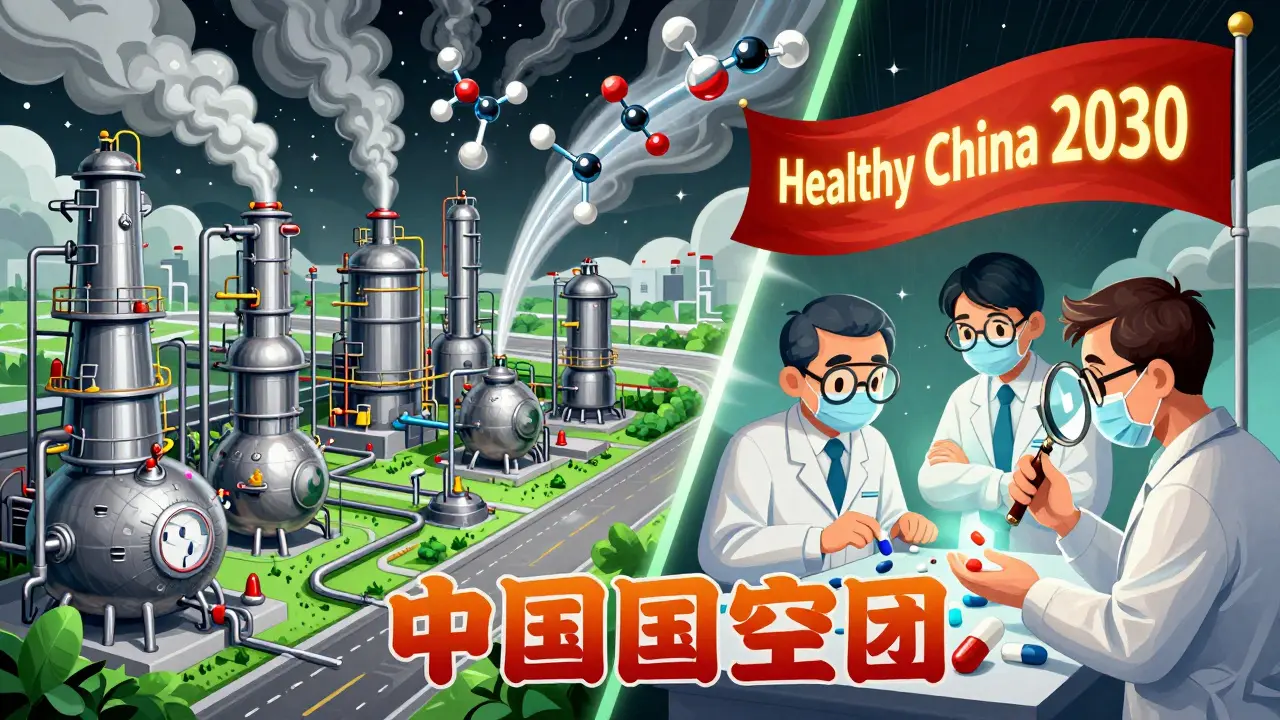
China’s government is betting big on innovation. Its Healthy China 2030 plan allocates $22.8 billion toward biologics R&D. The goal? Raise high-value exports from 8% of total pharmaceutical sales in 2024 to 25% by 2030. That’s not just about making cheaper pills. It’s about making better, more expensive ones-and selling them globally.
Emerging Economies: The New Players
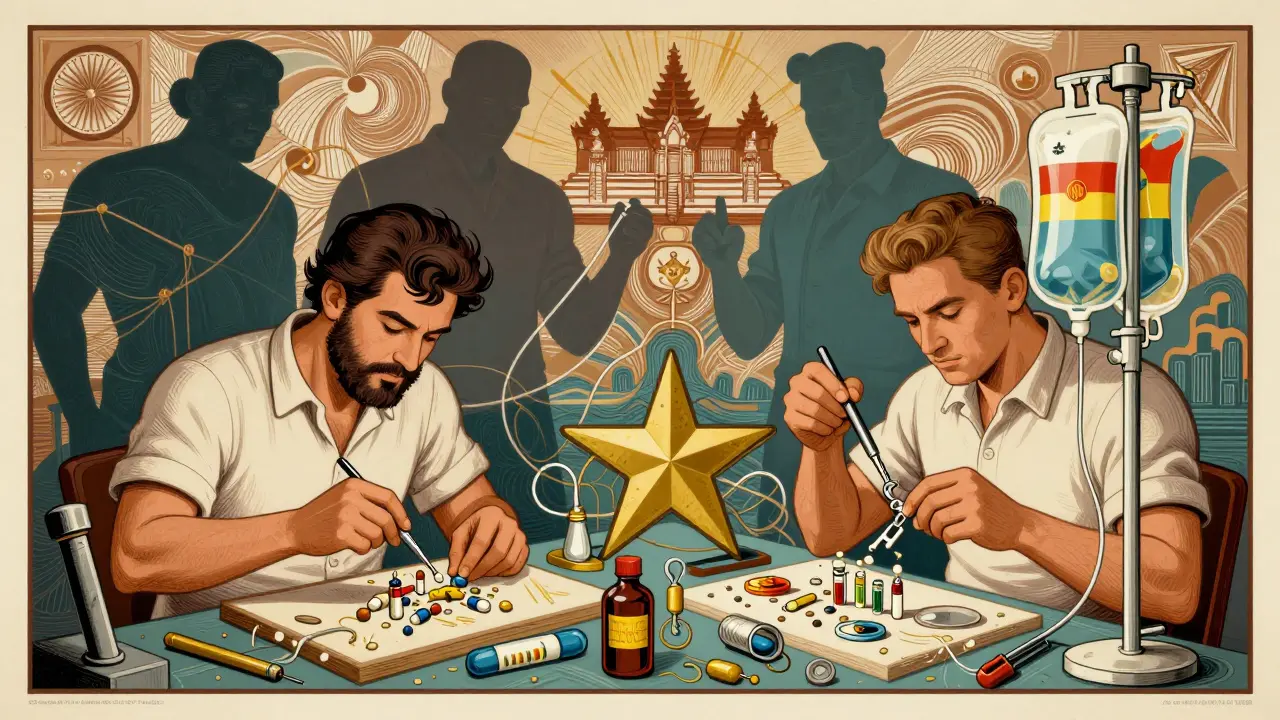
While India and China fight over volume and value, smaller countries are finding their own paths. Vietnam, for example, grew its pharmaceutical exports by 24.7% in 2024 to $2.8 billion. How? By specializing. It doesn’t try to compete with India on antibiotics or China on APIs. Instead, it focuses on antibiotic intermediates-complex chemical compounds that are hard to make but essential for finished drugs. It’s a smart niche.
Cambodia’s story is even more surprising. It doesn’t make pills at all. It assembles medical devices-IV bags, syringes, diagnostic kits. Its sector grew 32% in 2024, hitting $1.2 billion in exports. Why? Because it’s part of ASEAN trade deals that give it preferential access to markets like the EU and Australia. It’s not about drug manufacturing. It’s about becoming a logistics and assembly hub.
These economies aren’t replacing India or China. They’re filling gaps. When a U.S. hospital needs a specific type of IV bag or a rare antibiotic intermediate, they’re turning to Vietnam or Cambodia because those countries can deliver faster and with fewer regulatory hurdles than the giants.
Who Wins? It Depends on What You Need
Here’s the real takeaway: India and China aren’t rivals-they’re complements. If you need 10 million units of a common generic drug at the lowest possible price, India is your best bet. If you need a complex biosimilar or a high-purity API with tight quality controls, China is more reliable.
Procurement managers from German and U.S. hospitals say it plainly. One said: “Indian suppliers are better at communication. They answer emails in hours, not days. But their batch-to-batch consistency is shaky-we test three times as often.” Another: “Chinese prices are 20% lower, but after the 2024 FDA warnings, we had to double our inspection budget. Now we’re paying more for quality assurance than we saved on price.”
India wins on flexibility. Indian manufacturers often adjust formulations within 14 days to meet a customer’s request. Chinese factories? Minimum 30 days. But China wins on scale and infrastructure. Its ports, rail networks, and power grids are built for mass production. India’s roads and electricity grids still lag, adding 12-15% to logistics costs.
The Future: Quality Over Quantity
The next decade won’t be about who makes the most pills. It’ll be about who can make them reliably, safely, and with traceable ingredients. The FDA’s Project BioSecure, launched in late 2024, now requires full traceability of APIs from raw material to final pill. That means companies must track every step of production-and that’s expensive.
Both India and China are scrambling. India is investing in digital monitoring systems and blockchain-based supply chains. China is automating its API plants and upgrading its inspection tech. But the real challenge? Overcapacity. S&P Global warns that by 2026-2027, both countries may flood the market with too many APIs, causing prices to drop 15-20%. That could hurt profits, but it might also make medicines cheaper worldwide.
One thing is clear: the world can’t afford to lose either India or China. Together, they produce over 80% of the generic drugs used in low- and middle-income countries. If one falters, millions go without treatment. The goal now isn’t to replace one with the other. It’s to build a system where both can thrive-without risking global access to medicine.
What This Means for You
If you’re a patient, this means more affordable drugs. If you’re a healthcare provider, it means more supply options-but also more complexity. If you’re a policymaker, it means balancing cost, quality, and security. The days of relying on a single country for your medicine are over. The future is dual-sourcing, traceability, and smart partnerships.
The real winners won’t be the biggest factories. They’ll be the ones who combine low cost with high trust. That’s not just a business strategy. It’s a public health imperative.


