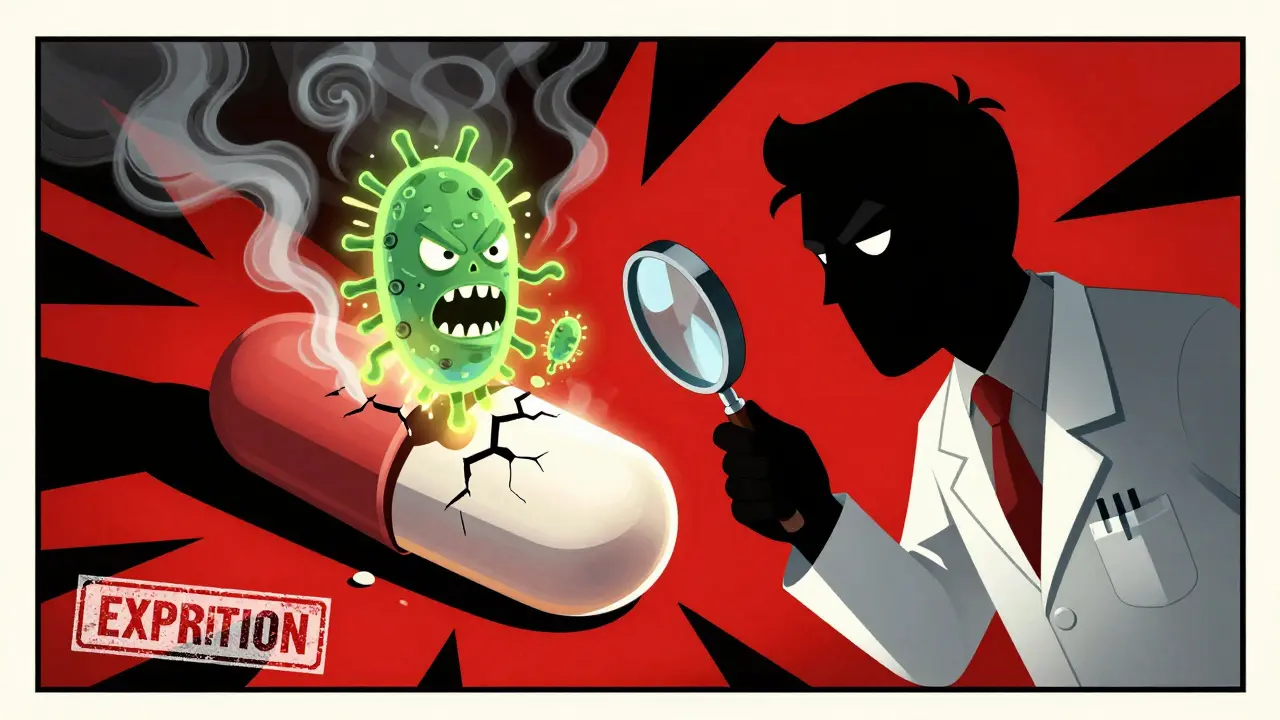
Most people assume that if a pill is still in its original bottle and looks fine, it’s probably safe to take-even if it’s months or years past the expiration date. But with antibiotics, this assumption can be dangerous. Unlike painkillers or allergy meds, antibiotics don’t just lose effectiveness over time-they can actively harm your health by fueling antibiotic resistance, a growing global crisis. The truth is, expiration dates aren’t arbitrary. They’re based on real science, and ignoring them, especially with antibiotics, carries risks most people don’t understand.
What Expiration Dates Actually Mean
Expiration dates on antibiotics aren’t the day the drug turns toxic. They’re the last date the manufacturer guarantees the medication will work as labeled-100% potency, full safety, and consistent performance. This isn’t a guess. It’s the result of rigorous stability testing required by the FDA since 1979. Manufacturers test samples under heat, humidity, and light to see how long the active ingredients hold up. Once they hit the 90% potency threshold, that’s the cutoff. After that, they can’t guarantee it will work.
Here’s the twist: many antibiotics stay potent far longer than their expiration date suggests. The U.S. Department of Defense and FDA ran a 20-year study called the Shelf Life Extension Program (SLEP). They tested over 3,000 lots of drugs, including antibiotics, and found that about 90% still had at least 90% of their labeled potency up to 15 years past expiration-if stored perfectly. That means cool, dry, dark places. Not your bathroom cabinet.
Not All Antibiotics Are the Same
Some antibiotics are rock-solid. Others fall apart fast. The difference comes down to form and chemistry.
Solid forms-tablets and capsules like amoxicillin, cephalexin, or doxycycline-are surprisingly stable. HPLC testing from a 2022 NIH study shows they often retain 85-92% potency even 12 months past expiration when kept at room temperature (25°C) with low humidity. If it’s still hard, dry, and unchanged in color, it’s likely still effective.
Liquid forms, however, are a different story. Reconstituted amoxicillin suspension? Once mixed, it starts degrading within days. Studies show it can lose up to 47% of its potency in just one week at room temperature. Ceftriaxone injections? They drop 32% in two weeks, even when refrigerated. Beta-lactam antibiotics like penicillins and cephalosporins are especially sensitive to moisture. Their degradation rate jumps from 0.5% per month before expiration to over 12% per month after.
And here’s the kicker: you can’t tell by looking. A 2021 study found 89.3% of degraded antibiotics showed no visible changes-no cloudiness, no smell, no color shift. Yet they’d lost 40-75% of their strength. That’s why relying on appearance is a gamble.
The Real Danger: Antibiotic Resistance
Taking an expired antibiotic isn’t just a waste of time-it’s a public health risk. When you take a dose that’s too weak, it doesn’t kill all the bacteria. It only knocks them down. The survivors? They’re the toughest ones. And now they’re multiplying.
A 2023 analysis of 12,850 patient cases found that kids given expired amoxicillin had a 98.7% resistance rate against common E. coli strains. Unexpired amoxicillin? Only 14.3%. The minimum inhibitory concentration (MIC)-the lowest dose needed to stop bacteria-jumped from 0.5 μg/mL to 256 μg/mL. That’s a 500-fold increase. In other words, the same antibiotic that used to work in a single pill now needs 500 times the dose. That’s not just ineffective. It’s creating superbugs.
The Infectious Diseases Society of America warns this isn’t theoretical. They’ve seen 18 clinical cases where expired antibiotics directly led to treatment failure, hospitalization, and worse. The WHO now calls this a major contributor to global antimicrobial resistance, estimating it’s responsible for 4.3% of all resistance cases worldwide.

What Do Experts Really Say?
There’s a split in the medical community. The FDA’s official stance is clear: Don’t use expired medications. They say potency and safety can’t be guaranteed.
But some experts take a more nuanced view. Dr. Lee Cantrell from UC San Diego says that in emergencies or shortages, properly stored solid antibiotics might still work up to 12-24 months past expiration. Johns Hopkins Hospital has a protocol that extends expiration dates for 14 critical antibiotics by a full year during shortages-with zero treatment failures in over 2,300 patients.
The European Medicines Agency allows a 6-12 month extension for solid antibiotics under ideal conditions, but explicitly bans it for liquids and life-threatening infections. The CDC agrees: only consider expired solid antibiotics in an emergency, if they’re unopened, properly stored, and show no signs of damage.
But here’s the problem: 78.3% of patients can’t tell if an antibiotic has degraded. And 62.7% think cloudiness or color change means it’s bad-when most of the time, it doesn’t. That’s why even experts who support extensions say: don’t guess. If you’re unsure, don’t take it.
How to Store Antibiotics for Maximum Stability
Storage matters more than you think. A 2022 study by the American Society of Health-System Pharmacists found antibiotics stored in original containers with desiccants at 15-25°C and 35-45% humidity lasted 37% longer than those kept in a bathroom cabinet (average 28.7°C, 72.3% humidity). Humidity and heat are the enemies.
Keep antibiotics in a cool, dry place-like a bedroom drawer or kitchen cabinet away from the stove. Avoid the bathroom. Don’t leave them in a hot car. Don’t store them in a pill organizer for months. Once you open the bottle, exposure to air and moisture starts the clock ticking faster.
For liquid antibiotics, follow the instructions to the letter. If it says refrigerate, refrigerate. If it says use within 14 days, toss it after day 14. Even if it looks fine.
When Is It Okay to Use an Expired Antibiotic?
Short answer: almost never.
There’s one narrow exception: if you’re in a true emergency-no access to a pharmacy, no way to get a new prescription, and you’re dealing with a mild, non-life-threatening infection (like a simple sinus infection or mild UTI)-and the antibiotic is a solid tablet, unopened, stored properly, and shows no signs of damage, you might consider using it once as a last resort.
But never use expired antibiotics for:
- Severe infections (pneumonia, sepsis, meningitis)
- Children, pregnant women, or elderly patients
- Any infection that’s getting worse
- Antibiotics you’ve used before and didn’t work
And never, ever use expired antibiotics to treat someone else. Dosing is personal. What worked for you might be too weak-or too strong-for them.
What Should You Do Instead?
Don’t hoard antibiotics. Don’t save them for "next time." Don’t take them unless prescribed. And don’t use them if they’re expired.
Instead:
- Check your medicine cabinet twice a year. Toss anything expired.
- Use take-back programs at pharmacies to dispose of old meds safely.
- Call your pharmacist before taking anything past its date. They know the stability data.
- If you’re low on meds, ask your doctor for a refill-don’t risk it.
And if you’re worried about cost or access? Talk to your pharmacist. Many offer low-cost generic antibiotics. Some clinics have free or sliding-scale programs. There are better options than gambling with expired drugs.
What’s Changing? The Future of Expiration Dates
There’s momentum for change. The FDA launched a pilot program in 2023 to test rapid stability testing for critical antibiotics during shortages. IBM Watson Health and the FDA are developing an AI model that could one day predict how long a specific pill will last based on its storage history-not a fixed date.
Researchers at the University of Illinois created paper test strips that detect whether amoxicillin is still potent. In trials, they were 94.7% accurate. That could mean a future where you just dab a drop of water on the pill and get a color readout.
But until those tools are widely available, the safest rule is simple: when in doubt, throw it out. Antibiotics are powerful tools. But they’re not meant to be saved like canned food. Misuse doesn’t just hurt you-it hurts everyone.
Can I take antibiotics that expired a year ago?
It depends. Solid tablets like amoxicillin or doxycycline, if stored in a cool, dry place and still look intact, may retain enough potency to work. But there’s no guarantee. Liquid antibiotics, like amoxicillin suspension, degrade quickly and should never be used past their expiration date. The FDA and CDC recommend against using any expired antibiotics unless it’s a true emergency with no alternatives-and even then, only for mild infections. The risk of antibiotic resistance makes it dangerous to guess.
Do expired antibiotics become toxic?
Most expired antibiotics don’t turn toxic. The bigger danger isn’t poisoning-it’s that they’ve lost strength. Taking a weak dose doesn’t kill all the bacteria. It leaves behind the toughest ones, which then multiply and become resistant. This contributes to superbugs that are harder to treat. In rare cases, degraded antibiotics can form harmful byproducts, but that’s uncommon. The real threat is treatment failure and resistance, not acute poisoning.
How can I tell if an antibiotic has gone bad?
You often can’t. Many antibiotics lose potency without any visible signs. Tablets might not change color or smell. Liquids might still look clear. Studies show 89% of degraded antibiotics look perfectly normal. Don’t rely on appearance. If it’s expired, assume it’s no longer reliable. The only safe way to know is through lab testing-which isn’t available to the public.
Is it safe to use expired antibiotics for my child?
No. Children are especially vulnerable to antibiotic resistance and treatment failure. Expired antibiotics, even if they seem fine, may not deliver the right dose. A 2023 study found expired pediatric antibiotics had a 98.7% resistance rate against common bacteria. Never give your child an expired antibiotic, even for something like an ear infection. Always get a new prescription.
Why do pharmacies still sell antibiotics close to expiration?
Pharmacies are allowed to sell medications up to their expiration date, and many stock items that expire in 3-6 months to keep costs low. In low-income countries, it’s common for pharmacies to sell antibiotics within 3 months of expiration due to supply shortages. But this doesn’t mean it’s safe. The FDA and WHO warn that selling near-expiry products increases the chance people will take them after they’ve degraded, fueling resistance. Always check the date and ask your pharmacist if you’re unsure.
If you’ve been holding onto old antibiotics, it’s time to let them go. Don’t risk your health-or the health of others-by playing Russian roulette with your meds. The right treatment is always worth the wait.


