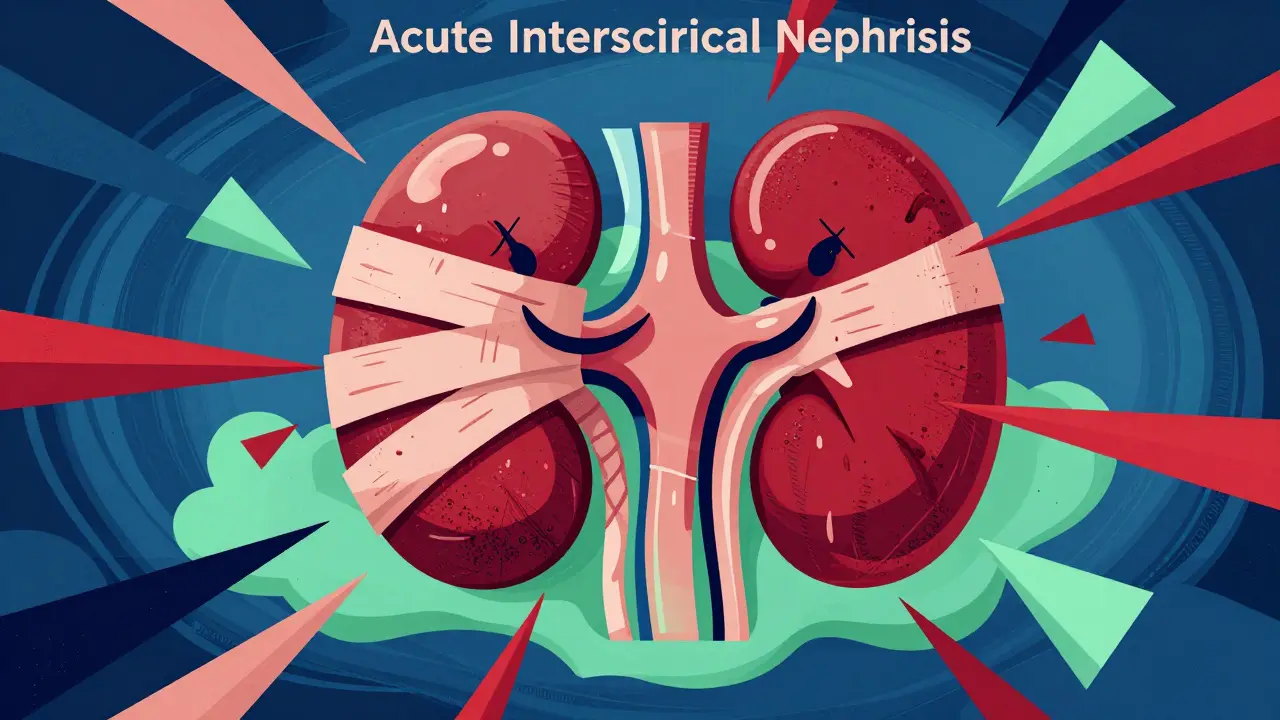
Your kidneys are working hard right now. They filter your blood, balance your fluids, and keep your body running smoothly. But sometimes, a medication you take to feel better can actually hurt them. This condition is called Acute Interstitial Nephritis, or AIN. It is a sudden inflammation of the kidney tissue that sits between the filtering units (tubules) and the outer layer. Most often, it happens because your immune system reacts badly to a drug. If you ignore the signs, this temporary issue can turn into permanent damage.
You might be taking a common pill for heartburn, pain, or an infection. You feel fine. Then, suddenly, your energy drops, your urine changes, or your legs swell. Many people miss the early warning signs because they look like a bad flu or a simple stomach bug. The good news? If we catch it early, your kidneys can bounce back. The bad news? Waiting too long can mean dialysis or chronic kidney disease. Let’s break down what causes this, how to spot it, and what you can do to recover.
The Hidden Culprits: Drugs That Trigger Kidney Inflammation
Not every medicine hurts your kidneys. But some are more likely than others to trigger an immune response that attacks kidney tissue. Doctors call this a hypersensitivity reaction. Your body sees the drug as a threat, sends white blood cells to fight it, and accidentally inflames the kidney interstitium-the space where waste gets processed.
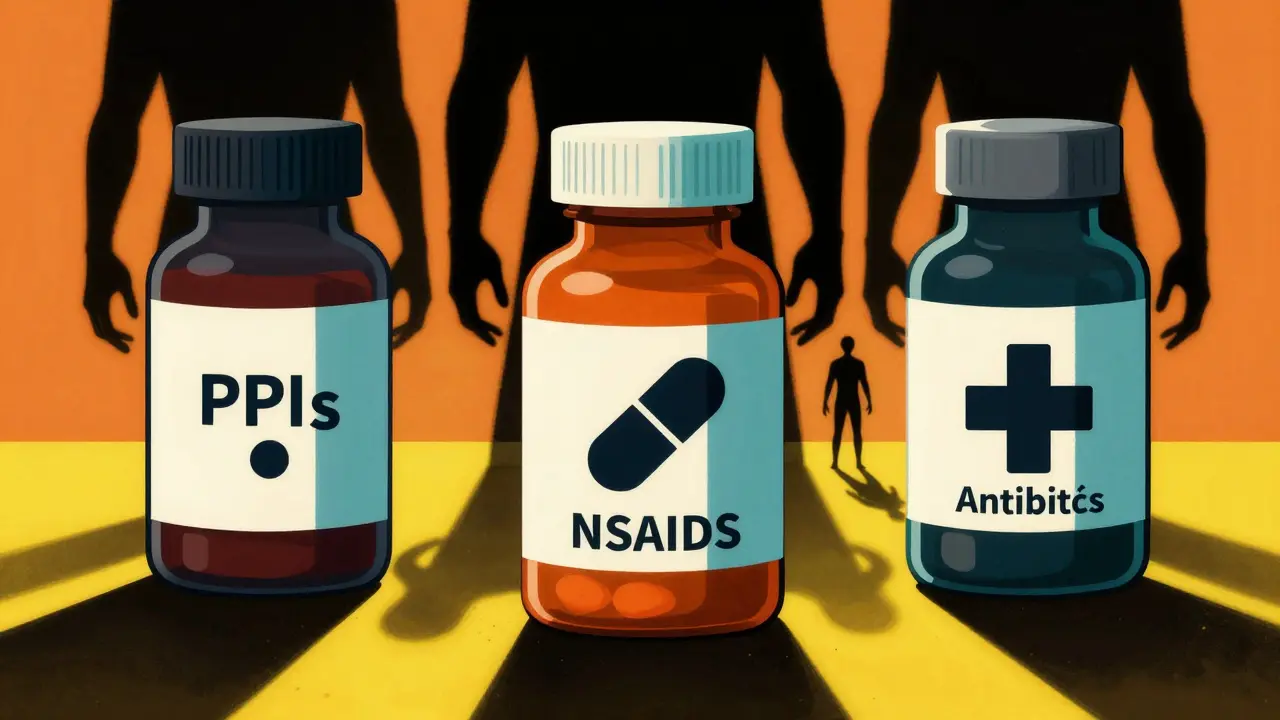
Three main groups of drugs cause most cases:
- Proton Pump Inhibitors (PPIs): These include omeprazole, pantoprazole, and lansoprazole. They treat acid reflux. Surprisingly, they are now one of the top causes of AIN. Why? Because so many people take them daily for years. Studies show about 1 in 8,300 users might develop AIN. The scary part? Symptoms can start months or even years after starting the drug.
- NSAIDs: Nonsteroidal anti-inflammatory drugs like ibuprofen, naproxen, and diclofenac. About 44% of drug-induced AIN cases come from these. They often affect older adults who have been taking them regularly for joint pain. Unlike other triggers, NSAID-induced AIN rarely causes a rash or fever, making it harder to spot.
- Antibiotics: Penicillins, cephalosporins, sulfonamides, and ciprofloxacin account for roughly one-third of cases. These usually hit faster-within days or weeks of starting the course. They also tend to cause more obvious allergic signs like rashes.
Newer medications, such as immune checkpoint inhibitors used in cancer therapy, are emerging as potential triggers too. While less common, their impact can be severe because patients are already under significant physical stress.
Why the Classic Signs Are Misleading
You’ve probably heard of the "classic triad" of AIN: fever, rash, and high eosinophils (a type of white blood cell). Textbooks love this trio. But here is the truth: fewer than 10% of patients actually get all three. Relying on this checklist will make you miss the diagnosis.
Instead, look for subtle shifts in your daily routine. Do you feel unusually tired? Is your appetite gone? Are your joints achy without a clear reason? These non-specific symptoms are far more common. Some people notice their urine looks cloudy or has a strange smell. Others experience nausea or mild abdominal discomfort.
If you are over 65, taking multiple medications, or have existing health issues, your risk jumps significantly. Data shows that people aged 65 and older face nearly five times the risk compared to younger adults. Taking five or more medications at once increases your odds by more than threefold. Polypharmacy isn’t just confusing; it’s dangerous for your kidneys.
How Doctors Spot the Problem Before It’s Too Late
Blood tests alone won’t tell the whole story. A rise in creatinine levels tells us your kidneys aren’t filtering well, but it doesn’t explain why. Urine tests might show tiny amounts of protein or white blood cells, but again, that’s vague.
To know for sure, doctors need to see inside the kidney. That means a kidney biopsy. It sounds intense, but it’s the gold standard. During the procedure, a specialist takes a tiny sample of kidney tissue using a needle guided by ultrasound. Under a microscope, they look for specific clues: swelling in the interstitial space, clusters of inflammatory cells, and sometimes damaged tubules.
Without a biopsy, you’re guessing. And guessing with your kidneys is risky. Early identification within the first week of symptoms boosts your chance of full recovery by 35%. Waiting two weeks or more drastically lowers those odds.
Treatment: Stop the Drug, Start the Healing
The moment AIN is suspected, the first step is immediate. Stop the offending drug. Yes, stop it today. Not tomorrow. Not when your next appointment comes up. Within 24 to 48 hours of suspicion, removing the trigger is critical. For many patients, simply stopping the medication allows the kidneys to begin healing on their own.
But stopping isn’t always enough. If your kidney function is severely impaired (eGFR below 30 mL/min/1.73m²), or if things don’t improve after three days off the drug, doctors may prescribe corticosteroids. Medications like prednisone or methylprednisolone help calm the immune system’s attack. Typical protocols involve a short burst of higher doses followed by a gradual taper over six to eight weeks.
In severe cases, where the kidneys shut down completely, temporary dialysis might be needed. About 15-20% of patients require this support for a few weeks until function returns. It’s not forever-it’s a bridge to recovery.
Recovery Timelines: What to Expect
Healing doesn’t happen overnight. How fast you bounce back depends heavily on what caused the problem and how quickly you got treatment.
| Cause | Average Time to Improvement | Chance of Full Recovery |
|---|---|---|
| Antibiotics | 14 days | 70-80% |
| NSAIDs | 28 days | Lower; higher risk of chronic damage |
| PPIs | 35 days | 50-60% |
Notice the difference? Antibiotic-induced AIN tends to resolve quicker and more completely. PPI-induced cases take longer and leave more scars. One study found that 42% of patients still had reduced kidney function (eGFR under 60) six months after diagnosis. That’s a significant number of people living with lasting consequences.
Real-life stories highlight this reality. Consider a 63-year-old woman who took omeprazole for heartburn for 18 months. She developed fatigue and swelling. After a biopsy confirmed AIN, she stopped the drug and underwent three weeks of dialysis. A year later, her kidney function stabilized, but never returned to normal. Her eGFR remained at 45, putting her at risk for future complications.
Protecting Your Kidneys Moving Forward
Once you’ve had AIN, you can’t just go back to normal medication habits. You need a new strategy. First, keep a detailed list of every drug and supplement you take. Share this list with every doctor and pharmacist. Ask specifically: "Could this affect my kidneys?"
Second, avoid unnecessary long-term use of PPIs and NSAIDs. If you need acid suppression, ask about H2 blockers like famotidine, which carry lower risks. For pain, explore acetaminophen or physical therapy options instead of relying on ibuprofen daily.
Third, monitor your kidney function regularly. Simple blood tests checking creatinine and eGFR can catch problems before they become emergencies. If you’re over 65 or take multiple meds, check these numbers every six months at least.
Finally, stay hydrated. Water helps your kidneys flush out toxins efficiently. Dehydration stresses them further, especially if you’re recovering from inflammation.
Can Acute Interstitial Nephritis go away on its own?
Yes, in many cases. If you stop the triggering medication early, your kidneys often heal themselves without additional treatment. However, if kidney function is severely low or doesn't improve within a few days, steroids or dialysis may be necessary to prevent permanent damage.
Is a kidney biopsy painful?
Most patients describe it as uncomfortable rather than painful. The area is numbed with local anesthesia, and the needle insertion feels like a sharp pinch. Afterward, you might have some soreness or minor bruising, but serious complications are rare. The information gained is worth the brief discomfort.
What should I eat while recovering from AIN?
Focus on a balanced diet low in sodium and processed foods. Avoid excessive protein intake, as it can strain healing kidneys. Stay well-hydrated with water. Limit potassium and phosphorus if your doctor advises it based on your blood work. Always follow dietary guidelines provided by your nephrologist.
Will I ever be able to take the same medication again?
Generally, no. Once a drug causes AIN, re-exposing yourself to it carries a high risk of triggering another episode, potentially worse than the first. Inform all healthcare providers about your history. There are usually safe alternatives available for most conditions.
How common is Acute Interstitial Nephritis?
It accounts for 5-15% of acute kidney injury cases requiring hospitalization. Incidence has risen due to increased use of proton pump inhibitors. Older adults and those on multiple medications are at highest risk. Early recognition is key because it is treatable if caught promptly.